
The Primebook 2 Max (2026) is a 15.6-inch Android laptop: it runs PrimeOS 3.0, which is based on Android 15, on a MediaTek Helio G99 chip with 8GB of LPDDR4X RAM and 256GB of UFS storage. It is a good fit for students and first-time computer users who mostly browse, attend online classes, use Android apps and write documents, and who want a big Full HD screen and a backlit keyboard. It is not a Windows laptop, so anyone who depends on Windows software should look elsewhere.
This review covers the Gray 8GB RAM + 256GB variant linked on this page, which is also the only configuration shown on Primebook’s official 2 Max product page when we checked on 17 October 2026. It is based on Primebook’s official product page, the Amazon.in listing and published specifications, not on hands-on testing. Where a specification appears only on the Amazon.in listing, we say so.
Quick verdict
- Best for: school and college students, online classes, browsing, YouTube, Android apps, light document work on a large screen
- Skip if: you need Windows programs, desktop Microsoft Office, heavy multitasking, gaming or video editing
- Key strengths: 15.6-inch Full HD IPS screen, backlit keyboard with numeric keypad (as per the listing), 256GB UFS storage plus microSD, a claimed 12 hours of battery life, USB-C charging
- Key limitations: entry-level smartphone-class processor, Android rather than a desktop OS, 250-nit screen brightness (listing claim), 1.61 kg weight, no HDMI port listed
Primebook 2 Max specifications at a glance

| Specification | Primebook 2 Max (2026), 8GB + 256GB, Gray |
|---|---|
| Processor | MediaTek Helio G99 (MT8781), octa-core, up to 2.2 GHz |
| Graphics | Integrated Mali-G57 (listing) |
| Memory | 8GB LPDDR4X |
| Storage | 256GB UFS (UFS 2.2 as per the listing) |
| Expandable storage | microSD, up to 1TB (listing) |
| Display | 15.6-inch Full HD (1920 x 1080) IPS, anti-glare, 60Hz |
| Brightness | 250 nits (listing) |
| Operating system | PrimeOS 3.0, based on Android 15 |
| Battery | 60.3Wh, up to 12 hours claimed (Wh figure from the listing) |
| Charger | 30W USB Type-C adapter (listing) |
| Ports (listing) | USB Type-C, USB 3.0 Type-A, microSD slot, 3.5mm audio jack |
| Wireless | Wi-Fi 5 (802.11ac), Bluetooth 5.1 (listing) |
| Webcam | 1080p front camera (listing) |
| Audio | 2 x 1W stereo speakers, dual microphones (listing) |
| Keyboard | Backlit, with numeric keypad (keypad per listing) |
| Weight and size | 1.61 kg, 35.7 x 24.9 x 2 cm (listing) |
| Warranty | 1 year manufacturer, non-transferable (listing) |
Check the current price of the Primebook 2 Max (8GB/256GB, Gray) on Amazon.in
First, understand what an Android laptop is
The most important thing to know about the Primebook 2 Max is its software. PrimeOS 3.0 is built on Android 15 and adapted for a laptop with a keyboard and touchpad. The Amazon.in listing describes multi-window multitasking, full-screen app support, a desktop-style file manager and a browser. In practice, this means you use Android apps from the app store rather than Windows programs.
That is a real advantage for some buyers. Many students already use Android apps for learning, video classes and messaging, and those apps run natively. Primebook also advertises PrimeOffice, which it describes as free for life without ads or subscription fees, for documents and spreadsheets. Its FAQ mentions a native Linux terminal and support for select Linux applications, which may interest students starting to learn coding.
The limitation is equally real. Windows-only software, such as the desktop versions of accounting packages or design tools, will not install. Primebook offers PrimeX Cloud PC access to Windows and Linux environments, which streams a desktop from the cloud. A cloud PC needs a steady internet connection, and Primebook’s own listing for its smaller 2 Neo mentions a nominal subscription for cloud apps, so check the current terms before you count on it for coursework.
Performance: a phone-class chip in a laptop body
The MediaTek Helio G99 is an octa-core chip that runs at up to 2.2 GHz with integrated Mali-G57 graphics. It is a chip designed for affordable Android devices, and it handles the kind of work this laptop targets: web browsing, video streaming, video calls, document editing and running several Android apps side by side. Paired with 8GB of LPDDR4X RAM, it should leave reasonable room for switching between a browser and a few apps.
Do not expect it to replace a Windows laptop with an Intel Core or AMD Ryzen processor for heavier work. Large spreadsheets, many browser tabs, photo or video editing and demanding games are outside what this kind of chip is built for. The listing gives 8GB as the maximum RAM, so treat the memory as fixed and buy with that in mind.
Storage is a strong point. The 256GB is UFS flash (UFS 2.2 according to the listing), the same kind of storage used in many phones, which is quicker than the eMMC storage found in some very cheap laptops. The listing also says you can add a microSD card of up to 1TB for photos, videos and study material.
Display: big Full HD screen, modest brightness
The 15.6-inch Full HD IPS panel is the main reason to choose the Max over smaller Primebooks. A 1920 x 1080 resolution on this size gives sharp text, and IPS panels hold their colours better at an angle than the TN panels used on many budget Windows laptops. It also makes split-screen use more comfortable.
The listing quotes 250 nits of brightness and an anti-glare coating. 250 nits is adequate indoors, in classrooms and under normal room lighting, but it can feel dim near a bright window or outdoors. The anti-glare finish helps reduce reflections under tube lights. The panel is non-touch, so you will use the touchpad for apps designed around tapping.
Battery, charging and ports
Primebook claims up to 12 hours of battery life, and the Amazon.in listing gives a 60.3Wh battery. Video calls and high brightness will shorten real-world runtime. Charging is via a 30W USB Type-C adapter, which the listing says is in the box, and the listing quotes about 1.5 hours to charge.
According to the listing, the ports are USB Type-C, USB 3.0 Type-A, a microSD card slot and a 3.5mm audio jack, with three USB ports in total. That covers a mouse, a pen drive and wired earphones. No HDMI port is listed, so if you plan to connect a monitor or a classroom projector, check whether the USB-C port supports display output before buying. Wireless connectivity is Wi-Fi 5 and Bluetooth 5.1.
Keyboard, webcam and audio
The backlit keyboard is useful for studying late or working in dim rooms. The listing also mentions a numeric keypad, which is helpful for anyone entering numbers often.
For online classes, the listing says the laptop has a 1080p front camera, dual microphones and 2 x 1W stereo speakers. Speakers rated at 1W each are modest, so a pair of earphones or a headset will give clearer sound for lectures and calls in a noisy home.
The AI features
Primebook advertises AI-powered global search, which lets you search files, apps, settings, app store results and the web, and ask AI questions from one search bar. The Amazon.in listing also mentions a Gemini AI assistant that can read what is on screen and give summaries and explanations, and the official FAQ describes PrimeAGNT, an “Operator AI” that Primebook says can carry out multi-step tasks from simple prompts. Their usefulness depends on software and online services. Primebook says it delivers over-the-air updates with security patches and improvements, but timelines vary by model and no fixed update period is stated.
Who should buy the Primebook 2 Max

- Students who mainly attend online classes, browse, watch lectures and write assignments
- Families looking for a large-screen shared device for children’s study and Android learning apps
- First-time computer users who are comfortable with Android on their phones
- Buyers who want a backlit keyboard, a Full HD screen and 256GB storage in an Android laptop
Who should skip it
- Anyone whose course, job or exam requires Windows software or desktop Microsoft Office
- Students in engineering, design or video courses that need heavy local software
- Buyers who travel daily and want a light laptop, since 1.61 kg is not light for an Android device
- People who need HDMI for projectors without adapters, or a bright screen for outdoor use
Alternatives worth comparing
- Primebook 2 Neo (2026): the same Helio G99 chip in a smaller 11.6-inch laptop with a 1366 x 768 HD screen and 128GB storage. The listing gives its weight as 0.98 kg, so it is far easier to carry, but the screen is lower resolution.
- Acer Aspire 3 A325-45: a 15.6-inch Windows 11 Home laptop with an Intel Celeron N4500, 8GB RAM, 256GB SSD and an HD 1366 x 768 TN screen. It runs Windows programs, but its screen resolution is lower than the Primebook’s.
- Lenovo V15 G4 AMN: a Windows 11 Home laptop with an AMD Ryzen 3 7320U, 8GB LPDDR5, 512GB NVMe storage and a 15.6-inch Full HD 250-nit TN screen, weighing 1.65 kg. It is a more capable desktop-OS option for office and study software.
For more Windows choices in this segment, see our guide to the best budget laptops in India for students and office work.
What to check before you order
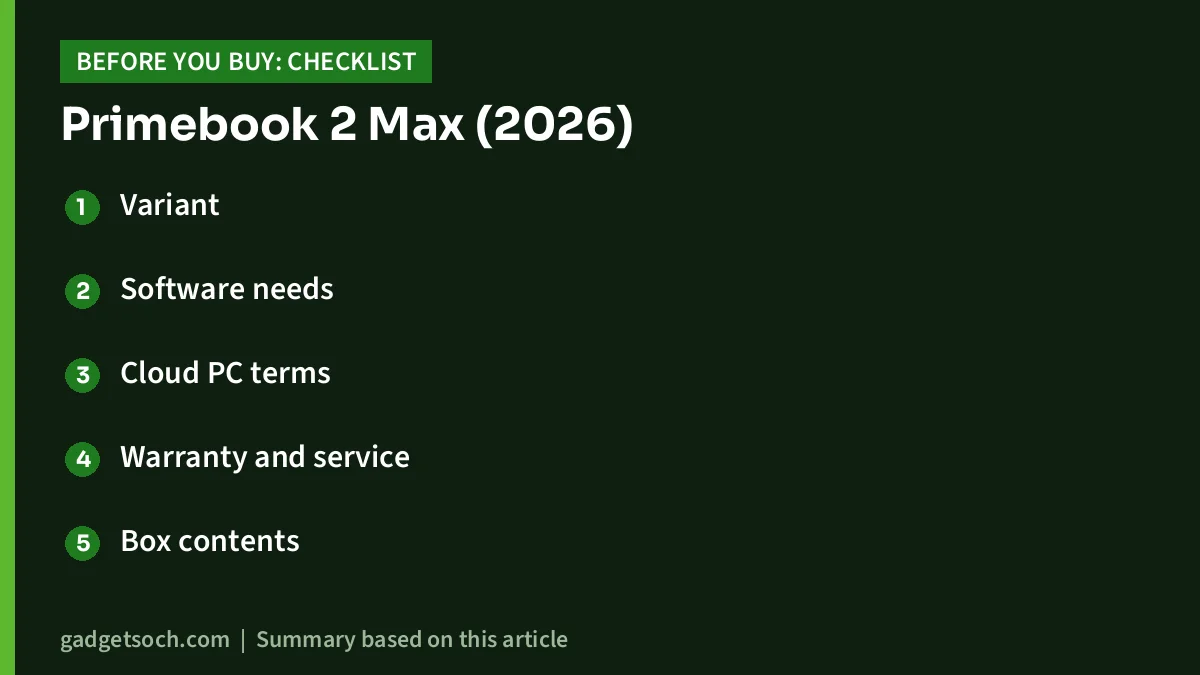
- Variant: this link is for the 8GB RAM, 256GB UFS, Gray model of the Primebook 2 Max (2026). Confirm the RAM, storage and model year on the listing, since older and smaller Primebooks have similar names.
- Software needs: list the apps your school or office requires and check that Android or cloud versions exist before buying.
- Cloud PC terms: if you plan to use PrimeX Cloud PC for Windows apps, check current pricing and requirements on Primebook’s site.
- Warranty and service: the listing states a 1-year non-transferable manufacturer warranty, with walk-in service centres available only in limited pincodes. Check your pincode coverage with Primebook.
- Box contents: the listing mentions the laptop, charger, user manual and a welcome card.
- Display output: if you need a projector or monitor, confirm USB-C video output or plan for an adapter.
See the Primebook 2 Max 8GB/256GB on Amazon.in
Frequently asked questions
Can the Primebook 2 Max run Windows software?
Not natively. It runs PrimeOS 3.0, which is based on Android 15. Primebook offers PrimeX Cloud PC access to Windows and Linux environments over the internet, but that is a streamed cloud desktop, not Windows installed on the laptop.
Can I upgrade the RAM on the Primebook 2 Max?
The Amazon.in listing gives 8GB as the maximum RAM, so treat the 8GB of LPDDR4X as fixed. Storage can be expanded with a microSD card of up to 1TB, according to the listing.
How long does the Primebook 2 Max battery last?
Primebook claims up to 12 hours, and the listing quotes a 60.3Wh battery. Actual runtime depends on brightness, video calls and the apps you use.
Is the Primebook 2 Max good for coding?
It is suitable for learning basics: Primebook says it includes a native Linux terminal and supports select Linux apps. For heavier development work, a Windows or Linux laptop with an Intel or AMD processor is the better tool.
Bottom line
The Primebook 2 Max makes sense if you want a large Full HD screen, a backlit keyboard and plenty of storage on an Android-based laptop for classes, browsing and documents. Its phone-class processor, Android software, 1.61 kg weight and modest brightness are the trade-offs. If your work depends on Windows programs, a budget Windows laptop is the safer choice.
Check the current price and availability of the Primebook 2 Max on Amazon.in
Related reading on GadgetSoch: Lenovo LOQ Ryzen 7 RTX 4050 vs ASUS TUF A15 RTX 3050: Which Gaming Laptop Should You Buy? and Lenovo V15 vs HP 15 (Ryzen 3 7320U): Windows and Full HD or a Lighter DOS Laptop?.
Sources
- Primebook official product page: Primebook 2 Max, checked 17 October 2026
- Amazon.in listing for the Primebook 2 Max (2026), ASIN B0FFMQB3KL: feature bullets and technical details, checked 17 October 2026
- Primebook official product page: Primebook 2 Neo and its Amazon.in listing (for comparison), checked 17 October 2026
- Acer Aspire 3 A325-45 and Lenovo V15 G4 AMN specifications as published by Acer and Lenovo and summarised in our earlier reviews, checked 17 October 2026