

If you are choosing between the Lenovo LOQ with a Ryzen 7 7435HS and RTX 4050 and the ASUS TUF Gaming A15 with the same Ryzen 7 7435HS and an RTX 3050, the short answer is this: the Lenovo LOQ is the stronger all-round pick for 1080p gaming and creative coursework, because it pairs the processor with a 105W RTX 4050 carrying 6GB of video memory, 24GB of dual-channel RAM, a 100% sRGB screen and a larger 60Wh battery. The ASUS TUF A15 makes sense if you mainly play lighter esports titles, want a chassis ASUS says has passed MIL-STD-810H durability tests, and the price gap on the day you buy is large enough to matter.
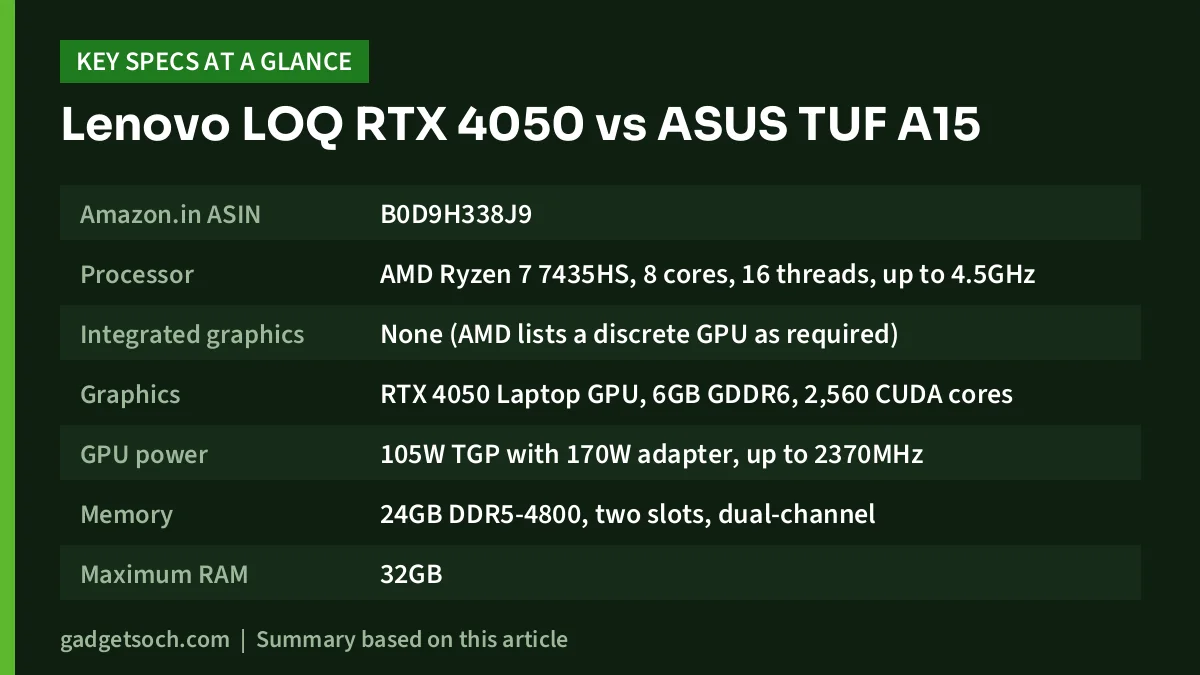
Both share the same eight-core processor, 512GB SSD and 15.6-inch Full HD 144Hz screen, so the LOQ RTX 4050 vs TUF A15 decision comes down to graphics, memory, display quality and battery.
How this comparison was made: our picks are based on official specifications and published reviews summarised in our individual reviews of each laptop, not hands-on testing. Gadget Soch has not run its own benchmarks on either machine. Availability, variants and prices on Amazon.in change often, so confirm the exact configuration on the listing before you order.
Quick verdict: LOQ or TUF A15?
- Choose the Lenovo LOQ (RTX 4050) if you want the faster graphics chip, 6GB of video memory, DLSS 3 support, 24GB of dual-channel RAM, a 100% sRGB display for design or photo coursework, and a slightly bigger battery
- Choose the ASUS TUF A15 (RTX 3050) if you mostly play esports games such as Valorant or CS2, value ASUS’s MIL-STD-810H durability claim and self-cleaning cooling, prefer a slightly lighter 2.30kg body, and the listing price is noticeably lower
Lenovo LOQ RTX 4050 vs ASUS TUF A15 RTX 3050: specifications side by side
| Specification | Lenovo LOQ 15ARP9 (Ryzen 7, RTX 4050) | ASUS TUF Gaming A15 FA506NCR (Ryzen 7, RTX 3050) |
|---|---|---|
| Amazon.in ASIN | B0D9H338J9 | B0D5DFR78J |
| Processor | AMD Ryzen 7 7435HS, 8 cores, 16 threads, up to 4.5GHz | AMD Ryzen 7 7435HS, 8 cores, 16 threads, up to 4.5GHz |
| Integrated graphics | None (AMD lists a discrete GPU as required) | None (AMD lists a discrete GPU as required) |
| Graphics | RTX 4050 Laptop GPU, 6GB GDDR6, 2,560 CUDA cores | RTX 3050 Laptop GPU, 4GB GDDR6, 2,048 CUDA cores |
| GPU power | 105W TGP with 170W adapter, up to 2370MHz | 60W, 75W with Dynamic Boost, up to 1675MHz |
| Memory | 24GB DDR5-4800, two slots, dual-channel | 16GB DDR5-4800, two slots (one or two modules not confirmed) |
| Maximum RAM | 32GB | Not confirmed |
| Storage | 512GB PCIe 4.0 NVMe, two M.2 slots | 512GB PCIe 4.0 NVMe, two M.2 slots |
| Display | 15.6-inch FHD IPS, 144Hz, G-SYNC | 15.6-inch FHD IPS-level, 144Hz, Adaptive-Sync |
| Colour coverage | 100% sRGB | 62.5% sRGB, 45% NTSC |
| Brightness | 300 nits | Not confirmed |
| Battery | 60Wh | 48WHr |
| Charging | Rapid Charge Pro, 50% in 30 minutes, 140W USB-C PD input | 50% in about 30 minutes when switched off, USB-C charging not listed |
| Adapter | 170W for the 105W GPU rating | 150W and 180W listed across the FA506 family, confirm box contents |
| USB-C | 10Gbps with DisplayPort 1.4 | USB 3.2 Gen 2 with DisplayPort |
| Other ports | 3x USB-A 5Gbps, HDMI 2.1, Gigabit Ethernet, 3.5mm | 3x USB-A Gen 1, HDMI 2.1, RJ45 LAN, 3.5mm |
| Wireless | Wi-Fi 6, Bluetooth 5.2 | Wi-Fi 6, Bluetooth 5.3 (5.2 on some units) |
| Keyboard backlight | White or 4-zone RGB by model | 1-zone RGB, highlighted WASD |
| Webcam | 720p or 1080p by model, E-shutter | 720p |
| Durability claim | Not listed | MIL-STD-810H (ASUS testing claim) |
| Weight | From 2.38kg | 2.30kg |
| Colour | Luna Grey | Graphite Black |
A note on conflicting details: the LOQ’s webcam resolution and keyboard backlighting vary by model according to Lenovo’s PSREF, and the TUF A15 listing does not say whether its 16GB is one module or two. Check these on the listing if they matter to you.
Gaming performance: RTX 4050 at 105W vs RTX 3050 at 60W
This is the biggest difference between the two. NVIDIA specifies the RTX 4050 Laptop GPU with 2,560 CUDA cores and 6GB of GDDR6, and Lenovo runs it at 105W with a boost clock of up to 2,370MHz, the top of NVIDIA’s range. As an RTX 40-series chip it supports ray tracing and DLSS 3, which can raise frame rates in supported games.
The ASUS uses an RTX 3050 Laptop GPU, which Notebookcheck lists with 2,048 CUDA cores and 4GB of GDDR6 on a 128-bit bus. ASUS runs it at 60W, rising to 75W with Dynamic Boost, which puts it in the upper half of the RTX 3050’s 35W to 80W range. Notebookcheck describes the RTX 3050 as best suited to Full HD gaming and says it is not powerful enough for ray tracing in most games. It does support DLSS.
Video memory is the long-term concern. Both laptops will need lower texture settings in demanding new releases, but 4GB runs out sooner than 6GB. Our reviews found no detailed lab tests of either exact configuration, so we do not quote frame rates.
Better for gaming: the Lenovo LOQ. Its RTX 4050 has more cores, more video memory, a much higher power rating and DLSS 3 support. The TUF A15 is enough for esports titles at 1080p, but the LOQ gives more room for newer AAA games.
Processor, memory and storage
Both laptops use the AMD Ryzen 7 7435HS, a Zen 3+ chip made on a 6nm process with 8 cores, 16 threads and up to 4.5GHz boost.
Two caveats apply to both. AMD marks the 7435HS as requiring a discrete graphics card, so it has no integrated graphics and the RTX chip powers the screen all the time. It also has no NPU, so on-device Copilot+ AI features are not supported.
Memory is where the LOQ pulls ahead. It ships with 24GB of DDR5-4800 running in dual-channel across two SODIMM slots, with a 32GB maximum. The TUF A15 has 16GB of DDR5-4800 in a system with two SO-DIMM slots, but the listing does not say whether that is one module or two, which affects dual-channel bandwidth. Both laptops have a 512GB PCIe 4.0 SSD and a spare M.2 slot.
Better for multitasking and student workloads: the Lenovo LOQ, thanks to the confirmed 24GB dual-channel memory. Both have a spare M.2 slot for extra storage.
Display: colour accuracy vs the basics
Both screens are 15.6-inch Full HD panels at 144Hz with anti-glare finishes, so fast games will look smooth on either. The LOQ supports G-SYNC and the TUF A15 lists Adaptive-Sync.
The LOQ’s panel covers 100% sRGB according to Lenovo’s PSREF, which suits photo, design and video coursework. Its weakness is brightness: 300 nits is fine indoors but can struggle near a bright window, and PCWorld found the LOQ 15ARP9 panel it tested dim. The TUF A15 covers 62.5% sRGB and 45% NTSC, so colours look less vivid, and ASUS’s spec sheet does not list a brightness figure at all.
Better display: the Lenovo LOQ for anyone who edits photos or videos or simply wants richer colour.
Battery life, charging and portability
Neither is a laptop for long days away from a socket, and the lack of integrated graphics on the shared processor hurts battery life on both. The LOQ has a 60Wh battery, and Lenovo quotes up to 3.8 hours in MobileMark 25 and 4.0 hours of 1080p video at 150 nits. PCWorld measured 196 minutes in its video test on a less powerful LOQ 15ARP9 configuration.
The TUF A15 has a smaller 48WHr battery. ASUS quotes up to 13.5 hours of web browsing for the TUF Gaming A15 range but notes results vary by configuration, so treat that as a best case for this variant without integrated graphics. Both support fast charging to 50% in about 30 minutes, and the LOQ also accepts up to 140W charging over USB-C, which ASUS does not list for the FA506NCR.
The TUF is slightly lighter at 2.30kg versus the LOQ’s starting weight of 2.38kg, but neither is easy to carry all day.
Better for battery and charging flexibility: the Lenovo LOQ, with a larger battery and USB-C power input. The TUF A15 is marginally lighter.
Build, cooling, keyboard and ports
The TUF A15’s standout feature is durability. ASUS says the chassis has passed MIL-STD-810H tests for drops, vibration, humidity and extreme temperatures. That is a manufacturer claim, not a guarantee against accidental damage. ASUS also describes two 83-blade fans, up to four heat pipes and self-cleaning anti-dust tunnels.
The LOQ uses a painted PC-ABS plastic chassis that PCWorld called solid for a budget gaming laptop, with no flex and a good hinge. PCWorld tested a less powerful CPU and GPU pairing, so its findings may not fully apply to the RTX 4050 version.
Ports are similar: three USB-A ports, one USB-C with DisplayPort, HDMI 2.1, Ethernet and a 3.5mm jack on each. The LOQ’s webcam has a physical E-shutter and may be 720p or 1080p depending on the model, while the TUF has a 720p camera. The LOQ’s full-size keyboard includes a number pad, while the TUF has single-zone RGB with highlighted WASD keys.
Better for rough handling: the ASUS TUF A15, thanks to its durability claim and dust-focused cooling design. On ports the two are effectively tied, with a small edge to the LOQ for USB-C charging.
Who should buy which

Buy the Lenovo LOQ Ryzen 7 RTX 4050 if you are a 1080p gamer who wants headroom for newer AAA titles, or a student working in CAD, 3D, coding or video editing who will benefit from 24GB of RAM and a 100% sRGB screen. Read our Lenovo LOQ Ryzen 7 RTX 4050 review for the full breakdown, and check the current price of the Lenovo LOQ on Amazon.in.
Buy the ASUS TUF Gaming A15 Ryzen 7 RTX 3050 if your games are mostly esports titles, you care about a toughened chassis, and you want the same eight-core processor at what may be a lower price. Read our ASUS TUF A15 Ryzen 7 RTX 3050 review for details, and check the current price of the ASUS TUF A15 on Amazon.in.
Before ordering, confirm the exact variant on the listing, because similar-looking TUF A15 and LOQ 15ARP9 models ship with other processors or graphics chips. Check that the LOQ includes the 170W adapter its 105W GPU rating depends on, check the TUF’s charger, and read the warranty terms on each listing.
Frequently asked questions

Is the RTX 4050 in the Lenovo LOQ much better than the RTX 3050 in the TUF A15?
On specifications, yes. The LOQ’s RTX 4050 has 2,560 CUDA cores, 6GB of video memory and a 105W rating with DLSS 3 support, while the TUF’s RTX 3050 has 2,048 CUDA cores, 4GB and a 60W rating (75W with Dynamic Boost).
Do both laptops have the same processor?
Yes. Both use the AMD Ryzen 7 7435HS with 8 cores and 16 threads.
Which one has the better screen?
The Lenovo LOQ, which covers 100% sRGB versus 62.5% sRGB on the TUF A15. Both run at 144Hz in Full HD.
Can I upgrade RAM and storage on both?
Both have two memory slots and two M.2 PCIe 4.0 SSD slots. The LOQ’s 24GB already uses both slots in dual-channel, with a 32GB maximum. ASUS does not confirm whether the TUF’s 16GB is one module or two, or the maximum supported memory.
Which has better battery life?
Neither is strong. The LOQ has a larger 60Wh battery versus 48WHr on the TUF. Plan to stay plugged in for gaming on either.
Our full reviews
For most buyers, the Lenovo LOQ’s stronger RTX 4050, extra memory and better screen make it the more future-proof choice, and you can see the Lenovo LOQ RTX 4050 on Amazon.in. If durability and esports performance are enough for you, see the ASUS TUF A15 RTX 3050 on Amazon.in.
Related reading on GadgetSoch: Lenovo V15 vs HP 15 (Ryzen 3 7320U): Windows and Full HD or a Lighter DOS Laptop? and HP 15 Core Ultra 5 125H vs Dell 15 i5-1334U: Which 16GB Laptop Should You Buy?.