The MSI GeForce RTX 3050 Ventus 2X 6G OC is a compact dual-fan desktop graphics card using NVIDIA’s 6GB version of the RTX 3050, with 2304 CUDA cores, 6GB of GDDR6 on a 96-bit bus and a factory boost clock of 1492 MHz, according to its Amazon.in listing. It suits small cabinets, budget builds and upgrades from integrated graphics, and MSI lists a minimum system power requirement of just 300 W. The catch is that it is the slower 6GB RTX 3050, not the 8GB model, so set your expectations accordingly.
Key takeaways
- Who it suits: Owners of a desktop with only integrated graphics who want their first dedicated GPU.
- Who should skip it: Anyone who wants the full RTX 3050 8GB, which has more CUDA cores, higher clocks and more memory.
- Check before you buy: Confirm the listing title reads “RTX 3050 Ventus 2X 6G OC” and the model number is V812-015R.
This review covers the exact variant linked here: MSI model V812-015R, the RTX 3050 Ventus 2X 6G OC with 6GB GDDR6. It is based on the Amazon.in listing data (captured 17 October 2026), NVIDIA’s official RTX 3050 page and published specifications, not hands-on testing. MSI’s own specification page could not be opened on 17 October 2026 because the request was rate-limited, so card-specific figures are labelled as the listing’s claims.
Specs at a glance
| Specification | MSI RTX 3050 Ventus 2X 6G OC | Source |
|---|---|---|
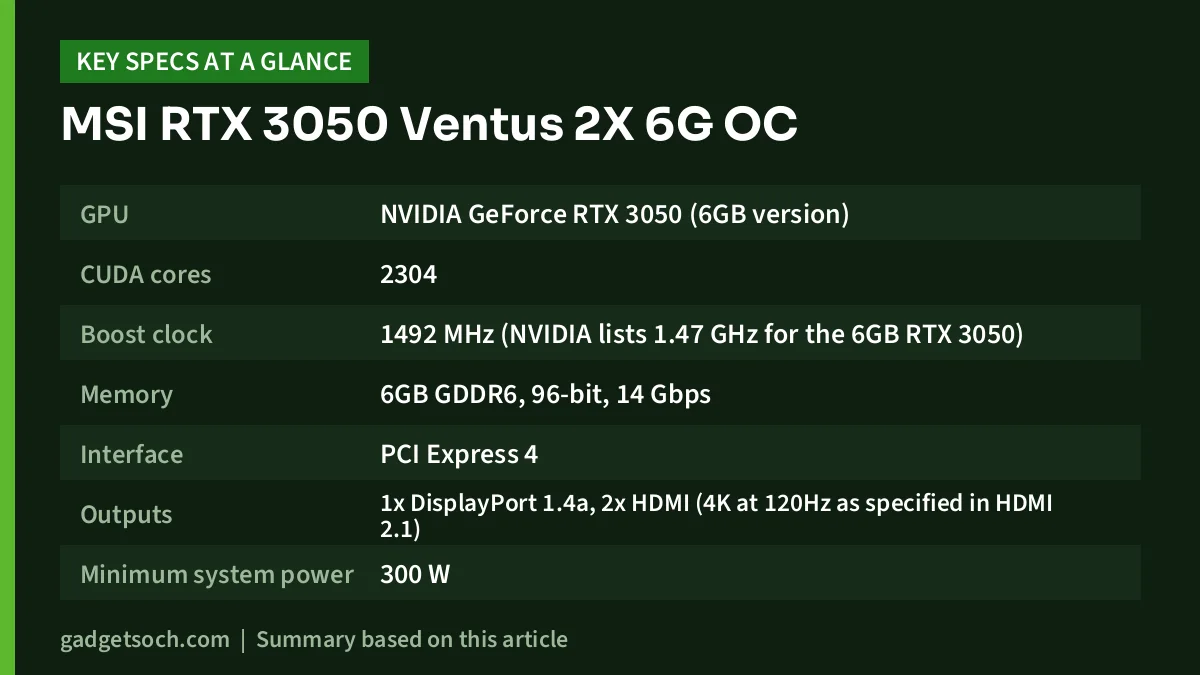
| GPU | NVIDIA GeForce RTX 3050 (6GB version) | Listing and NVIDIA |
| CUDA cores | 2304 | Listing and NVIDIA |
| Boost clock | 1492 MHz (NVIDIA lists 1.47 GHz for the 6GB RTX 3050) | Listing and NVIDIA |
| Memory | 6GB GDDR6, 96-bit, 14 Gbps | Listing |
| Interface | PCI Express 4 | Listing |
| Outputs | 1x DisplayPort 1.4a, 2x HDMI (4K at 120Hz as specified in HDMI 2.1) | Listing |
| Minimum system power | 300 W | Listing |
| Dimensions | 189 x 109 x 42 mm | Listing |
| Weight | 381 g | Listing |
| Fans | 2 | Listing |
| Model number | V812-015R | Listing |
| Box contents | Graphics card, quick setup guide | Listing |
| Warranty | 3 years, manufacturer | Listing |
Quick verdict
- Best for: small or budget desktop builds, first graphics cards for PCs that only had integrated graphics, and systems with modest power supplies
- Skip if: you want the stronger 8GB RTX 3050, or you play new demanding games and want more than 6GB of video memory
- Strengths: 189 mm length, light 381 g build, 300 W minimum system power, three display outputs, NVIDIA RTX features and a 3-year warranty per the listing
- Limitations: cut-down RTX 3050 with fewer CUDA cores and lower clocks than the 8GB model, 6GB on a narrow 96-bit bus, and only one DisplayPort
Check the current price of the MSI RTX 3050 Ventus 2X 6G OC on Amazon.in
The naming trap: RTX 3050 6GB is not the RTX 3050 8GB
This is the single most important thing to understand before you buy. NVIDIA’s India product page lists two desktop RTX 3050 versions. The RTX 3050 8GB has 2560 CUDA cores and a 1.78 GHz boost clock. The RTX 3050 6GB, which this MSI card uses, has 2304 CUDA cores and a 1.47 GHz boost clock. Both carry the RTX 3050 name, but the 6GB version has about 10 percent fewer CUDA cores, a lower clock and less memory.
NVIDIA’s own performance note on that page refers only to the 8GB model, so do not assume performance figures quoted for “the RTX 3050” apply to this card. When you read reviews or watch benchmark videos, check which version was tested. For this article we have not quoted any frame rates, because we could not verify benchmark data for the 6GB card.
Factory overclock: how much “OC” you actually get
The listing gives the Ventus 2X 6G OC a boost clock of 1492 MHz. NVIDIA’s reference figure for the 6GB RTX 3050 is 1.47 GHz, so MSI’s factory overclock adds roughly 20 MHz, or about 1.5 percent. That is a small bump. It will not change which games are playable, so pick between RTX 3050 6GB cards on size, outputs, warranty and cooling rather than on the “OC” label.
Memory: 6GB on a 96-bit bus
The card has 6GB of GDDR6 running at 14 Gbps on a 96-bit interface, according to the listing. Multiplying those out (96 bits x 14 Gbps, divided by 8) gives about 168 GB/s of memory bandwidth. Bandwidth is how quickly the GPU can read textures and other data, and a narrow 96-bit bus is one reason this is an entry-level card.
The 6GB capacity also matters. Video memory holds a game’s textures and frame buffers, and newer games at high texture settings can ask for more than 6GB. If a game warns you about VRAM use, lower texture quality first. One small note: the listing’s technical table shows a “Memory Clock Speed” of 1807 MHz, which is expressed differently from the 14 Gbps figure in the title and bullets. Use the 14 Gbps figure when comparing cards.
Size and power: why this card fits where bigger ones don’t
At 189 x 109 x 42 mm and 381 g, as the listing states, this is a short and light card. That matters if you are upgrading a compact cabinet, a branded office desktop or an older budget build where a 23 to 30 cm card simply would not fit. Always check the cabinet’s GPU length limit and whether the card’s height clears the side panel, especially in slim or small-form-factor cases.
MSI lists the minimum system power requirement as 300 W. That is a modest figure, which makes the card interesting for people who do not want to replace their power supply. However, the listing does not say whether the card needs a separate PCIe power cable, and we could not confirm this on MSI’s page. Before ordering, check MSI’s specification page for the power connector, and make sure your power supply is a genuine 300 W or higher unit from a reputable brand rather than an unbranded one with an inflated label.
Display outputs
According to the listing, the card offers one DisplayPort 1.4a and two HDMI ports, with HDMI supporting 4K at 120Hz as specified in HDMI 2.1. Two HDMI ports are handy if you use a monitor plus a TV. If your gaming monitor relies on DisplayPort for its highest refresh rate, remember that you only get one DisplayPort here, so a second high-refresh monitor would have to use HDMI. The listing gives a maximum display resolution of 3840 x 2160.
RTX features: ray tracing, DLSS and NVENC
The RTX 3050 is built on NVIDIA’s Ampere architecture. NVIDIA’s page says it has dedicated Ray Tracing Cores, AI Tensor Cores that enable DLSS, and the NVIDIA Encoder (NVENC). In practice, DLSS can help in supported games by rendering at a lower resolution and upscaling, which is useful on an entry-level GPU. NVENC is the hardware video encoder that streaming and recording apps can use, so the main GPU cores are less burdened when you record gameplay. On a card at this level, treat ray tracing as something to try selectively rather than leave on everywhere.
Who should buy it
- Owners of a desktop with only integrated graphics who want their first dedicated GPU
- Builders using a CPU without integrated graphics, such as the one in our Intel Core i5-12400F review, who need a display output in a budget build
- People with compact cabinets that cannot fit long cards
- Users who value NVIDIA features like DLSS and NVENC for light gaming, streaming or video work
Who should skip it
- Anyone who wants the full RTX 3050 8GB, which has more CUDA cores, higher clocks and more memory
- Gamers who plan to play demanding new releases at high texture settings
- Users who need two or more DisplayPort outputs
- Buyers who want a laptop rather than a desktop upgrade, who may prefer our guide to the best RTX 3050 and RTX 4050 gaming laptops
Alternatives worth comparing
- Gigabyte GeForce RTX 3050 WINDFORCE OC 6G (GV-N3050WF2OC-6GD): the same 6GB RTX 3050 with a 96-bit bus, but its listing shows two HDMI 2.1 and two DisplayPort 1.4a outputs
- NVIDIA GeForce RTX 3050 8GB cards: 2560 CUDA cores, a 1.78 GHz boost and 8GB of GDDR6 per NVIDIA, a clear step up on paper
- ASUS Dual Radeon RX 7600 EVO OC Edition: an AMD option with 8GB GDDR6 and one HDMI 2.1 plus three DisplayPort 1.4a outputs per its listing, but it is larger at 22.9 cm and 2.5 slots
What to check before you order
- Confirm the listing title reads “RTX 3050 Ventus 2X 6G OC” and the model number is V812-015R
- Do not confuse it with MSI’s separately listed “RTX 3050 Ventus 2X E 6G OC”, which is a different model name
- Check MSI’s specification page for the power connector, and make sure your PSU meets the 300 W minimum
- Measure your cabinet for the 189 mm length and 42 mm thickness
- Plan your monitor connections around one DisplayPort and two HDMI ports
- Keep the invoice: the listing states a 3-year manufacturer warranty, and service claims in India need proof of purchase from an authorised seller
See the MSI RTX 3050 Ventus 2X 6G OC (6GB, V812-015R) on Amazon.in
After installation, connect your monitor to the graphics card rather than the motherboard’s video port, and install the latest GeForce driver from NVIDIA’s website.
Frequently asked questions
Is the MSI RTX 3050 Ventus 2X 6G OC the same as the RTX 3050 8GB?
No. Per NVIDIA’s page, the 6GB version has 2304 CUDA cores and a 1.47 GHz boost clock, while the 8GB version has 2560 CUDA cores and a 1.78 GHz boost. This MSI card uses the 6GB version.
What power supply does it need?
MSI lists a minimum system power requirement of 300 W on the Amazon.in listing. The listing does not state the power connector, so confirm that detail on MSI’s specification page.
Will it fit in a small cabinet?
The listing gives dimensions of 189 x 109 x 42 mm, which is short for a dual-fan card. Check your cabinet’s maximum GPU length and clearance before ordering.
Does it support DLSS and ray tracing?
Yes. NVIDIA’s RTX 3050 page lists dedicated Ray Tracing Cores and Tensor Cores for DLSS. Support depends on each game, and on an entry-level card ray tracing is best used selectively.
How long is the warranty?
The Amazon.in listing states a 3-year manufacturer warranty. Buy from an authorised seller and keep your invoice for service claims.
Bottom line
The MSI GeForce RTX 3050 Ventus 2X 6G OC is a small, light, low-power way to add an NVIDIA RTX card to a desktop, with a 3-year warranty and a 300 W minimum system power figure that suits modest builds. Its limits are built into the GPU: fewer cores, lower clocks and less memory than the 8GB RTX 3050. Buy it for compact or budget systems, not for high settings in new games. Check the current price of the MSI RTX 3050 Ventus 2X 6G OC on Amazon.in.
Related reading on GadgetSoch: Gigabyte RTX 3060 Windforce OC 12G Review (GV-N3060WF2OC-12GD): Still Worth It in 2026? and ASUS GeForce GT 710 2GB GDDR5 EVO Review: A Silent Display Card, Not a Gaming GPU.
Sources
- Amazon.in listing for ASIN B0CSPNYB42 (title, feature bullets and technical details), captured 17 October 2026
- NVIDIA GeForce RTX 3050 family page (India): CUDA cores, boost clocks and memory for the 6GB and 8GB versions, plus RT Cores, Tensor Cores, DLSS and NVENC, checked 17 October 2026
- MSI RTX 3050 Ventus 2X 6G OC specification page: could not be opened on 17 October 2026 (rate-limited), listed so you can verify the power connector yourself