
The Gigabyte GeForce RTX 5070 WINDFORCE OC SFF 12G (GV-N5070WF3OC-12GD) is a factory-overclocked RTX 5070 with 12 GB of GDDR7 memory, a triple-fan WINDFORCE cooler and NVIDIA’s SFF-Ready label. It suits gamers building or upgrading a mid-to-high-end desktop who want a mainstream-sized RTX 50-series card without a premium cooler. Skip it if you need more than 12 GB of video memory, or if your case cannot take a 282 mm card.
This guide is based on Gigabyte’s official specification page, NVIDIA’s RTX 5070 specifications and the Amazon.in listing data, all checked on 17 October 2026. It is not a hands-on review, and we have not quoted benchmark numbers because we did not verify any independent test of this exact card.
Note that the Amazon.in listing contains a few errors in its memory details. Gigabyte’s own spec sheet is clear, and we explain the differences below so you know exactly what you are buying.
Quick verdict
- Best for: gamers with a capable power supply who want an RTX 5070 with DLSS support, GDDR7 memory and a straightforward triple-fan cooler
- Skip if: you want 16 GB of video memory, have a compact case with less than about 290 mm of GPU clearance, or your power supply is below Gigabyte’s 750 W recommendation
- Key strengths: 2542 MHz factory core clock (reference 2512 MHz), 6,144 CUDA cores, 12 GB GDDR7 at 28 Gbps, three DisplayPort 2.1b outputs plus HDMI 2.1b, semi-passive fans that stop at low load
- Key limitations: 12 GB is less than the RTX 5070 Ti’s 16 GB, a 16-pin power connector (adapter included), and a listing with incorrect memory details
Listing vs official spec: what to trust
Before looking at what the card does, it is worth clearing up the listing. The Amazon.in title says “12GB 256-bit GDDR7”, a feature bullet says “192bit”, and the technical table lists the memory type as “GDDR6X” and a GPU clock of “2600 GHz”. Gigabyte’s specification page and NVIDIA’s RTX 5070 page both say the same thing: 12 GB of GDDR7 on a 192-bit bus. The 256-bit and GDDR6X entries are listing errors, and a 2600 GHz clock is not realistic for any GPU.

| Item | Amazon.in listing says | Gigabyte official spec says |
|---|---|---|
| Memory type | GDDR7 (title), GDDR6X (table) | GDDR7 |
| Memory bus | 256-bit (title), 192-bit (bullet) | 192-bit |
| Core clock | 2600 GHz (table) | 2542 MHz (reference card 2512 MHz) |
| Length | 28.2 cm | 282 mm |
| Fans | 3 | Not stated on the spec page |
| Warranty | 3 years | Not stated on the pages we checked |
The part number, GV-N5070WF3OC-12GD, matches across the listing and Gigabyte’s page, so the product itself is the same. Just rely on Gigabyte’s numbers for memory and clocks.
Key specifications
| Specification | GV-N5070WF3OC-12GD |
|---|---|
| GPU | NVIDIA GeForce RTX 5070 (Blackwell architecture) |
| CUDA cores | 6,144 |
| Core clock | 2542 MHz (reference card 2512 MHz) |
| Memory | 12 GB GDDR7, 28 Gbps |
| Memory bus | 192-bit |
| Card bus | PCI Express 5.0 |
| Outputs | 3 x DisplayPort 2.1b, 1 x HDMI 2.1b |
| Multi-view | Up to 4 displays |
| Digital max resolution | 7680 x 4320 |
| Card size | 282 x 110 x 50 mm (L x W x H) |
| PCB form | ATX |
| APIs | DirectX 12, OpenGL 4.6 |
| Recommended PSU | 750 W (Gigabyte) |
| Power connector | 1 x 16-pin |
| In the box | Quick guide, 1 x 12V-2×6 to 2 x PCIe 8-pin adapter |
| Total graphics power (NVIDIA RTX 5070) | 250 W |
| Cooling | WINDFORCE, 3 fans per the Amazon.in listing |
Check the current price of the Gigabyte RTX 5070 WINDFORCE OC SFF 12G on Amazon.in.
Where the RTX 5070 sits in NVIDIA’s line-up
NVIDIA’s specifications put the RTX 5070 between the RTX 5060 Ti and the RTX 5070 Ti. It has 6,144 CUDA cores, against 4,608 for the RTX 5060 Ti and 8,960 for the RTX 5070 Ti. NVIDIA lists 988 AI TOPS for its fifth-generation Tensor cores, 94 TFLOPS for its fourth-generation RT cores, a 2.51 GHz boost clock and a 2.33 GHz base clock for the reference design.
The memory is the other big piece. 12 GB of GDDR7 on a 192-bit bus is a clear step up from the 8 GB on the standard RTX 5060, while the RTX 5070 Ti moves to 16 GB on a 256-bit bus. On paper, that makes the RTX 5070 a natural fit for high-refresh 1080p and 1440p gaming. For actual frame rates in the games you play, check independent benchmarks before you buy, since we have not verified any for this card.
For streamers and video editors, NVIDIA lists one ninth-generation NVENC encoder and one sixth-generation NVDEC decoder on the RTX 5070. The RTX 5070 Ti has two encoders, which matters mainly if you do heavy video export work.
DLSS and RTX features
NVIDIA’s RTX 5070 specification table lists DLSS 4 with Super Resolution, DLAA, Ray Reconstruction, Frame Generation and Multi Frame Generation. Gigabyte’s product page and NVIDIA’s own marketing section also mention DLSS 5 and Dynamic Multi Frame Generation, which NVIDIA says can generate up to five frames per rendered frame. These features depend on game support and up-to-date drivers, so check whether the games you care about support them. Frame generation raises smoothness on screen, but it is not the same as a higher native frame rate.
Gigabyte also lists NVIDIA Reflex support for lower system latency, which is useful in competitive shooters.
The WINDFORCE cooler and build
Gigabyte’s WINDFORCE cooler is its mainstream design. The product page describes Hawk fan blades that Gigabyte says raise air pressure by up to 53.6 percent and air volume by 12.5 percent, adjacent fans spinning in opposite directions to reduce turbulence, composite copper heat pipes with a large copper plate that directly touches the GPU, and an extended heatsink that lets air pass straight through. Server-grade thermal gel cools the memory and MOSFETs, and graphene nano lubricant is claimed to extend the life of the sleeve-bearing fans by 2.1 times.
The fans are semi-passive. Gigabyte’s 3D Active Fan feature stops them during low-load work and light gaming, which keeps the PC quiet when you are browsing or working. A reinforced metal backplate fastened to the I/O bracket helps stiffen the card. The Gigabyte Control Center software can adjust clock speed, voltage, fan mode and power target.
Note that these are Gigabyte’s design claims. Real-world temperature and noise depend on your case airflow, and we have not verified independent measurements for this model.
Size, SFF-Ready and case fit
Gigabyte describes this card as compliant with NVIDIA’s small form factor (SFF-Ready) guidelines. That does not mean it is tiny. Gigabyte’s spec page lists a length of 282 mm, a width of 110 mm and a height of 50 mm. For comparison, NVIDIA lists its RTX 5070 Founders Edition at 242 mm long and 2 slots thick.
Before ordering, check your case’s maximum GPU length, leaving a little room for cables at the front, and whether front fans or a radiator reduce that space. Also check how the 50 mm height lines up with the slots below the card, especially if you use a second PCIe card.
Power supply and connectors
This is where many upgrades go wrong. Gigabyte recommends a 750 W power supply for this card. NVIDIA lists 650 W as the required system power for an RTX 5070, measured on a system with a Ryzen 9 9950X, and recommends a PCIe CEM 5.1 compliant power supply. Gigabyte’s higher figure leaves extra margin for a factory-overclocked card, so treat 750 W as the safer target.
The card uses a single 16-pin connector. If your power supply has a native 12V-2×6 cable, use that. If not, Gigabyte includes an adapter that takes two separate PCIe 8-pin cables. Use two separate cables from the PSU rather than one cable with two daisy-chained plugs where possible, and push the connector in fully until it clicks.
Who should buy it

- Gamers upgrading from an older card who want RTX 50-series features such as DLSS 4 and newer frame generation
- Players targeting high refresh rates at 1080p or 1440p who are happy with 12 GB of memory
- Builders with a mid-tower case and a 750 W or larger power supply
- Owners of a PCI Express 5.0 or 4.0 motherboard who want a card that plugs straight in
Who should skip it
- Anyone who wants 16 GB of video memory for heavy texture mods, large AI models or long-term headroom
- Owners of very compact cases with less clearance than the card’s 282 mm length
- Buyers who are not ready to upgrade a weak or ageing power supply
- Shoppers who want a premium cooler with extra features beyond Gigabyte’s mainstream WINDFORCE design
Alternatives worth comparing
NVIDIA GeForce RTX 5070 Ti. The bigger step. NVIDIA lists 8,960 CUDA cores, 16 GB of GDDR7 on a 256-bit bus and two NVENC encoders, with 300 W total graphics power and a 750 W required system power.
NVIDIA GeForce RTX 5060 Ti 16 GB. If memory capacity matters more than raw speed, NVIDIA lists the RTX 5060 Ti with 4,608 CUDA cores and an optional 16 GB of GDDR7 on a 128-bit bus, at 180 W and a 600 W required system power.
Gigabyte RTX 5070 WINDFORCE SFF 12G (GV-N5070WF3-12GD). Gigabyte also lists a non-OC version of this card. Compare its core clock on Gigabyte’s page with the OC model’s 2542 MHz, and make sure you order the part number you actually want.
If you are weighing a previous-generation card, our MSI RTX 4070 Ti Gaming X Trio review covers one of the larger RTX 40-series options.
Buying checklist for India
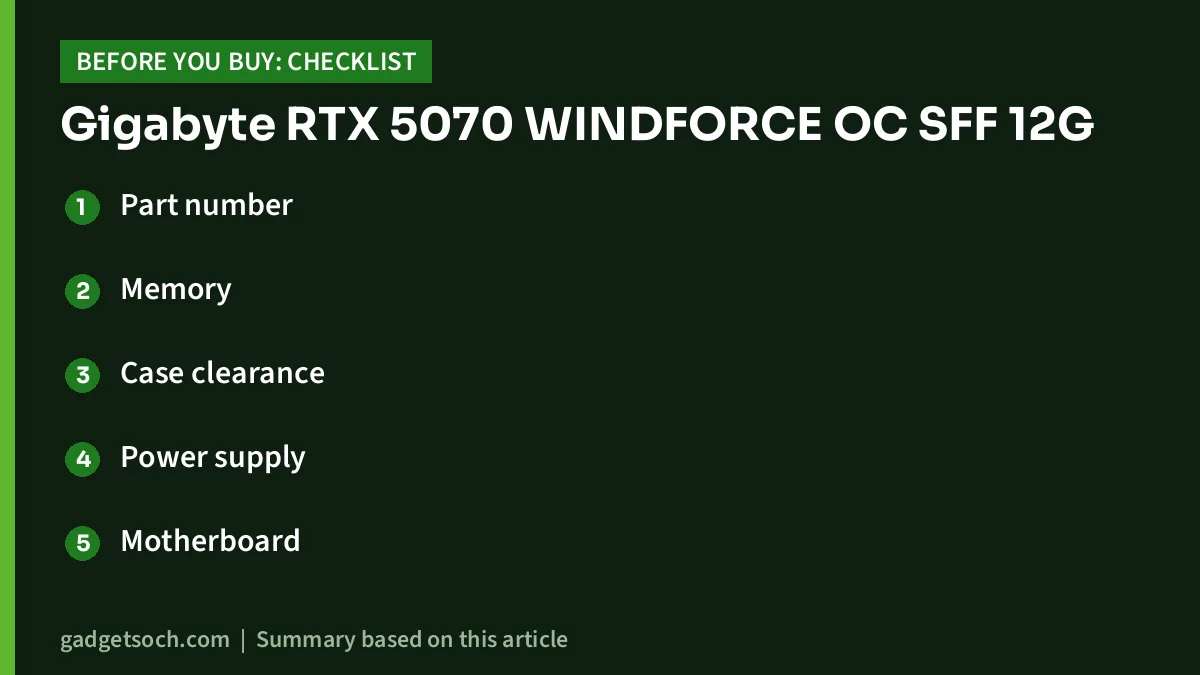
- Part number: confirm GV-N5070WF3OC-12GD on the listing. The OC SFF and non-OC versions have similar names
- Memory: expect 12 GB GDDR7 on a 192-bit bus, per Gigabyte. Ignore the listing’s 256-bit and GDDR6X errors
- Case clearance: at least 282 mm of GPU length plus cable room
- Power supply: 750 W recommended by Gigabyte, with a 12V-2×6 cable or two PCIe 8-pin cables for the included adapter
- Motherboard: a PCIe x16 slot. The card is PCIe 5.0 and also works in PCIe 4.0 and 3.0 slots, with some bandwidth reduction on older slots
- Monitor: use DisplayPort 2.1b or HDMI 2.1b to get high refresh rates at high resolutions
- Warranty: the listing states 3 years. Keep the invoice and box, and check Gigabyte India’s support process for graphics cards before you need it
- Drivers: download the latest GeForce driver from NVIDIA after installing the card
See the GV-N5070WF3OC-12GD (12 GB GDDR7) on Amazon.in and confirm the part number before you check out.
Frequently asked questions
Is the Gigabyte RTX 5070 WINDFORCE OC SFF 12G memory 192-bit or 256-bit?
192-bit. Gigabyte’s spec page and NVIDIA’s RTX 5070 specifications both list 12 GB of GDDR7 on a 192-bit bus. The “256-bit” in the Amazon.in title is an error.
What power supply do I need?
Gigabyte recommends 750 W. NVIDIA lists 650 W as the minimum system power for a reference RTX 5070, so 750 W gives a sensible margin for this overclocked model.
Does it come with a power adapter?
Yes. Gigabyte lists a quick guide and one 12V-2×6 to two PCIe 8-pin adapter in the box.
Will it fit a small form factor case?
It carries NVIDIA’s SFF-Ready label, but it is still 282 mm long and 50 mm high. Measure your case’s GPU clearance before ordering.
Does it support DLSS 4?
Yes. NVIDIA’s RTX 5070 specifications list DLSS 4, including Multi Frame Generation. Gigabyte’s page also mentions DLSS 5. Support varies by game.
Bottom line
The Gigabyte RTX 5070 WINDFORCE OC SFF 12G offers the full RTX 5070 feature set, a modest factory overclock and a sensible semi-passive triple-fan cooler. Its 12 GB of GDDR7 is the main trade-off against the RTX 5070 Ti, and the Amazon.in listing’s memory errors are worth ignoring in favour of Gigabyte’s spec sheet. If your case and power supply are ready, check the current price of the Gigabyte RTX 5070 WINDFORCE OC SFF 12G on Amazon.in.
Related reading on GadgetSoch: MSI RTX 5060 Ti 16G Shadow 2X OC Plus Review: A 16GB Card for 1080p and 1440p and ASRock Arc B570 Challenger 10GB OC Review: 10GB for 1080p, If Your PC Passes Three Checks.
Sources
- Gigabyte: GeForce RTX 5070 WINDFORCE OC SFF 12G specifications (checked 17 October 2026)
- Gigabyte: GeForce RTX 5070 WINDFORCE OC SFF 12G product page (checked 17 October 2026)
- NVIDIA: GeForce RTX 5070 family specifications (checked 17 October 2026)
- NVIDIA: GeForce RTX 5060 family specifications (checked 17 October 2026)
- Amazon.in listing for ASIN B0DTQMLX4F: title, bullets and technical details captured 17 October 2026