The ASUS Dual GeForce RTX 3050 6GB GDDR6 OC Edition (model DUAL-RTX3050-O6G) is an entry-level desktop graphics card whose biggest practical advantage is that ASUS lists no external power connector for it. That makes it a candidate for upgrading an older or prebuilt desktop for 1080p gaming without replacing the power supply, as long as the PSU meets ASUS’s 450W recommendation and the case has room for a 201 mm, two-slot card.
The short verdict: it is a sensible upgrade from integrated graphics or a very old card, but buyers should know that the 6GB RTX 3050 is a cut-down version of the RTX 3050. NVIDIA’s own spec table gives it fewer CUDA cores and a lower boost clock than the 8GB model, so it is not the same card with less memory.
This review is based on ASUS’s official technical specifications, NVIDIA’s RTX 3050 page and the Amazon.in listing data, all checked on 17 October 2026. It is not a hands-on review, and it does not quote frame-rate numbers, because none could be verified from independent tests for this article.
Quick verdict
- Best for: upgrading an office or older desktop to a dedicated NVIDIA GPU for 1080p gaming, video encoding and creative apps, without a PSU with PCIe power cables
- Skip if: you want high settings in the newest demanding games, plan to game above 1080p, or your case cannot fit a 201 mm two-slot card
- Key strengths: no external power connector listed, two-slot design, HDMI 2.1, DisplayPort 1.4a and DVI-D outputs, RTX features such as DLSS and NVENC, 3-year warranty according to the listing
- Key limitations: 6GB of memory on a 96-bit bus, fewer cores and lower clocks than the RTX 3050 8GB, ray tracing is demanding for a card at this level
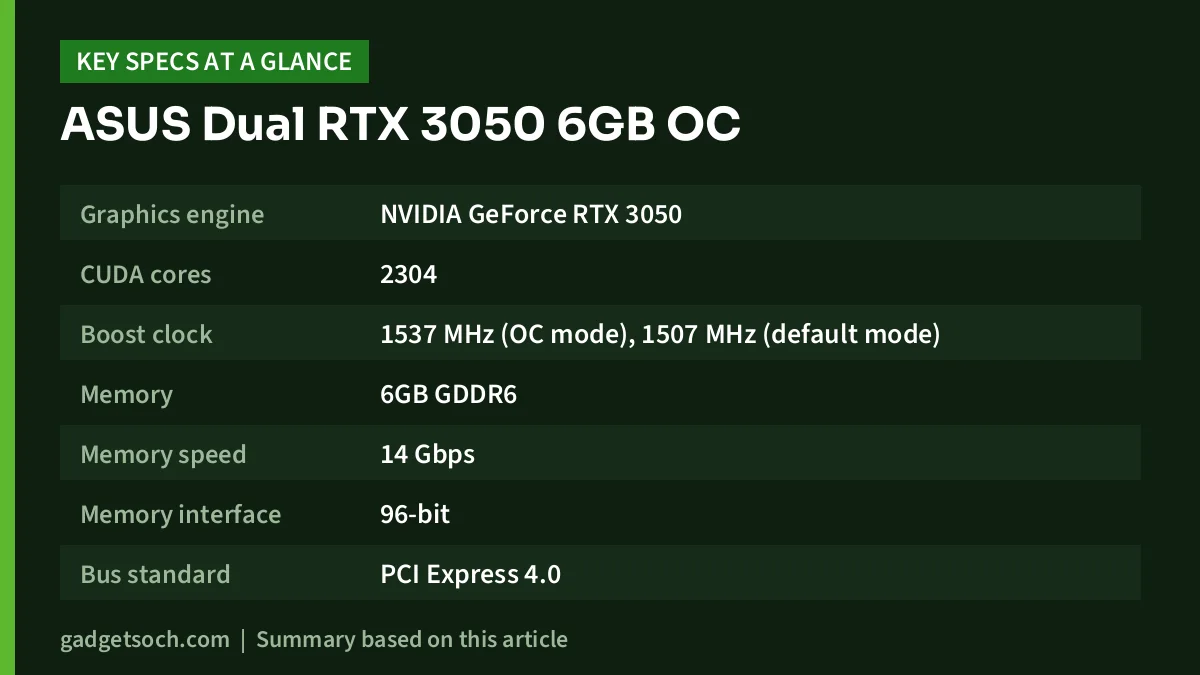
ASUS Dual RTX 3050 6GB OC specifications
| Specification | ASUS DUAL-RTX3050-O6G (official ASUS spec page) |
|---|---|
| Graphics engine | NVIDIA GeForce RTX 3050 |
| CUDA cores | 2304 |
| Boost clock | 1537 MHz (OC mode), 1507 MHz (default mode) |
| Memory | 6GB GDDR6 |
| Memory speed | 14 Gbps |
| Memory interface | 96-bit |
| Bus standard | PCI Express 4.0 |
| Outputs | 1 x DVI-D, 1 x HDMI 2.1, 1 x DisplayPort 1.4a, HDCP 2.3 |
| Maximum displays | 3 |
| Maximum digital resolution | 7680 x 4320 |
| External power connector | None |
| Recommended PSU | 450W |
| Dimensions | 201 x 120 x 37 mm |
| Slot width | 2 slots |
| In the box (ASUS) | 1 x Speedsetup manual |
| Software | ASUS GPU Tweak III, GeForce Game Ready and Studio drivers (download from the support site) |
| Weight (Amazon.in listing) | 408 g |
| Warranty (Amazon.in listing) | 3 years ASUS India warranty |
The variant on the affiliate link is the 6GB GDDR6 OC Edition with model number DUAL-RTX3050-O6G. Check the current price of the ASUS Dual RTX 3050 6GB OC on Amazon.in and confirm that the model number on the listing matches.
RTX 3050 6GB vs RTX 3050 8GB: not the same chip setup
“RTX 3050” covers more than one configuration, and the difference is bigger than memory size. NVIDIA’s RTX 3050 page lists:
| Specification | RTX 3050 (8GB) | RTX 3050 (6GB) |
|---|---|---|
| CUDA cores | 2560 | 2304 |
| Boost clock (NVIDIA reference) | 1.78 GHz | 1.47 GHz |
| Memory | 8GB GDDR6 | 6GB GDDR6 |
With about 10% fewer CUDA cores and a noticeably lower reference boost clock, the 6GB model should be expected to trail the 8GB model in games. ASUS’s OC Edition raises the boost clock to 1537 MHz in OC mode (1507 MHz in default mode), slightly above NVIDIA’s 1.47 GHz reference for the 6GB version, but that factory overclock does not close the gap to the 8GB card’s specifications. If a seller or a used listing just says “RTX 3050”, check which version it is.
No power cable needed: the main reason to buy it
ASUS’s spec page lists the card’s power connectors as “No”. In practice, that means the card draws its power from the motherboard’s PCIe slot alone. Many branded office desktops and older budget PCs ship with power supplies that have no PCIe power cables, which rules out most gaming cards. A card without an external connector avoids that problem.
That does not mean any power supply will do. ASUS recommends a 450W PSU for this card, so check the wattage on your power supply’s label before buying. A reputable PSU near that rating is safer than an unbranded unit with a bigger printed number. If yours is well below 450W, budget for a PSU upgrade.
Will it fit in your case?
ASUS lists the card at 201 x 120 x 37 mm and two slots wide. A length of around 20 cm fits most mid-tower and many compact cases, but this is not a low-profile card. Slim desktop towers that only take half-height cards will not accept it, because the card’s height and full-height bracket need a standard expansion slot.
Measure the free length from the rear slot to the drive cages or front fans, and check the space for two expansion slots. The listing gives slightly different dimensions (20.4 x 11.5 cm), so leave a few millimetres of margin.
What 6GB on a 96-bit bus means for gaming
Video memory (VRAM) holds textures and other game data close to the GPU. When a game wants more VRAM than the card has, performance can stutter, so you lower the texture setting. With 6GB, expect to adjust texture settings in demanding new releases, even at 1080p. Older games and esports titles are less affected.
The 96-bit memory interface with 14 Gbps GDDR6, as listed by ASUS, limits how quickly data moves between the GPU and its memory. Together with 6GB of VRAM, this is why the card is best treated as a 1080p card. The card can drive high-resolution displays, but gaming at 1440p or 4K is not what this class of GPU is built for.
NVIDIA’s DLSS upscaling helps here. The Amazon.in listing highlights third-generation Tensor cores and DLSS, and NVIDIA’s RTX 3050 page refers to DLSS Super Resolution on RTX 30 Series hardware. In supported games, DLSS renders at a lower resolution and upscales the image, which can make demanding games more playable. If a game advertises DLSS Frame Generation, check NVIDIA’s support information for which GPU generations it covers, rather than assuming it applies to this card.
Ray tracing, streaming and creative work
The listing highlights second-generation RT cores for ray tracing, but ray tracing is demanding, and on an entry-level 6GB card it usually needs lower settings and DLSS. Treat it as a bonus, not a reason to buy.
For non-gaming work, the RTX features are useful. NVIDIA lists NVENC hardware encoding, Reflex, the Broadcast app and Studio drivers for GeForce RTX cards, and ASUS’s spec page points to both Game Ready and Studio drivers. NVENC lets you stream or record gameplay with less load on the CPU, and many video editors can use NVIDIA GPUs for acceleration. If you edit large, high-resolution projects, the 6GB of memory can again be a limit.
Outputs, cooling and software
ASUS lists one HDMI 2.1, one DisplayPort 1.4a and one DVI-D output, with support for up to three displays. The DVI-D port is handy for older office monitors that lack HDMI or DisplayPort. Note that the Amazon.in technical details list a maximum resolution of 3840 x 2160, while ASUS’s spec page gives a maximum digital resolution of 7680 x 4320. The listing also gives the interface as “PCI-Express x4” and the memory clock as 1537 MHz, whereas ASUS lists PCI Express 4.0 and 14 Gbps memory (1537 MHz is the OC boost clock). Rely on ASUS’s figures.
According to the Amazon.in listing, the card has two fans, IP5X dust resistance, a stainless-steel bracket, and ASUS’s Auto-Extreme automated manufacturing. ASUS GPU Tweak III, listed on both the official page and the listing, handles performance tuning, thermal controls and system monitoring.
Who should buy it
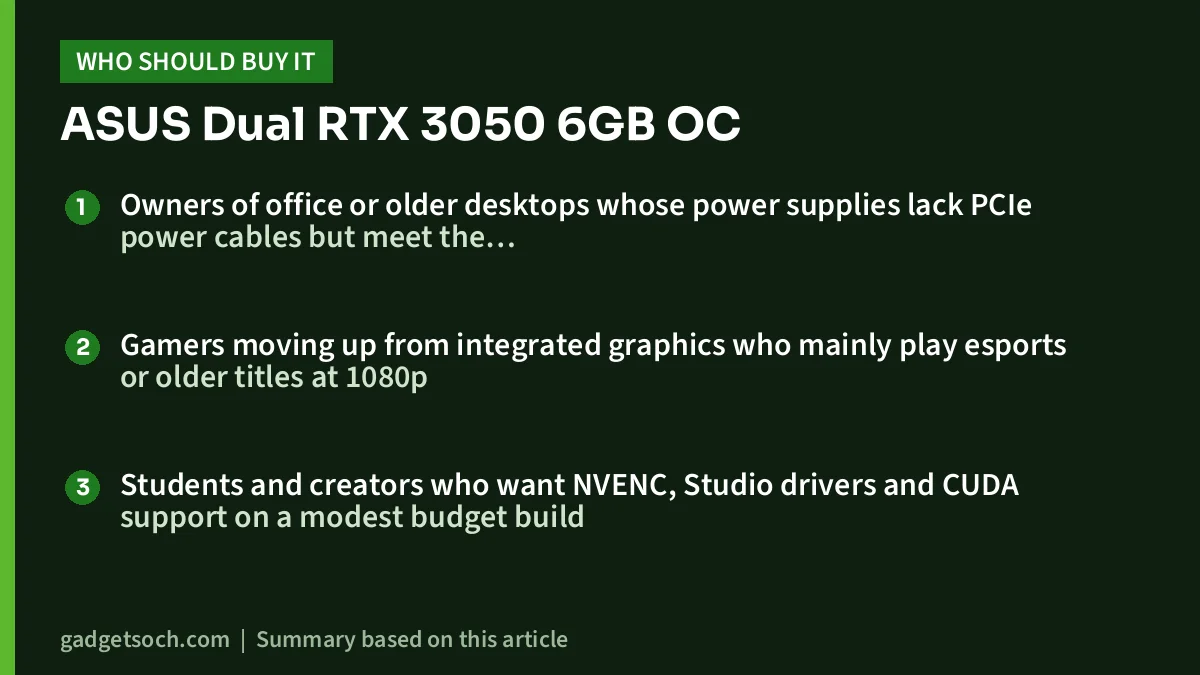
- Owners of office or older desktops whose power supplies lack PCIe power cables but meet the 450W recommendation
- Gamers moving up from integrated graphics who mainly play esports or older titles at 1080p
- Students and creators who want NVENC, Studio drivers and CUDA support on a modest budget build
Who should skip it
- Players who want high or ultra settings in the newest demanding games
- Anyone gaming at 1440p or above
- Buyers who assume it matches the RTX 3050 8GB, which has more cores and higher clocks
- Owners of slim, low-profile desktops that cannot fit a full-height card
Alternatives worth comparing
An RTX 3050 8GB card: NVIDIA lists 2560 CUDA cores, a 1.78 GHz boost clock and 8GB of GDDR6 for this version. It is the better-specified RTX 3050, but check each card’s power connector and PSU requirements, because they can differ from this connector-free model.
Another brand’s RTX 3050 6GB: all RTX 3050 6GB cards share NVIDIA’s 2304-core, 6GB configuration. Differences come from factory clocks, cooler size, card length and warranty terms, so compare those details if the ASUS card does not fit your case.
A ready-made RTX 3050 gaming laptop: if you do not have a suitable desktop, a laptop may make more sense, but laptop RTX 3050 GPUs are mobile chips with their own specifications. Our guide to the best RTX 3050 and RTX 4050 gaming laptops covers that route.
Before you order: a checklist
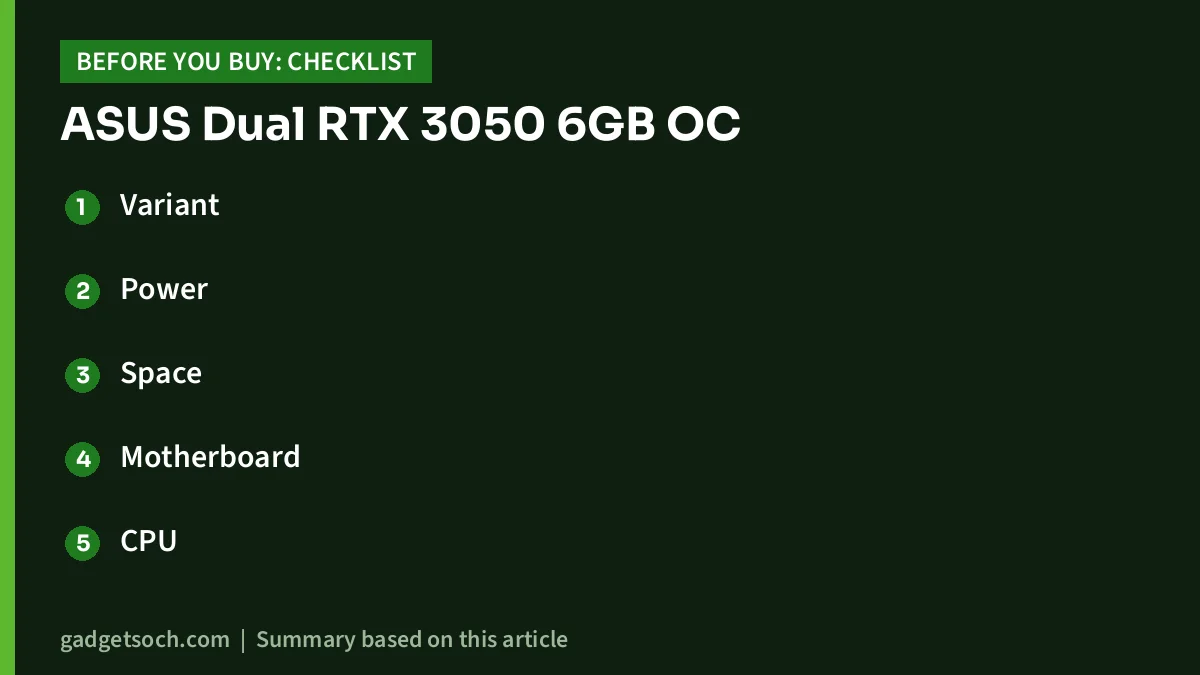
- Variant: confirm the listing says 6GB GDDR6 OC Edition and model DUAL-RTX3050-O6G
- Power: check that your PSU meets ASUS’s 450W recommendation
- Space: measure for a 201 mm long, 120 mm tall, two-slot card
- Motherboard: you need a free full-length PCIe graphics slot. The card is PCIe 4.0, and PCIe is backward compatible with PCIe 3.0 slots
- CPU: make sure the processor is not a severe bottleneck. A modern six-core chip such as the one in our Intel Core i5-12400F review is a sensible pairing
- Display: check which port your monitor uses, and use HDMI or DisplayPort for high refresh rates
- Box contents: ASUS lists only a Speedsetup manual, so do not expect cables or adapters
- Warranty: the listing states a 3-year ASUS India warranty. Keep the invoice and confirm the seller before buying
Once the checks are done, see the ASUS Dual RTX 3050 6GB OC Edition on Amazon.in.
Frequently asked questions
Does the ASUS Dual RTX 3050 6GB OC need a PCIe power cable?
No. ASUS’s spec page lists no power connector, so it is powered through the PCIe slot. ASUS still recommends a 450W power supply.
Is the RTX 3050 6GB slower than the RTX 3050 8GB?
Based on NVIDIA’s specifications, yes. The 6GB version has 2304 CUDA cores and a 1.47 GHz reference boost clock, against 2560 cores and 1.78 GHz for the 8GB version.
Will it work in a PCIe 3.0 motherboard?
Yes. The card uses PCI Express 4.0, and PCIe is backward compatible, so it runs in a PCIe 3.0 slot at that slot’s speed.
Can it play games at 4K?
It can output 4K and higher to a display, but with 6GB of memory on a 96-bit bus, it is aimed at 1080p gaming. Expect to rely on lower settings or DLSS in demanding games.
What warranty does it have in India?
The Amazon.in listing states a 3-year ASUS India warranty. Confirm the terms with the seller and keep your invoice.
Bottom line
The ASUS Dual RTX 3050 6GB OC Edition makes the most sense as a drop-in upgrade for a desktop that cannot power a bigger card, bringing RTX features and 1080p gaming without a PCIe power cable. Buy it knowing it sits below the RTX 3050 8GB and that 6GB of memory needs sensible settings in new games. Check the current price of the ASUS Dual RTX 3050 6GB OC on Amazon.in.
Related reading on GadgetSoch: GIGABYTE RX 7600 Gaming OC 8G Review: A 1080p Card, Its Specs and a Port Mismatch and ZEBRONICS GT740-4GD3 Review: A Basic 4GB Graphics Card for Display, Not Gaming.
Sources
- ASUS: Dual GeForce RTX 3050 OC Edition 6GB tech specs, checked 17 October 2026
- NVIDIA India: GeForce RTX 3050 family page and specifications, checked 17 October 2026
- Amazon.in listing for ASIN B086ZSQZZ7 (title, feature bullets and technical details), captured 17 October 2026