
The GIGABYTE GeForce RTX 5050 WINDFORCE OC 8G (GV-N5050WF2OC-8GD) is a dual-fan entry-level gaming card built on NVIDIA’s Blackwell architecture, with 8GB of GDDR6 memory and DLSS 4 support. It is aimed at 1080p gaming in a mainstream desktop that has a 550W power supply. It is a sensible pick if you are upgrading from integrated graphics or an older GTX card. Look higher if you want to run demanding games at high texture settings.
Gigabyte’s version runs a small factory overclock, 2587 MHz against NVIDIA’s 2572 MHz reference, and uses a 199 mm long WINDFORCE cooler with fans that stop at low load. It needs one 8-pin power cable, and it offers two HDMI 2.1b and two DisplayPort 2.1b outputs.
Note on method: everything here comes from Gigabyte’s official India product and specification pages, NVIDIA’s RTX 5050 page, and the Amazon.in listing, all checked on 17 October 2026. It is not a hands-on test, and we do not quote frame rates we have not verified.
Quick verdict
- Best for: 1080p gamers building or upgrading a mainstream PC, and creators who want NVIDIA’s ninth-generation NVENC encoder and Studio drivers
- Skip if: you play at 1440p with high texture settings, or your power supply is under 550W and has no 8-pin PCIe cable
- Strengths: Blackwell features including DLSS 4 with Multi Frame Generation (per NVIDIA), fans that stop at low load, a modest 130W total graphics power per NVIDIA, and four outputs
- Limitations: 8GB of VRAM, a 128-bit memory bus, and GDDR6 rather than the GDDR7 used on the RTX 5060
Specifications at a glance
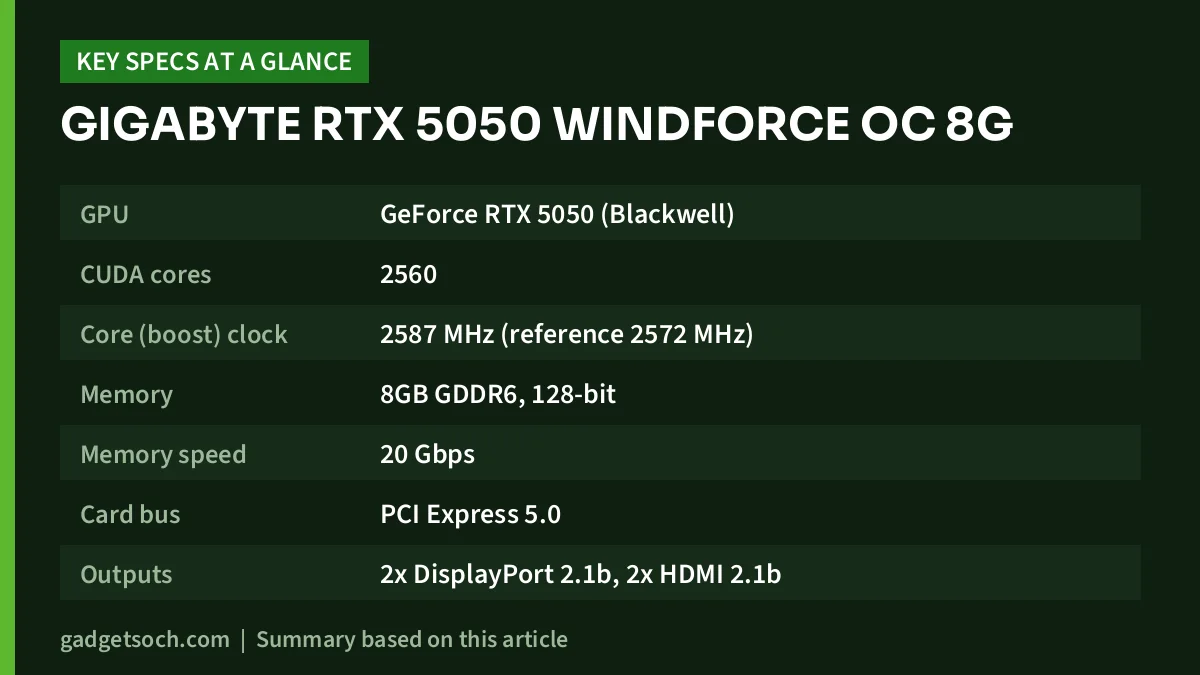
| Item | GIGABYTE RTX 5050 WINDFORCE OC 8G | Source |
|---|---|---|
| GPU | GeForce RTX 5050 (Blackwell) | Gigabyte, NVIDIA |
| CUDA cores | 2560 | Gigabyte, NVIDIA |
| Core (boost) clock | 2587 MHz (reference 2572 MHz) | Gigabyte |
| Memory | 8GB GDDR6, 128-bit | Gigabyte |
| Memory speed | 20 Gbps | Gigabyte |
| Card bus | PCI Express 5.0 | Gigabyte (lane count not stated) |
| Outputs | 2x DisplayPort 2.1b, 2x HDMI 2.1b | Gigabyte |
| Max displays | 4 | Gigabyte, NVIDIA |
| Digital max resolution | 7680 x 4320 | Gigabyte |
| Power connector | 1x 8-pin | Gigabyte |
| System power | 550W | Gigabyte, NVIDIA |
| Total graphics power | 130W (RTX 5050 spec) | NVIDIA |
| AI TOPS | 421 | NVIDIA |
| Encoder and decoder | 1x 9th-gen NVENC, 1x 6th-gen NVDEC | NVIDIA |
| Card size | 199 x 116 x 40 mm | Gigabyte |
| Box contents | Quick guide (plus card) | Gigabyte |
Check the current price of the GIGABYTE RTX 5050 WINDFORCE OC 8G on Amazon.in
Where the RTX 5050 sits in NVIDIA’s line-up
The RTX 5050 is the entry point of NVIDIA’s desktop RTX 50 series. NVIDIA lists 2560 CUDA cores, a 2.31 GHz base clock and 2.57 GHz boost clock, 8GB of GDDR6 on a 128-bit interface, and a 130W total graphics power. Those figures put it below the RTX 5060, which (per the Gigabyte RTX 5060 WINDFORCE listing on Amazon.in) has 3840 CUDA cores and faster GDDR7 memory.
What the RTX 5050 shares with its bigger siblings is the feature set. NVIDIA’s page lists DLSS 4 with Super Resolution, DLAA, Ray Reconstruction, Frame Generation and Multi Frame Generation, plus fifth-generation Tensor Cores rated at 421 AI TOPS. In practice, DLSS is the reason to buy an RTX card at this level. In games that support it, upscaling and frame generation can lift smoothness well beyond what the raw core count suggests. How much depends on the game and settings, and generated frames do not improve input response the way real frames do.
The Gigabyte WINDFORCE design
Gigabyte’s version differs from other RTX 5050 cards in its cooler and its small overclock. According to Gigabyte’s product page, the WINDFORCE system includes:
- Hawk fans with a reworked blade shape, which Gigabyte says increase air pressure and air volume compared with its previous design
- Alternate spinning, where the two fans turn in opposite directions to reduce turbulence
- 3D Active Fan, which keeps the fans off when the GPU is at low load, so desktop work and video playback can be silent
- Server-grade thermal conductive gel on the memory and MOSFETs, a deformable gel meant to fill uneven gaps better than pads
- A copper plate in direct contact with the GPU feeding a composite copper heat pipe
- Graphene nano lubricant, which Gigabyte claims extends sleeve-bearing fan life
The Amazon.in listing describes the card as compact and slim. Gigabyte’s spec sheet gives 199 x 116 x 40 mm. A length under 20 cm fits most mid-tower and many micro-ATX cabinets, and 40 mm is roughly a two-slot thickness. Still, measure your case’s GPU clearance, especially if front radiators or drive cages are in the way.
8GB of VRAM: the honest trade-off
The main limitation of any RTX 5050 is its 8GB frame buffer on a 128-bit bus. For esports titles and most games at 1080p with sensible settings, 8GB is workable. In some recent big-budget games, ultra texture settings and high-resolution texture packs can exceed 8GB, which leads to stutter or blurry textures until you lower texture quality. DLSS reduces the rendering load but does not remove the need for texture memory.
If you mainly play competitive shooters, MOBAs, or older AAA games at 1080p, this is unlikely to bother you. If you want to keep a card for four or five years and play every new release at high settings, a card with 10GB or more is the safer bet. Our alternatives list includes one.
Power and platform requirements
Gigabyte and NVIDIA both list a 550W system power requirement. NVIDIA notes its figure is based on a high-end test system. The card takes a single 8-pin PCIe power connector, so check your power supply has one, and avoid unbranded units that only claim their wattage. Gigabyte suggests its own AORUS or UD power supply series, but any reputable unit of the right capacity with an 8-pin PCIe cable will do.
The card uses a PCI Express 5.0 interface. It is backward compatible, so it works in PCIe 4.0 and 3.0 x16 slots too. The pages we checked do not state how many PCIe lanes the card uses electrically. If it uses fewer than 16, an older PCIe 3.0 motherboard would give it less bandwidth than a newer board. It still works, but if you are on an old platform, look for independent reviews of RTX 5050 performance on PCIe 3.0 before buying.
For a balanced build, pair it with a modern six-core processor. Our Intel Core i5-12400F review explains why that chip needs a dedicated graphics card and where it fits in a budget gaming PC.
Creators and streamers
NVIDIA lists one ninth-generation NVENC encoder and one sixth-generation NVDEC decoder for the RTX 5050. For streamers, a hardware encoder means you can stream or record gameplay without loading the CPU heavily. Gigabyte also highlights NVIDIA Broadcast and Studio drivers, which are useful for microphone noise removal, virtual backgrounds, and stable driver support in editing apps. For heavy 4K video editing or large AI models, the 8GB of VRAM is again the ceiling to keep in mind.
Who it suits, and who should look elsewhere

- Good fit: 1080p gamers moving up from integrated graphics or a GTX 16-series or older card
- Good fit: streamers and YouTubers who want NVENC and NVIDIA Broadcast on a sensible budget
- Good fit: compact mid-tower builds, given the 199 mm length and single 8-pin connector
- Look elsewhere: 1440p high-settings gamers, who should consider a card with more VRAM or a higher tier
- Look elsewhere: anyone with a low-wattage branded office PSU and no 8-pin cable, unless you also replace the PSU
Alternatives worth comparing
Facts for these alternatives come from their Amazon.in listings (captured 17 October 2026) or, for the ASRock card, from ASRock’s official specification page.
- GIGABYTE GeForce RTX 5060 WINDFORCE OC 8G: its listing shows 3840 CUDA cores, 8GB of GDDR7 on a 128-bit bus, a 2512 MHz boost clock, PCIe 5.0, and 3x DisplayPort plus 1x HDMI. It is the step-up within the same family if your budget stretches, though it is still an 8GB card.
- ASRock Intel Arc B570 Challenger 10GB OC: ASRock lists 10GB of GDDR6 on a 160-bit bus at 19 Gbps, PCIe 4.0 x8, and a 600W recommended PSU. It has more video memory, and Intel says enabling Resizable BAR can improve Arc performance, so check that your platform supports it.
- ASUS Dual Radeon RX 7600 EVO OC 8GB: according to its listing, it has 8GB of GDDR6, a boost clock of up to 2715 MHz in OC mode, PCIe 4.0, 1x HDMI 2.1 and 3x DisplayPort 1.4a, and a 2.5-slot cooler with 0dB fan stop. It does not support DLSS, since AMD uses its own FSR upscaling.
Before you order: a quick checklist

- Confirm the exact model: the affiliate link points to GV-N5050WF2OC-8GD, the RTX 5050 WINDFORCE OC 8G with 8GB GDDR6. Check that the model number on the listing matches before checkout.
- Ignore a listing glitch: one technical-detail field on the Amazon.in listing names the graphics coprocessor as “RTX 5070”. The title, model number and Gigabyte’s page all confirm this is an RTX 5050.
- Box contents: Gigabyte lists a quick guide. The listing’s “Fan” entry under box contents looks like a data error, so do not expect extra fans.
- Power supply: 550W or higher from a reputable brand, with a free 8-pin PCIe cable.
- Clearance: at least 20 cm of GPU length clearance, plus about two slots of thickness.
- Warranty and service: the Amazon.in listing we captured does not state warranty terms. Confirm the warranty period and Gigabyte’s India service process with the seller, and keep the invoice.
- Drivers: install the latest NVIDIA driver from NVIDIA’s website after fitting the card, and remove old drivers if you are switching from an AMD card.
See the GIGABYTE RTX 5050 WINDFORCE OC 8G (GV-N5050WF2OC-8GD) on Amazon.in to confirm the variant, seller, and delivery details.
Frequently asked questions
Is the RTX 5050 good for 1080p gaming?
That is the resolution it is designed for. With 2560 CUDA cores, 8GB of GDDR6, and DLSS 4 support (per NVIDIA), it targets 1080p. Demanding new games may need lower texture settings because of the 8GB limit. We have not tested it, so we do not quote frame rates.
What power supply does the Gigabyte RTX 5050 WINDFORCE OC need?
Gigabyte and NVIDIA list 550W system power, and the card uses one 8-pin PCIe power connector.
Does it support DLSS 4 Multi Frame Generation?
Yes. NVIDIA’s RTX 5050 page lists DLSS 4 including Multi Frame Generation, Frame Generation, Ray Reconstruction, Super Resolution, and DLAA. Each game must support the feature.
Will it work on a PCIe 4.0 or 3.0 motherboard?
Yes. PCIe 5.0 cards are backward compatible. On older boards, available bandwidth may be lower, and the official pages we checked do not give the card’s lane count.
How long is the card, and will it fit a micro-ATX case?
Gigabyte lists 199 x 116 x 40 mm. Most micro-ATX and mid-tower cases have room for that, but check your case’s maximum GPU length.
Are the fans noisy at idle?
Gigabyte’s 3D Active Fan feature keeps the fans off when the GPU is at low load, so they should not run during light desktop use.
Bottom line
The GIGABYTE GeForce RTX 5050 WINDFORCE OC 8G is a straightforward 1080p card. It offers NVIDIA’s latest feature set, a compact dual-fan cooler with fan stop, a single 8-pin connector, and four modern outputs. Its 8GB of GDDR6 on a 128-bit bus is the trade-off to accept. If you want one card to play everything at high settings for years, look at a model with more memory.
Check the current price of the GIGABYTE GeForce RTX 5050 WINDFORCE OC 8G on Amazon.in
Related reading on GadgetSoch: Gigabyte RTX 3050 WINDFORCE OC 6G Review: Four Outputs, 6GB and What to Check, GIGABYTE RX 6500 XT EAGLE 4G Review (GV-R65XTEAGLE-4GD): Small, Easy to Power, With Clear Limits and Gigabyte RTX 5060 WINDFORCE OC 8G Review: A Compact 1080p Card With an 8 GB Catch.
Sources
- GIGABYTE India: GV-N5050WF2OC-8GD specifications (checked 17 October 2026)
- GIGABYTE India: RTX 5050 WINDFORCE OC 8G product overview (checked 17 October 2026)
- NVIDIA: GeForce RTX 5050 family specifications (checked 17 October 2026)
- ASRock: Intel Arc B570 Challenger 10GB OC (checked 17 October 2026)
- Intel: Resizable BAR support article (checked 17 October 2026)
- Amazon.in listings for B0FG8JRDQ6, B0F6NLT7M4 (RTX 5060 WINDFORCE) and B0DKPGQT97 (RX 7600 EVO), captured 17 October 2026