The Canon RF 75-300mm F4-5.6 is a telephoto zoom for Canon EOS R mirrorless cameras that Canon itself describes as accessible and affordable: a light, 507g lens that reaches 300mm, but without image stabilisation and with a simple DC autofocus motor. It is a sensible first telephoto for beginners who want to try wildlife, sports, stage shows or tight portraits in good light. It is not the right choice if you shoot fast action in dim light, record video with autofocus, or need stabilisation on a body that lacks it.
Canon lists it as a full-frame RF lens, and on an APS-C EOS R body it gives an effective 120-480mm field of view, according to Canon. That extra reach is a big reason it appeals to owners of entry-level APS-C bodies.
This guide is based on Canon’s official specification pages and the Amazon.in listing, checked on 17 October 2026. We have not shot with this lens, so sharpness and autofocus speed are not judged here.
At a glance
- Best for: beginners on EOS R bodies who want affordable reach for daylight wildlife, sport, events and portraits
- Skip if: you need image stabilisation in the lens, quiet video autofocus, weather sealing or strong low-light performance
- Strengths: 75-300mm range (120-480mm equivalent on APS-C), light 507g build, 58mm filter thread, Canon says Servo AF and Eye Detection work in stills and video
- Limitations: no optical stabilisation, DC motor instead of STM or USM, f/5.6 at 300mm, 1.5m minimum focus distance, lens hood sold separately
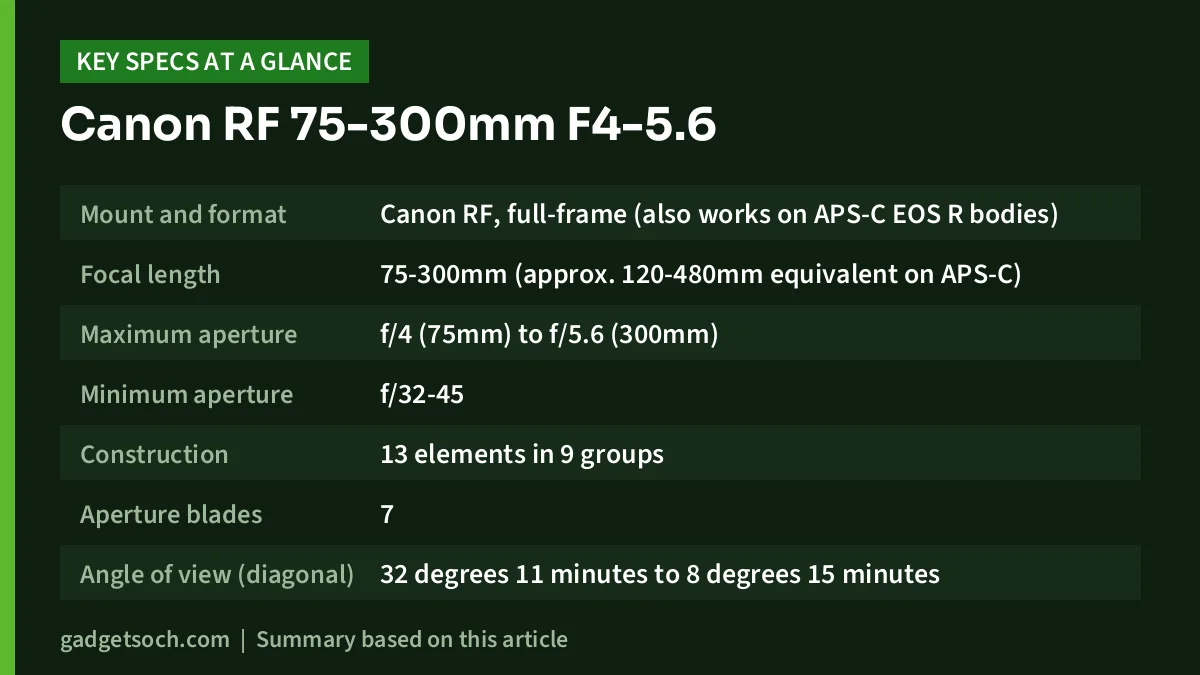
Canon RF 75-300mm F4-5.6 specifications
| Specification | Canon RF 75-300mm F4-5.6 |
|---|---|
| Mount and format | Canon RF, full-frame (also works on APS-C EOS R bodies) |
| Focal length | 75-300mm (approx. 120-480mm equivalent on APS-C) |
| Maximum aperture | f/4 (75mm) to f/5.6 (300mm) |
| Minimum aperture | f/32-45 |
| Construction | 13 elements in 9 groups |
| Aperture blades | 7 |
| Angle of view (diagonal) | 32 degrees 11 minutes to 8 degrees 15 minutes |
| Closest focusing distance | 1.5m |
| Maximum magnification | 0.06x at 75mm, 0.25x at 300mm |
| Focus drive | DC motor |
| Image stabilisation | None in the lens |
| Filter size | 58mm |
| Dimensions | 71.2 x 146.1mm (approx.) |
| Weight | 507g (approx.) |
| Included caps | Lens Cap E-58 II and Lens Dust Cap RF |
| Lens hood | ET-60, sold separately |
Check the current price of the Canon RF 75-300mm F4-5.6 on Amazon.in
How much reach does 300mm really give?
A 300mm focal length on a full-frame body gives a diagonal angle of view of about 8 degrees, according to Canon. In practical terms, that lets you fill the frame with a bird on a nearby branch, a player on the far side of a school ground or a performer on stage from the middle of a hall.
On an APS-C EOS R body, such as the Canon EOS R50, the smaller sensor crops the image, so the same lens frames like a 120-480mm lens on full frame, according to Canon. That is why this lens is often paired with entry-level APS-C bodies: you get noticeably more reach without paying for a much larger lens.
At the short end, 75mm on full frame (around 120mm equivalent on APS-C) is a useful length for head-and-shoulders portraits. Longer focal lengths also compress the background, making distant scenery look closer behind your subject, which Canon highlights for portrait work.
The trade-offs Canon made
Every budget telephoto cuts something. Understanding the cuts here will tell you quickly whether this lens fits the way you shoot.
No image stabilisation in the lens
Canon’s spec sheet lists no optical image stabilisation, and the Amazon.in listing says “No image stabilization”. At 300mm, small hand movements are magnified, so blur from camera shake is the most common problem with long lenses. If your camera has in-body image stabilisation (IBIS), it will help. If it does not, you will need faster shutter speeds, a higher ISO or a monopod.
A widely used rule of thumb is to keep the shutter speed at least as fast as 1 divided by the effective focal length. At 300mm on full frame that is about 1/300s; at the 480mm equivalent on APS-C, aim for about 1/500s or faster. For moving subjects such as birds in flight or cricket, you will want faster speeds anyway to freeze motion.
DC motor autofocus
Canon lists the focus drive as a “DC motor”. Many other RF lenses use STM (stepping motor) or USM drives, as their names show, and Canon generally markets those for smoother, quieter focusing. Canon’s own page for this lens makes no claim about focusing noise or speed, so if you plan to film with autofocus and an on-camera microphone, look for published video tests before buying.
Canon does state that the lens supports continuous Servo AF and Eye Detection in both stills and video, and Canon USA says Servo AF and pupil detection still track at the longest focal length. Those features come from the camera body, so results depend on which EOS R camera you pair it with.
f/4-5.6 aperture
At 75mm the maximum aperture is f/4, narrowing to f/5.6 at 300mm. That is fine in daylight, but indoors, in shade, or at dusk you will have to raise the ISO to keep shutter speeds fast enough. Indoor sports halls and dim concerts are where this lens will struggle most.
1.5m minimum focus distance
The lens cannot focus closer than 1.5m. Canon lists a maximum magnification of 0.25x at 300mm, which is useful for flowers and insects from a distance, but this is not a macro lens.
Build, size and handling
Canon lists the lens at about 71.2 x 146.1mm and 507g. That is light for a 300mm zoom, so it is easy to carry for a day at a zoo, national park or school sports day. The 58mm filter thread means protective and polarising filters are relatively inexpensive.
Weather sealing is a grey area. Canon’s Asia specification page does not list dust and moisture resistance, while Canon UK’s specification page appears to mark it as resistant. Because Canon’s own pages disagree, treat it as not weather-sealed unless Canon India confirms, and protect it from rain and dust.
The ET-60 lens hood is sold separately, according to Canon. A hood is worth buying for a telephoto lens: it reduces flare when shooting towards the sun and gives the front element some protection from knocks.
Who this lens suits
- Owners of EOS R APS-C bodies who want reach for birds, wildlife and sport at a lower weight
- Beginners who want to learn telephoto composition and background compression before spending more
- Parents shooting school events and outdoor sports in daylight
- Travellers who want a light long lens for safaris and landscapes with distant subjects
Who should look elsewhere
- Videographers who need quiet, smooth autofocus and stabilisation
- Anyone shooting indoor sports, weddings or concerts in dim light
- Owners of bodies without IBIS who cannot use fast shutter speeds
- Photographers who need weather sealing for monsoon and dusty outdoor shoots
Other Canon telephoto options to compare
Canon RF 100-400mm F5.6-8 IS USM: a full-frame RF zoom that Canon UK describes as compact and lightweight, with 5.5-stop image stabilisation. It trades a slower aperture for longer reach and stabilisation.
Canon RF-S 55-210mm F5-7.1 IS STM: an APS-C-only telephoto zoom with image stabilisation and an STM motor, according to Canon UK. It suits APS-C owners who prefer stabilisation over the extra reach at the long end.
Canon RF 70-200mm F4L IS USM: a compact L-series zoom with image stabilisation, listed by Canon UK for travel, sport and portraits. It has a constant f/4 aperture but stops at 200mm.
Before you buy: practical checks
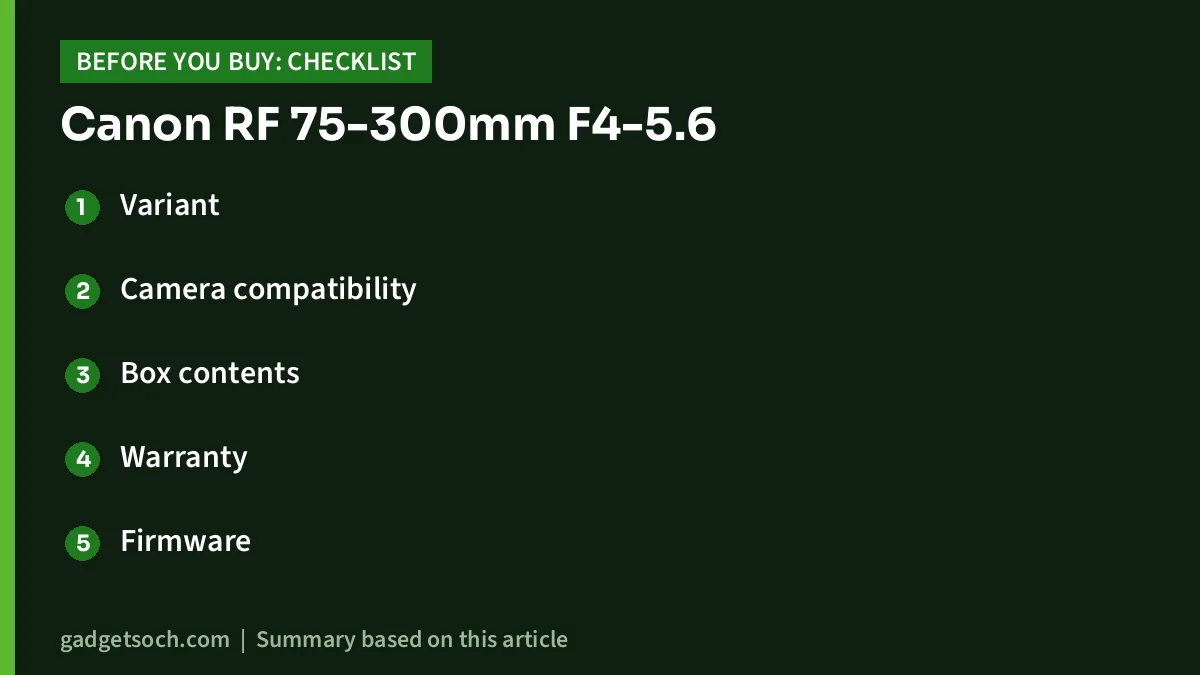
- Variant: the Amazon.in link is for the Canon RF 75-300mm F4-5.6 lens (Canon part RF75-300) in black. It is the lens only, not a camera kit. Check the listing title before you order
- Camera compatibility: it needs a Canon RF-mount EOS R body. It will not mount on Canon EF or EF-S DSLRs
- Box contents: Canon lists the front cap E-58 II and dust cap RF as included. The ET-60 hood is extra
- Warranty: the listing does not state warranty terms. Buy from Canon or an authorised seller and check the Canon India warranty on the invoice
- Firmware: update your camera body firmware for the best lens support
- Accessories: a 58mm UV or protect filter, the ET-60 hood and a fast memory card for burst shooting
See the Canon RF 75-300mm F4-5.6 telephoto lens on Amazon.in
Getting sharper shots with it
- Use shutter priority (Tv) and start at 1/500s or faster at the long end, then raise ISO as needed
- Turn on Servo AF and subject or eye detection for moving subjects
- Stop down to f/8 if you need more depth of field for a group of animals or players
- Brace yourself against a wall or rail, or use a monopod, since there is no lens stabilisation
- Use the hood when shooting towards bright light to reduce flare
Frequently asked questions
Does the Canon RF 75-300mm F4-5.6 have image stabilisation?
No. Canon’s specifications list no optical image stabilisation. You will need in-body stabilisation, fast shutter speeds or a support.
Will it work on APS-C cameras such as the Canon EOS R50?
It uses the RF mount and Canon states it gives an effective 120-480mm range on APS-C EOS R bodies, so it mounts on Canon’s APS-C RF-mount cameras as well as full-frame EOS R bodies. Check Canon’s compatibility notes for your camera’s firmware.
Is it good for video?
Canon says Servo AF and Eye Detection work in video, but the lens uses a DC motor and has no stabilisation. Check published video tests for focus noise before relying on it for filming.
Is the lens hood included?
No. Canon lists the ET-60 hood as sold separately. The front cap E-58 II and rear dust cap RF are included.
What filter size does it use?
58mm, according to Canon.
Final word
The Canon RF 75-300mm F4-5.6 does one thing well on paper: it gives EOS R owners a lot of reach in a light, simple package. The price of that simplicity is no stabilisation, a basic DC motor and a modest aperture. Use it outdoors in good light, ideally on a body with IBIS, and it is a reasonable first telephoto. If you need video, low-light or weather-sealed performance, look at Canon’s stabilised RF zooms instead.
Check the current price of the Canon RF 75-300mm F4-5.6 on Amazon.in
Related reading on GadgetSoch: CrossBeats Clip M02 Review: Dual Wireless Collar Mic, Official Specs vs Listing Claims and UTECTION by VOOK Wireless Mic Review: Two Clip Mics for iPhone and Android, Explained.
Sources
- Canon Asia: RF75-300mm f/4-5.6 specifications (checked 17 October 2026)
- Canon Asia: RF75-300mm f/4-5.6 product page (checked 17 October 2026)
- Canon UK: RF 75-300mm F4-5.6 specifications (checked 17 October 2026)
- Canon USA: RF75-300mm F4-5.6 product page (checked 17 October 2026)
- Canon UK: telephoto lenses range, for alternatives (checked 17 October 2026)
- Amazon.in listing for ASIN B0F6YH1B2V, title, feature bullets and technical details (checked 17 October 2026)