

The Nikon Z50 twin lens kit pairs Nikon’s compact DX-format mirrorless camera with two zooms, the NIKKOR Z DX 16-50mm f/3.5-6.3 VR and the NIKKOR Z DX 50-250mm f/4.5-6.3 VR. It is a good fit for beginners and families who want a comfortable camera that covers everything from group photos to distant wildlife and sports, without buying lenses separately. Its main weaknesses are no in-body stabilisation, average battery life and a 4K mode limited to 30fps.
In short: if you want a grippy, easy-to-use camera with a long telephoto option in the box, the Z50 kit makes sense. If you shoot a lot of handheld video or want the newest subject-detection autofocus, compare the alternatives below first.
Note on method: this review draws on Nikon’s official Z 50 specifications, the Amazon.in listing captured on 17 October 2026 and published reviews, checked on 17 October 2026. Nothing here comes from hands-on testing.
Nikon Z50 at a glance

| Feature | Nikon Z50 (as listed by Nikon) | What it means for you |
|---|---|---|
| Sensor | DX format (23.5 x 15.7 mm) CMOS, 20.9MP effective | APS-C-size sensor, far larger than a phone sensor |
| ISO | 100 to 51,200, expandable to 204,800 | Usable range for indoor and evening shots |
| Autofocus | Hybrid phase/contrast AF, 209 points, down to -2 EV (-4 EV with low-light AF) | Designed to keep focusing in dim light |
| Burst | Up to 11fps high-speed continuous | Enough for kids, pets and local sports |
| Video | 4K UHD at 30/25/24fps, Full HD up to 120fps, max clip 29 min 59 s | Good 4K, but no 4K 60fps |
| Rear screen | 3.2-inch tilting touch LCD, approx. 1,040,000 dots | Bigger than the 3.0-type, 921,600-dot screen on the Sony a6400 |
| Viewfinder | 0.39-inch OLED, approx. 2,360k dots, 1.02x, 100% coverage | Clear eye-level framing in sunlight |
| Stabilisation | Lens-based VR (both kit lenses are VR), plus Movie e-VR | No sensor-shift stabilisation in the body |
| Battery | EN-EL25, approx. 300 shots or 75 min of video | A spare battery is wise |
| Storage | One SD/SDHC/SDXC slot (UHS-I) | No backup slot |
| Ports | Micro-B USB, Type D HDMI, 3.5 mm stereo mini-pin jack, ISO 518 hot shoe | External mic and flash support |
| Wireless | Wi-Fi (802.11b/g/n/a/ac), Bluetooth, SnapBridge app | Phone transfers and remote control |
| Weight | Approx. 395 g | Small and light for an interchangeable-lens camera |
Specifications from Nikon USA’s Z 50 page, checked 17 October 2026. The Amazon.in listing additionally names the EXPEED 6 image processor, which we could not confirm on the Nikon page we opened.
Check the current price of the Nikon Z50 with 16-50mm and 50-250mm lenses on Amazon.in
Quick verdict
- Best for: beginners and families who want a two-lens kit that reaches far, in a comfortable body
- Skip if: you mostly vlog handheld, need 4K at 60fps, or need dual card slots
- Strengths: deep grip, sharp 2,360k-dot EVF, large tilting touchscreen, 11fps bursts, 4K from the full sensor width, USB charging
- Limitations: no in-body stabilisation, about 300 shots per charge, single UHS-I slot, slow f/6.3 aperture at the long end of both lenses
Exactly which variant this link covers
The Amazon.in listing title is “Nikon Z50 Mirrorless Camera with Z DX 16-50mm f/3.5-6.3 VR & Z DX 50-250mm f/4.5-6.3 VR Lens”. That is the twin lens kit. Any other Z50 configuration, such as a single-lens kit, would be a different listing, so do not assume this link covers it.
One inconsistency to check: the listing’s “In the Box” bullet names the Z50, the 16-50mm lens, strap, battery, charger and USB cable, but does not mention the 50-250mm lens that appears in the title. Before ordering, confirm on the listing or with the seller that both lenses are included. The listing’s technical table also shows a “1-inch” sensor size and “FHD 1080p” video resolution, both of which conflict with Nikon’s specification of a DX sensor and 4K UHD recording. Trust Nikon’s figures.
Two lenses, and what each one is for
The 16-50mm is the everyday lens. It covers wide group photos, rooms, street scenes and travel. On the DX format (roughly a 1.5x crop), it frames like about 24-75mm on a full-frame camera. The 50-250mm takes over where that stops, framing like roughly 75-375mm. That is the lens for a child on a football field, birds in a park, a temple spire, or a performer seen from the back of a hall.
Both lenses are VR models, which matters because Nikon’s specification lists vibration reduction as lens shift, meaning stabilisation lives in the lens rather than the camera body. Both lenses also have small maximum apertures (f/6.3 at their long ends), so in dim indoor light the camera will raise ISO or slow the shutter. For low-light portraits, many owners later add a brighter prime lens.
Handling and screen
DPReview’s Z50 review by Richard Butler and Carey Rose (December 2019) praises “Comfortable, well-placed controls” and describes generally excellent grip and ergonomics. For first-time camera buyers, a deep grip makes the camera easier to hold steady, especially with the longer 50-250mm attached.
Nikon lists a 3.2-inch tilting touchscreen with about 1,040,000 dots. DPReview reports that it tilts up about 90 degrees and down about 180 degrees. Flipping it downward lets you see yourself for selfies and vlogging. The catch with any flip-down design is that a tripod head or mounting plate can get in the way of the screen, so check your setup if you plan to record yourself regularly.
DPReview also notes a missing feature: there is no touchpad control of the AF point while your eye is at the viewfinder. You can still move the point with the buttons.
Image quality and autofocus
DPReview lists “Very good image quality” and “Excellent dynamic range” among the Z50’s pros. It notes that 20.9MP captures somewhat less detail than some higher-resolution rivals, which matters only if you crop heavily or print very large.
On autofocus, DPReview’s cons include “AF Tracking will occasionally drift off the intended subject” and “Autofocus features seem poorly integrated and slower to operate”. It found face and eye detection worked well when the subject was fairly large in the frame. For most family and travel use that is fine. For fast, small subjects such as birds in flight, expect a lower hit rate.
Video: decent 4K, with stabilisation caveats
Nikon lists 4K UHD (3840 x 2160) at 30, 25 and 24fps, and Full HD at up to 120fps, with slow-motion options and a maximum clip length of 29 minutes 59 seconds. There is a built-in stereo microphone, a 3.5 mm jack for an external mic, movie focus peaking, Movie e-VR and a time-lapse movie mode.
DPReview reports that 4K uses the full width of the sensor with no crop, which helps keep the 16-50mm genuinely wide for video. Its cons include “Lack of in-body stabilization may be limiting, especially for video”. If you plan to walk and talk on camera, a gimbal or careful technique will be needed. Nikon’s page does not list a headphone jack. If you are building a creator setup, our YouTube starter kit guide for India covers lighting and audio basics.
Battery, charging and connectivity
Nikon rates the EN-EL25 battery at approximately 300 shots or 75 minutes of video. DPReview lists “Middling battery life” as a con but says it often got about double the rating in practice, and it counts “USB charging” as a pro. Charging in-camera over USB is handy on trips, but carry a spare battery for weddings or long outdoor days.
Wi-Fi and Bluetooth work with Nikon’s SnapBridge app, which DPReview describes as offering “Fairly simple Wi-Fi image transfer”. Storage is a single UHS-I SD slot, so copy important images off the card promptly.
Who the Z50 twin kit suits, and who it does not
- Good choice: parents who shoot school events and sports from a distance
- Good choice: travellers who want a wide zoom and a telephoto without spending on lenses separately
- Good choice: beginners who value a comfortable grip and an eye-level viewfinder
- Look elsewhere: handheld vloggers who need in-body stabilisation
- Look elsewhere: creators who need 4K at 60fps or headphone monitoring
- Look elsewhere: anyone who needs a dual card slot for paid jobs
Alternatives to consider
Nikon Z fc: Nikon lists a 20.9MP DX-format sensor, the EXPEED 6 engine, a 3.0-inch vari-angle touchscreen that faces forward for vlogging, 4K at up to 30fps without cropping and retro-styled dials. It uses the same EN-EL25 battery and Z mount, so the same DX lenses fit.
Sony Alpha a6400: Sony India lists a 24.2MP APS-C sensor, 425 phase-detection AF points with Real-time Eye AF and Real-time Tracking, 11fps bursts and a screen that tilts up about 180 degrees. Like the Z50, it has no in-body stabilisation.
Canon EOS R50: Canon India lists a 24.2MP APS-C sensor, subject detection for people, animals and vehicles, 4K 30p from 6K oversampling and a fully articulating screen. Canon also offers it with an RF-S18-45mm and RF-S55-210mm twin lens kit. Our Canon EOS R50 review covers it in detail.
Buying checklist for India
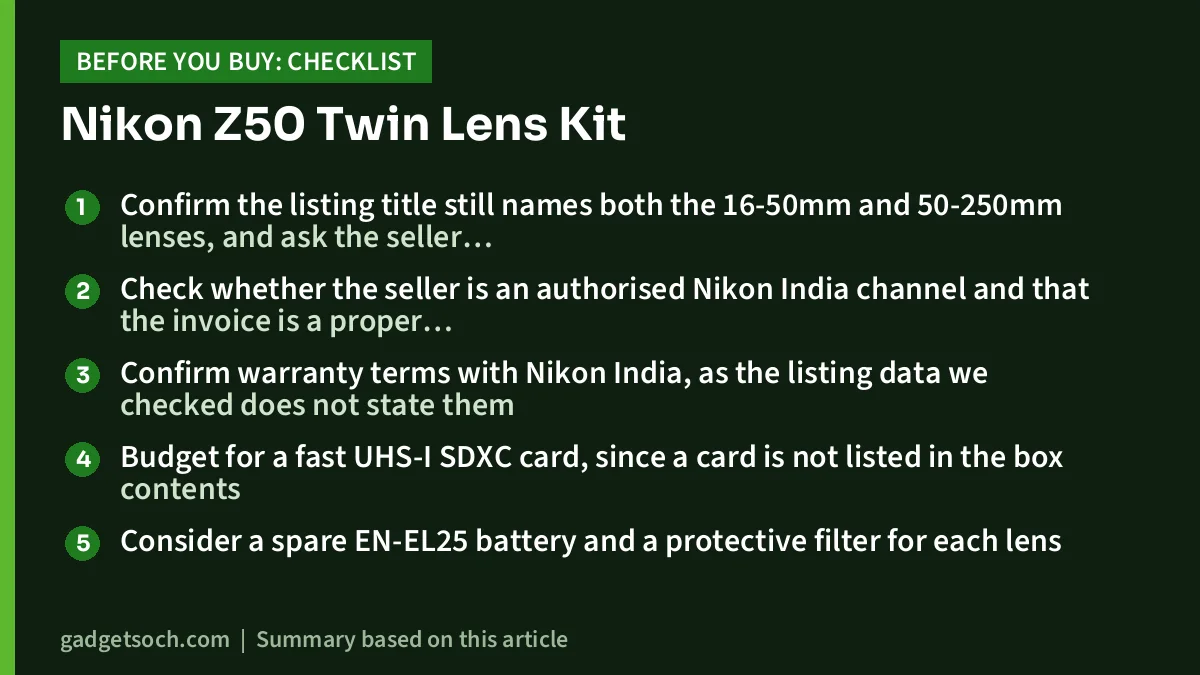
- Confirm the listing title still names both the 16-50mm and 50-250mm lenses, and ask the seller if the box contents list differs
- Check whether the seller is an authorised Nikon India channel and that the invoice is a proper GST invoice, which helps with warranty claims
- Confirm warranty terms with Nikon India, as the listing data we checked does not state them
- Budget for a fast UHS-I SDXC card, since a card is not listed in the box contents
- Consider a spare EN-EL25 battery and a protective filter for each lens
- If you vlog, plan for a side-mounted or external mic setup and a tripod that does not block the flip-down screen
See the Nikon Z50 twin lens kit (16-50mm + 50-250mm) on Amazon.in and verify the box contents before you order.
Frequently asked questions
Does the Nikon Z50 have in-body image stabilisation?
No. Nikon’s specification describes vibration reduction as lens shift, and DPReview confirms there is no in-body stabilisation. Both kit lenses have VR, and video gets an electronic Movie e-VR option.
Can the Nikon Z50 record 4K video?
Yes. Nikon lists 4K UHD at 30, 25 and 24fps, and Full HD at up to 120fps. There is no 4K 60fps mode.
Is the Nikon Z50 good for wildlife and sports?
For casual use, yes. The 50-250mm lens reaches roughly 375mm in full-frame terms and the camera shoots up to 11fps. Reviewers noted AF tracking can drift, so serious bird-in-flight shooters may want something more advanced.
Can I use my old Nikon DSLR lenses on the Z50?
Nikon says F-mount NIKKOR lenses can be used with a mount adapter, with restrictions. DPReview noted that adapted F-mount lenses can feel unbalanced on the small body.
How many photos does the Z50 battery last?
Nikon quotes approximately 300 shots or 75 minutes of video per charge. Actual results depend on screen use, Wi-Fi and temperature.
The bottom line
The Nikon Z50 twin lens kit is a practical all-in-one package: a well-built, comfortable DX camera, a sharp viewfinder and two VR zooms that between them cover wide angle to long telephoto. Accept its limits on stabilisation, battery life and 4K frame rates, and it is a sensible first mirrorless camera for families and travellers.
Check the current price of the Nikon Z50 twin lens kit on Amazon.in
Related reading on GadgetSoch: Qubo Dashcam Pro 4K (2026 Edition) Review: IMX415 Front and Rear Dash Cam With GPS and JioEyeQ Dashcam (2026) Review: 1080p GPS Dashcam With AI Pedestrian Alerts.
Sources
- Nikon USA: Z 50 overview and specifications (checked 17 October 2026)
- DPReview: Nikon Z50 review (checked 17 October 2026)
- Nikon USA: Z fc (checked 17 October 2026)
- Sony India: ILCE-6400 (checked 17 October 2026)
- Canon India: EOS R50 (checked 17 October 2026)
- Amazon.in listing for ASIN B084MH4VBS, captured 17 October 2026