If you want louder built-in sound, richer colour and Google TV in a 32-inch set, the Xiaomi 32-inch A Pro QLED (L32MB-APIN) is the better fit. If you plan to add a soundbar, want newer wireless hardware and prefer LG’s webOS with its AI search features, the LG 32LB650BPLA (LB650, 2026) makes more sense. Both are HD Ready (1366 x 768) TVs at 60Hz, so neither is the right choice if you need Full HD sharpness for close seating or monitor use.
The biggest practical differences are sound output (20W on the Xiaomi versus 10W on the LG), soundbar connectivity (the LG has eARC on HDMI 2, while Xiaomi’s official spec sheet does not list ARC or eARC) and the software platform. The Xiaomi has two USB ports and a QLED panel, while the LG has more RAM, Bluetooth 5.3 and LG’s Alpha 5 Gen9 processor.
How we compared them: this comparison is based on official specifications and the published listings and spec databases summarised in our individual reviews of each TV, not hands-on testing. We have not measured brightness, colour or sound on either set. Availability and prices on Amazon.in change, so check the listing before you order.
Quick verdict: which 32-inch TV suits you
- Choose the Xiaomi A Pro QLED 32 if you want 20W speakers with Dolby Audio and DTS:X, a QLED panel that Xiaomi rates at 90% DCI-P3, Google TV with Google Cast, and two USB ports
- Choose the LG 32LB650BPLA if you plan to connect a soundbar over eARC, want Bluetooth 5.3, 1.5GB of RAM and webOS 26 with LG’s AI search and voice features
- Skip both if you sit close to the screen or want to use the TV as a computer monitor, since both are HD Ready rather than Full HD
Xiaomi A Pro QLED 32 vs LG 32LB650BPLA: specifications side by side
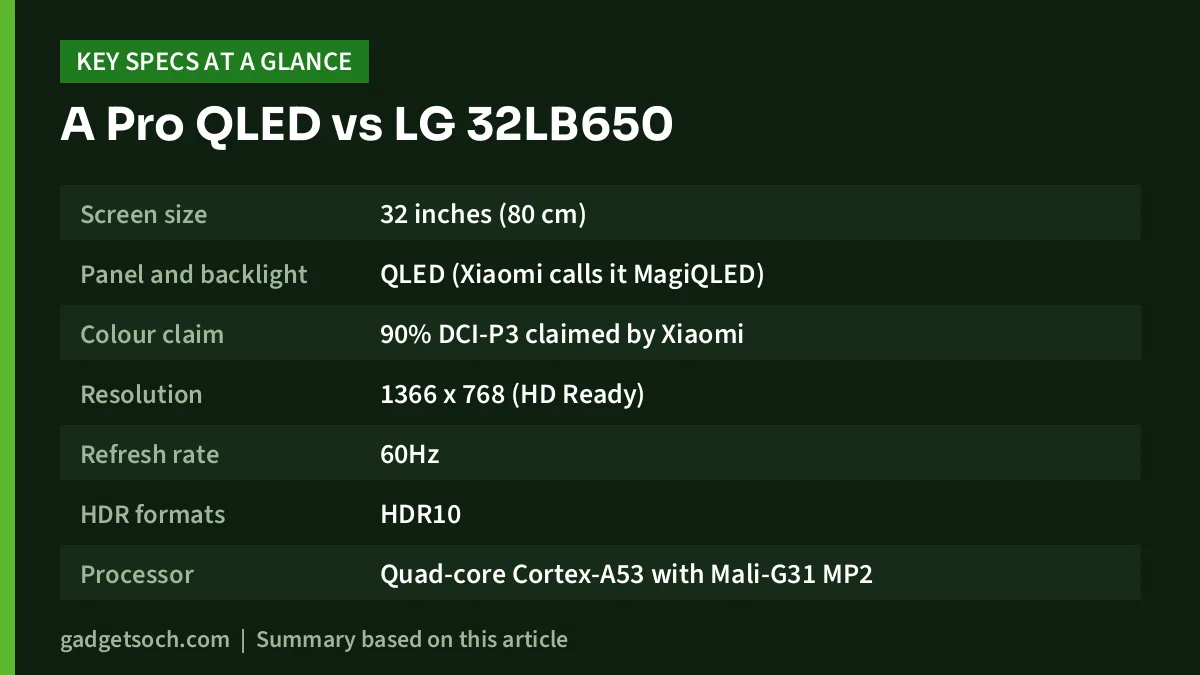
| Specification | Xiaomi A Pro QLED 32 (L32MB-APIN) | LG 32LB650BPLA (LB650, 2026) |
|---|---|---|
| Screen size | 32 inches (80 cm) | 32 inches (80 cm class) |
| Panel and backlight | QLED (Xiaomi calls it MagiQLED) | Direct LED. Amazon title says VA, not confirmed on an LG page |
| Colour claim | 90% DCI-P3 claimed by Xiaomi | Not confirmed |
| Resolution | 1366 x 768 (HD Ready) | 1366 x 768 (HD Ready) |
| Refresh rate | 60Hz | 60Hz |
| HDR formats | HDR10 | HDR10 and HLG with Dynamic Tone Mapping |
| Processor | Quad-core Cortex-A53 with Mali-G31 MP2 | Alpha 5 AI Processor Gen9 |
| Operating system | Google TV with PatchWall | webOS 26 |
| RAM and storage | 1GB and 8GB | 1.5GB and 8GB (per Smartprix) |
| Speakers | 20W with Dolby Audio, DTS:X and DTS Virtual:X | 10W (2 x 5W, down-firing) with AI Sound Pro |
| HDMI | 2 ports, ARC or eARC not listed on official spec sheet | 2 ports, eARC on HDMI 2 |
| USB | 2 x USB 2.0 | 1 port |
| Wi-Fi | Dual-band (2.4GHz and 5GHz) | Wi-Fi 5 |
| Bluetooth | 5.0 | 5.3 |
| Ethernet | Yes | Yes |
| Size without stand | 716.4 x 61 x 424 mm | 719 x 430 x 71 mm |
| Weight without stand | 3.1 kg | 3.5 kg |
| VESA pattern | 100 x 200 mm (per Croma) | 100 x 100 mm (per LG US sheet) |
| Energy rating | 2-star (per Croma) | 1-star BEE (per Croma) |
| Warranty | 1+1 year as listed by Xiaomi | 1 year (per Smartprix and Croma) |
Notes: Xiaomi’s FAQ mentions an optical port that its own spec sheet does not list, so we have left it out. Some LG figures come from LG’s spec sheet for the US twin (32LB650BPUA) because LG India’s product page could not be loaded when our review was written, so confirm details on the listing.
Picture quality: QLED colour versus LG’s processing
Both TVs share the same core limitation: a 1366 x 768 HD Ready panel running at 60Hz. On a 32-inch screen, that works out to roughly 49 pixels per inch. From two metres or more, most people find HD Ready acceptable for TV channels and streaming, but text, menus and subtitles look softer up close than on a Full HD panel.
The Xiaomi’s main picture advantage on paper is its quantum-dot layer. Xiaomi claims 90% coverage of the DCI-P3 colour space, which should mean more saturated colours than a basic LED panel, although Xiaomi gives no brightness figure and nobody we could find has measured it. It also lists Vivid Picture Engine 2 and an Eye Care Mode with low blue light, DC dimming and flicker-free operation.
The LG relies on its Alpha 5 AI Processor Gen9 for upscaling and picture tuning, and supports both HDR10 and HLG with Dynamic Tone Mapping, which adapts HDR content to what the panel can show. Croma quotes a 220-nit peak brightness for the LG, but we could not confirm that on an LG page. The Amazon title describes a VA panel, which typically gives deeper blacks head-on but can lose contrast at wide angles. LG’s sheet lists only a direct LED backlight.
Better for whom: the Xiaomi suits viewers who want punchier colour on paper. The LG suits those who watch HLG broadcasts or value LG’s tone mapping and processing. Without lab measurements, neither can be called the clear winner on picture quality.
Smart TV software and everyday speed
The Xiaomi runs Google TV with Xiaomi’s PatchWall on top. You get the Play Store, Google Assistant voice search, Google Cast, Miracast mirroring, Xiaomi TV+ free channels, a Kids Mode with parental lock and Universal Search. Its hardware is basic: a quad-core Cortex-A53 chip, Mali-G31 MP2 graphics, 1GB of RAM and 8GB of storage. Our review notes that 1GB is on the low side for Google TV, so switching between apps may mean reloads.
The LG runs webOS 26, LG’s 2026 platform. Croma’s listing for the Indian model mentions Multi AI Search with Google Gemini and Microsoft Copilot, an AI Chatbot, AI Concierge, AI Voice ID, LG Channels and a web browser. LG’s US sheet for the twin model lists Google Cast, Apple AirPlay, ThinQ app control and up to five years of software updates, but we could not confirm which of these apply to the Indian version. Smartprix lists 1.5GB of RAM and 8GB of storage.
One caution on the LG: voice features such as AI Voice ID need the AI Magic Remote. Croma’s box contents mention a Magic Remote, while LG’s US sheet lists a standard remote, so check which remote ships with the Amazon.in unit.
Better for whom: pick the Xiaomi if you live in the Google ecosystem and want Cast and Assistant confirmed out of the box. Pick the LG if you prefer webOS, want its AI search tools and value the extra half-gigabyte of RAM.
Sound: 20W versus 10W
Sound is the clearest spec gap. Xiaomi lists 20W of output with Dolby Audio, DTS:X and DTS Virtual:X decoding, plus Standard, Movie, News and Game presets.
The LG has a 10W, 2.0-channel system with two down-firing 5W speakers. AI Sound Pro adds a virtual 9.1.2 up-mix, and LG lists Clear Voice Pro with automatic volume levelling, which can help dialogue in news and serials. Virtual surround modes on both TVs are processing, not real surround speakers.
Better for whom: if you will rely on the built-in speakers, the Xiaomi’s 20W rating gives it the edge on paper. If you plan to add a soundbar anyway, the LG’s connectivity (next section) matters more than its lower speaker output.
Ports, soundbar support and gaming
Both TVs have two HDMI ports and Ethernet. The differences are in the details. The LG confirms eARC on HDMI 2 and HDMI-CEC (SimpLink), which makes a soundbar connection straightforward. Xiaomi’s official spec sheet does not list ARC or eARC, and its FAQ mentions an optical port the spec sheet omits, so check the rear panel on the listing images if you need a wired soundbar link.
The Xiaomi has two USB 2.0 ports, an AV input, an earphone jack and dual-band Wi-Fi on 2.4GHz and 5GHz, with Bluetooth 5.0. The LG has one USB port, Wi-Fi 5 and Bluetooth 5.3. Croma’s overview text for the LG mentions three HDMI ports, but its own spec section and other listings say two, so we treat it as two.
For gaming, both panels are 60Hz. The LG lists Game Optimizer and HGiG, while B&H’s listing for the US twin says VRR and ALLM are not supported. Xiaomi lists a Game sound preset, but our review found no dedicated gaming modes listed. Both are fine for casual console play, not competitive gaming.
Better for whom: the LG is the safer choice for soundbar owners and anyone who wants the newer Bluetooth version. The Xiaomi suits people who plug in USB drives or use wired earphones.
Design, power and warranty
The two TVs are close in size. The Xiaomi measures 716.4 x 61 x 424 mm and weighs 3.1 kg without its stand, with a metal, slim-bezel design and up to a 97.5% screen-to-body ratio according to Xiaomi. The LG measures 719 x 430 x 71 mm and weighs 3.5 kg without its stand. Croma lists a 100 x 200 mm VESA pattern for the Xiaomi, and LG’s US sheet lists 100 x 100 mm for the LG, so buy the matching wall bracket.
On running costs, Croma lists a 2-star energy rating for the Xiaomi (50W power rating) and a 1-star BEE rating for the LG. Both list 0.5W standby power. Check the energy label on the listing if this matters to you.
Warranty favours the Xiaomi on paper. Xiaomi’s spec page lists 1+1 year, which Croma describes as 12 months on the TV plus another year on the panel. For the LG, Smartprix lists one year and Croma lists 12 months onsite. Confirm current terms on the Amazon.in listing and keep your invoice.
Better for whom: the Xiaomi is slightly lighter and lists a better energy rating and a longer panel warranty.
Who should buy which

Buy the Xiaomi 32-inch A Pro QLED if you want a bedroom or kitchen TV that sounds fuller without extra speakers, prefer Google TV with Cast and Assistant, and like the idea of a wider-gamut QLED panel. Accept that 1GB of RAM limits app switching and that ARC is not confirmed on the official spec sheet. Read our Xiaomi 32-inch A Pro QLED review for the full breakdown, or check the current price of the Xiaomi A Pro QLED 32 on Amazon.in.
Buy the LG 32LB650BPLA if you plan to add a soundbar via eARC, want Bluetooth 5.3 and slightly more RAM, or prefer webOS 26 and LG’s AI search features. Accept the 10W speakers, the single USB port and the need to confirm which remote is included. Read our LG 32LB650BPLA review for details, or check the current price of the LG LB650 32-inch on Amazon.in.
Frequently asked questions
Is either TV Full HD?
No. Both the Xiaomi A Pro QLED 32 and the LG 32LB650BPLA have 1366 x 768 HD Ready panels. LG sells a Full HD sibling, the 32LB651BPLA, if you need sharper detail with LG software.
Which one is better for connecting a soundbar?
The LG, on paper. LG lists eARC on HDMI 2 and HDMI-CEC. Xiaomi’s official spec sheet does not list ARC or eARC, and its FAQ and spec sheet disagree on an optical port, so check the Xiaomi’s rear panel before buying if a wired soundbar link matters.
Which has louder built-in speakers?
The Xiaomi lists 20W of output with Dolby Audio and DTS:X, while the LG lists 10W with AI Sound Pro. These are rated outputs, and neither has been independently tested that we could find.
Which runs apps more smoothly?
Neither has been benchmarked. The LG lists 1.5GB of RAM against 1GB on the Xiaomi, both with 8GB of storage, so the LG has more headroom on paper. Both suit a handful of streaming apps rather than a large app library.
Do both TVs support Bluetooth headphones?
Yes. The Xiaomi lists Bluetooth 5.0 and the LG lists Bluetooth 5.3.
Our full reviews
Related reading on GadgetSoch: Best 32-inch and 43-inch Smart TVs on Amazon India (2026 Guide) and Samsung 43-inch Crystal UHD UE86 (2026) Review: Specs, Strengths and Trade-offs.