
The Eveready Ultima Power Bank PB11 is a 20,000 mAh power bank with built-in charging cables, a digital battery indicator and fast charging rated at 22.5W on its Amazon.in listing. Should you buy it? It makes sense if you want a large-capacity, cable-free carry option from a well-known Indian brand and mainly charge phones. It is harder to recommend if you need confirmed details such as which connectors the built-in cables use, how fast it recharges, or whether it can power a laptop, because Eveready does not publish those figures.
The Amazon link on this page points to the PB11 in Black, listed as “Eveready Ultima Power Bank PB11 with Built-in-Cables 20,000 mAh, 22.5W Fast Charging”. Eveready’s own PB11 product page links to this same Amazon listing.
A note on method: this article is based on Eveready’s official PB11 page and the Amazon.in listing data, both checked on 17 October 2026. We have not tested the power bank ourselves, and we could not find an independent review of the PB11, so there are no real-world capacity or charging-time results here.
The short version
- Good for: phone users who hate carrying cables and want 20,000 mAh for travel, commutes and power cuts
- Look elsewhere if: you need to charge a laptop, want wireless charging, or need precise per-port specifications
- Strengths: built-in cables, QC and PD support, battery percentage display, BIS certification, made in India, 1-year warranty on the listing
- Weak points: built-in cable types and port layout not stated in text, recharge time unpublished, 257 g weight, conflicting details on Eveready’s own page
Eveready PB11 specifications at a glance
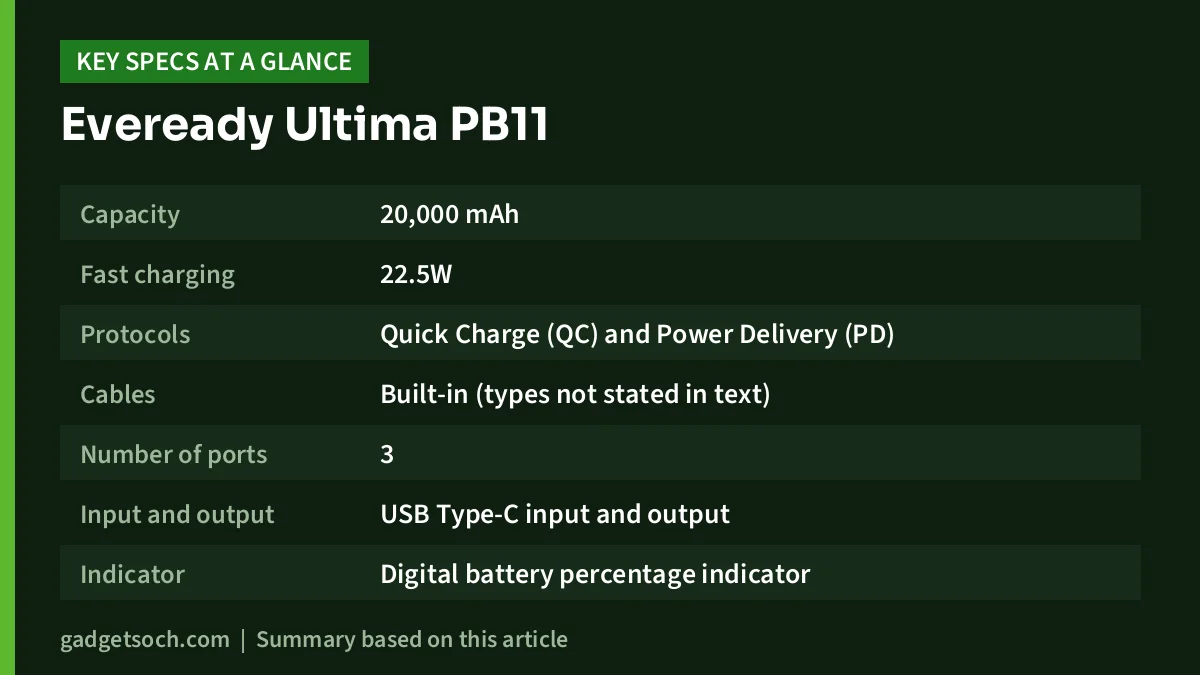
| Specification | Eveready Ultima PB11 (Black) | Source |
|---|---|---|
| Capacity | 20,000 mAh | Amazon.in listing and Eveready page field |
| Fast charging | 22.5W | Amazon.in listing |
| Protocols | Quick Charge (QC) and Power Delivery (PD) | Eveready page and listing |
| Cables | Built-in (types not stated in text) | Eveready page and listing |
| Number of ports | 3 | Amazon.in listing |
| Input and output | USB Type-C input and output | Eveready page and listing |
| Indicator | Digital battery percentage indicator | Eveready page and listing |
| Protection | Overvoltage and overload at output, overcharging | Eveready page and listing |
| Certification | BIS | Eveready page and listing |
| Weight | 257 g | Amazon.in listing |
| Dimensions | 6.7 x 3 x 14.4 cm | Amazon.in listing |
| Colour | Black | Amazon.in listing |
| Model | PB11 | Eveready page and listing |
| Country of origin | India | Amazon.in listing |
| Warranty | 1 year | Amazon.in listing |
Check the current price of the Eveready Ultima PB11 (20,000 mAh, Black) on Amazon.in
What is confirmed, and what is not
Before you rely on any spec, it helps to know where it comes from. Eveready’s official PB11 page confirms the QC and PD support, USB Type-C input and output, the battery percentage indicator, built-in cables, multiple ports, BIS certification and protection against overvoltage and overload at the output. Its “Product mAh” field lists 20,000 mAh.
There is one inconsistency on that page: its short description refers to a “PB10” with “10,000 mAh”. The page title, model name, capacity field and the linked Amazon listing all say PB11 and 20,000 mAh, so the description appears to be a copy error. Still, it is worth checking the capacity printed on the product label when it arrives.
The 22.5W figure, the three-port count, the 257 g weight, the dimensions and the 1-year warranty come only from the Amazon.in listing, which is seller-provided information. Neither source spells out in text which connectors the built-in cables use, how many watts each port delivers, the input wattage for recharging, or the total output when several devices charge together. Look at the listing photos for the cable connectors before ordering.
Why built-in cables are useful (and the trade-off)
The PB11’s main selling point is the built-in cables. If you have ever reached for a power bank only to find you left the cable at home, the appeal is obvious: the cable is always there, and there is one less thing to pack.
The trade-off is that you cannot easily swap a built-in cable. If it frays or the connector wears out, the whole power bank is affected, whereas a separate cable is cheap to replace. Eveready says the design is built to withstand daily wear, and that the built-in cables “enhance durability and convenience”, but it does not give a bend-test rating. Treat the cables gently: avoid sharp bends at the joint and do not wrap them tightly when warm.
Also check connector types. A built-in USB-C cable is ideal for most Android phones, recent iPhones and many earbuds. If you still use an iPhone with a Lightning port, confirm from the listing photos whether a Lightning cable is included before you buy.
What 22.5W, QC and PD mean in practice
Eveready says the PB11 supports Quick Charge (QC), a standard common on Android phones, and Power Delivery (PD), used by iPhones, many Samsung and Pixel phones and other USB-C devices. Fast charging only happens when both sides agree: the phone has to support the same standard, and its own maximum speed sets the limit.
The 22.5W figure on the listing is the bank’s headline maximum. Eveready does not say which port or protocol reaches it, so do not assume every device will charge at 22.5W. A phone that charges at 18W or 20W will simply take that, which is still noticeably faster than an old 10W power bank.
For laptops, 22.5W is generally too low for active use. Some small USB-C laptops may trickle-charge from it, but neither source mentions laptop support, so it is better to treat the PB11 as a phone, earbuds and tablet power bank.
How much charge will 20,000 mAh actually give you?
Capacity on the box is measured at the battery cell’s internal voltage. When the bank charges your phone, it converts that to USB output voltage, and some energy is lost as heat in the process. So the energy that reaches your phone is always noticeably less than the headline number suggests. Eveready does not publish a rated output capacity for the PB11, so we cannot give an exact figure.
As a rough rule of thumb, expect a 20,000 mAh bank to give a typical 5,000 mAh phone around two to three full charges, not four. Fast charging, a warm room and using the phone while it charges all reduce the total a little more.
Size, weight and the battery display
The listing gives a weight of 257 g and dimensions of 6.7 x 3 x 14.4 cm. That is normal for a 20,000 mAh bank, but it is heavier than most phones, so it suits a bag better than a shirt pocket. Eveready describes it as compact and travel-friendly.
The digital battery indicator, which Eveready calls a battery percentage indicator, is a genuinely useful feature. Four-dot LED gauges only tell you roughly how much is left, while a percentage readout lets you decide whether to top up before leaving home.
Safety and travel
Eveready says the PB11 is BIS certified and protects against overvoltage and overload at the output, and the listing adds overcharging protection. For daily safety, avoid leaving it in a hot car, do not charge it under a pillow, and stop using it if it swells, smells or gets unusually hot.
For flights, power banks generally have to go in cabin baggage, not checked luggage, and airlines limit capacity by watt-hours. Check the Wh rating printed on the PB11 label and your airline’s current rules before you fly, as some carriers also restrict using power banks on board.
Who should buy the PB11, and who should skip it

- Buy it if: you mostly charge phones and earbuds and want cables that are always attached
- Buy it if: you want a battery percentage readout and BIS certification from a familiar Indian brand
- Skip it if: you need to charge a laptop or want guaranteed PD wattage figures for your iPhone or Samsung phone
- Skip it if: you prefer a lighter 10,000 mAh bank for daily carry, or you want a replaceable cable
Alternatives to consider
- Eveready Ultima Power Bank PB 21: also 20,000 mAh with QC and PD, but with USB-C and USB-A outputs and a separate cable included instead of built-in cables, according to Eveready’s page
- Eveready Ultima Power Bank PB 20: a 10,000 mAh option with USB-C and USB-A ports and QC and PD support, for lighter daily carry
- Eveready PB31: a 10,000 mAh MagSafe-compatible power bank with wireless charging, per Eveready, for recent iPhone users who want cable-free charging
- Ambrane PowerlitDuo 30: a 20,000 mAh, 33W power bank that we cover in our Ambrane PowerlitDuo 30 review, worth a look if you want more wattage
For a broader explanation of capacity and wattage, see our power bank and charger buying guide for India.
What to check before ordering

- Model and colour: confirm the listing title says PB11 and the colour is Black
- Cable connectors: study the product photos to confirm which built-in connectors you get
- Wall charger: the listing does not say a wall adapter is included, so plan to recharge it with a USB-C charger you already own
- Warranty: the listing states 1 year, so keep the invoice and note the seller name
- On arrival: check the label for the PB11 model, 20,000 mAh capacity and the BIS mark
See the Eveready Ultima PB11 (Black) on Amazon.in and confirm the variant and seller before you buy.
Frequently asked questions
Does the Eveready PB11 have built-in cables?
Yes. Both Eveready’s page and the Amazon.in listing say it has built-in cables. Neither states the connector types in text, so check the listing photos.
How fast does the Eveready PB11 charge phones?
The Amazon.in listing rates it at 22.5W fast charging, and Eveready says it supports QC and PD. Your phone’s own supported standard and maximum wattage decide the actual speed.
How long does the PB11 take to recharge?
Eveready does not publish a recharge time or input wattage. Its page lists the question in its FAQ but no answer is shown. Using a USB-C fast charger will generally be quicker than an old 5V adapter.
Can it charge a laptop?
Neither Eveready nor the listing mentions laptop support. With a 22.5W maximum, it is best treated as a power bank for phones, earbuds and similar devices.
What warranty does the Eveready PB11 have?
The Amazon.in listing states a 1-year warranty. Eveready’s own page does not list the duration.
Bottom line
The Eveready Ultima PB11 offers a practical package on paper: 20,000 mAh, built-in cables, a percentage display, QC and PD support and a 1-year warranty listed on Amazon.in. Its weak spot is documentation, with no published per-port output, recharge time or cable details in text, and no independent tests yet. If you mainly need a dependable, cable-free phone power bank, it is worth a look. Check the Eveready PB11 listing on Amazon.in for the current price.
Related reading on GadgetSoch: Ambrane Charge 100 Review: 100W GaN Charger With 4 Ports, Explained and Beetel Volte PB20 Review: 20000mAh, 22.5W Power Bank With a Percentage Display.
Sources
- Eveready India: Power Bank PB11 product page (QC and PD, Type-C input and output, battery indicator, built-in cables, BIS, protections, 20,000 mAh field), checked 17 October 2026
- Amazon.in listing for ASIN B0F6CL93PZ (title, 22.5W, 3 ports, weight, dimensions, colour, warranty, country of origin), captured 17 October 2026
- Eveready India: mobile accessories range (PB20 and PB31 details), checked 17 October 2026
- Eveready India: Ultima Power Bank PB 21 page, checked 17 October 2026