The DIGIMORE D-740 is a plug-on wireless XLR kit: a small transmitter that plugs into the XLR output of a microphone or other audio source, and a matching receiver that plugs into your mixer, amplifier or PA input, replacing the cable between them. It suits singers, speakers, small-venue performers and church or event sound setups that want to lose one cable run. Our short verdict: it is a simple, budget way to cut a mic cable, but the published frequency details are contradictory, so confirm what you are getting before you rely on it for a show.
Digimore rates the D-740 for up to 100 feet of range, latency under 5 ms and a 3.7V 2000mAh rechargeable battery charged over USB Type-C. The Amazon.in listing title also promises about 5 hours of battery life. These are manufacturer and seller claims, not independent measurements.
This article is based on Digimore’s official India product page and the Amazon.in listing, both checked on 17 October 2026, plus general reference material on XLR and phantom power. It is not a hands-on review: we have not tested the D-740 ourselves, and we could not find an independent lab review of it.
Quick verdict
- Best for: turning a wired dynamic mic, or a line-level source, into a wireless one for speeches, karaoke, small stages and rehearsals
- Skip if: you need phantom power for a condenser mic, run multiple wireless channels in a crowded venue, or need a documented frequency plan
- Key strengths: claimed latency under 5 ms, 100 ft rated range, Type-C charging, metal body (per the official page), 90 dB SNR claim
- Key limitations: the official page says UHF 640-697 MHz while the Amazon listing says 2400 MHz, no phantom power is mentioned anywhere, single channel, about 5 hours claimed runtime
Key specifications

| Specification | DIGIMORE D-740 (as published) | Source |
|---|---|---|
| Type | Wireless XLR transmitter and receiver kit | Official page and Amazon.in listing |
| Rated range | Up to 100 ft | Official page and listing |
| Latency | Under 5 ms | Official page and listing |
| Wireless band | UHF, 640-697 MHz | Official page |
| Wireless band (listing) | 2400 MHz, also lists 2402-2480, 2400-2483.5 and 865-867 MHz | Amazon.in listing |
| Battery | 3.7V 2000mAh rechargeable | Official page and listing |
| Battery life | About 5 hours | Product title (official and listing) |
| Charging | USB Type-C, fast charging claimed | Official page and listing |
| Signal-to-noise ratio | 90 dB | Official page and listing |
| Dynamic range | Above 150 dB (claimed) | Official page and listing |
| Channels | 1 | Amazon.in listing |
| Build | Metal body (listing tech table says ABS enclosure) | Official page and listing |
| Size | 10 x 2 x 2.7 cm | Amazon.in listing |
| Box contents | Transmitter, receiver, Type-C cable, manual, warranty card | Amazon.in listing |
| Warranty | 1 year, void with physical damage | Amazon.in listing |
Check the current price of the DIGIMORE D-740 wireless XLR kit on Amazon.in
What the D-740 actually does
A wireless XLR kit is not a microphone but a cable replacement. The transmitter sends the signal from a mic’s XLR socket over the air, and the receiver turns it back into a wired signal at the mixer. Sound quality therefore still depends mostly on the microphone you plug in.
This suits schools, community halls, churches and wedding DJs in India who already own wired dynamic mics: one of them can go wireless without buying a full handheld system. The trade-off is two more battery-powered boxes to keep charged.
Under the XLR convention, audio outputs use a male connector and inputs use a female one, with three pins carrying ground, a “hot” and a “cold” signal for balanced audio. Neither Digimore’s page nor the listing spells out the gender of each unit, so look at the product photos on the listing and check that the transmitter will mate with your mic and the receiver with your mixer input.
The frequency question you should not ignore
This is the biggest issue with the D-740’s published information. Digimore’s own product page calls it a UHF system and gives the operating range as 640-697 MHz. The Amazon.in listing, for the same model number, says 2400 MHz in its title and also claims it works across 2402-2480 MHz, 2400-2483.5 MHz and 865-867 MHz, describing these as licence-free bands. The listing does not explain how one unit would cover all of those, and the two sources cannot both be an accurate description of the same unit.
Why it matters: the band affects how the kit behaves around other wireless gear. Products in the 2.4 GHz range share the air with Wi-Fi routers, Bluetooth devices and other 2.4 GHz wireless mics, which is common in busy venues. A UHF system avoids Wi-Fi but may clash with other UHF mics on stage. The band can also matter for whether a product is permitted for use where you live, so it is worth knowing exactly what you own.
Once it arrives, check the label and manual, and if the frequency is not stated, ask the seller before the return window closes. Do not depend on it for a paid event until you have run it in that venue.
Range, latency and battery in practice
Range. Up to 100 feet (about 30 metres) is a rated figure, usually quoted for clear line of sight. Walls, crowds and metal stage structures shorten it. It is plenty for a hall or small stage, but test before placing the mixer at the far end of a large marriage lawn.
Latency. Digimore claims under 5 ms. That is the reason the listing pitches it for live performance and real-time monitoring, where a long delay between singing and hearing yourself is distracting. We have no independent measurement to confirm the figure.
Battery. Both the official page and the listing give a 3.7V 2000mAh rechargeable battery with USB Type-C charging, and the product title claims about 5 hours. Charging time is not published. Five hours is enough for a speech session or a rehearsal, but not a full-day event without a recharge break. Keep a power bank and two Type-C cables in your kit bag, since there are two units to charge and only one cable in the box.
The Amazon.in listing’s technical table also says “2 A batteries required (included)”, which conflicts with the built-in rechargeable battery described everywhere else. We read this as a listing error, but check the manual when the unit arrives.
Sound-related specifications
Digimore quotes a 90 dB signal-to-noise ratio and a dynamic range above 150 dB. A higher SNR generally means less hiss under quiet passages. No measurement method is given for the 150 dB dynamic range claim, so treat it as marketing rather than a comparable number. The listing’s technical table also shows “Frequency Response: 16 KHz” without a lower limit, which is too incomplete to judge.
Because the kit passes along whatever goes into it, your microphone and mixer gain setting will matter more than these figures. Start with the channel gain low and raise it at performance level until the signal is healthy without clipping.
Phantom power and mic compatibility
Neither Digimore’s page nor the Amazon.in listing mentions phantom power. Phantom power is the 48V DC supply that mixers send down an XLR cable to run condenser microphones; dynamic mics do not need it. A plug-on transmitter sits between the mic and the mixer, so the mic cannot draw phantom power from the mixer through it.
In practice, assume the D-740 is meant for dynamic microphones and line-level sources unless the manual states otherwise. If your favourite vocal mic is a condenser that needs 48V, this is not the right product.
The listing also says the kit is compatible with guitars and includes 6.35mm-to-XLR converters, but the box contents line on the same listing does not mention any converters, and Digimore’s own page does not mention them either. If you plan to use it with a guitar or keyboard, confirm the adapters are in the box, or budget for a suitable adapter. For regular guitar use, a wireless system designed and specified for instruments is the safer choice.
Build and handling
The official page describes a sturdy metal body, while the Amazon.in technical table lists an ABS plastic enclosure, another inconsistency. The listing gives dimensions of 10 x 2 x 2.7 cm. A plug-on unit adds length to the bottom of a handheld mic and hangs off the mixer socket, so keep cables tidy on a crowded stage.
Who should buy it, and who should skip it
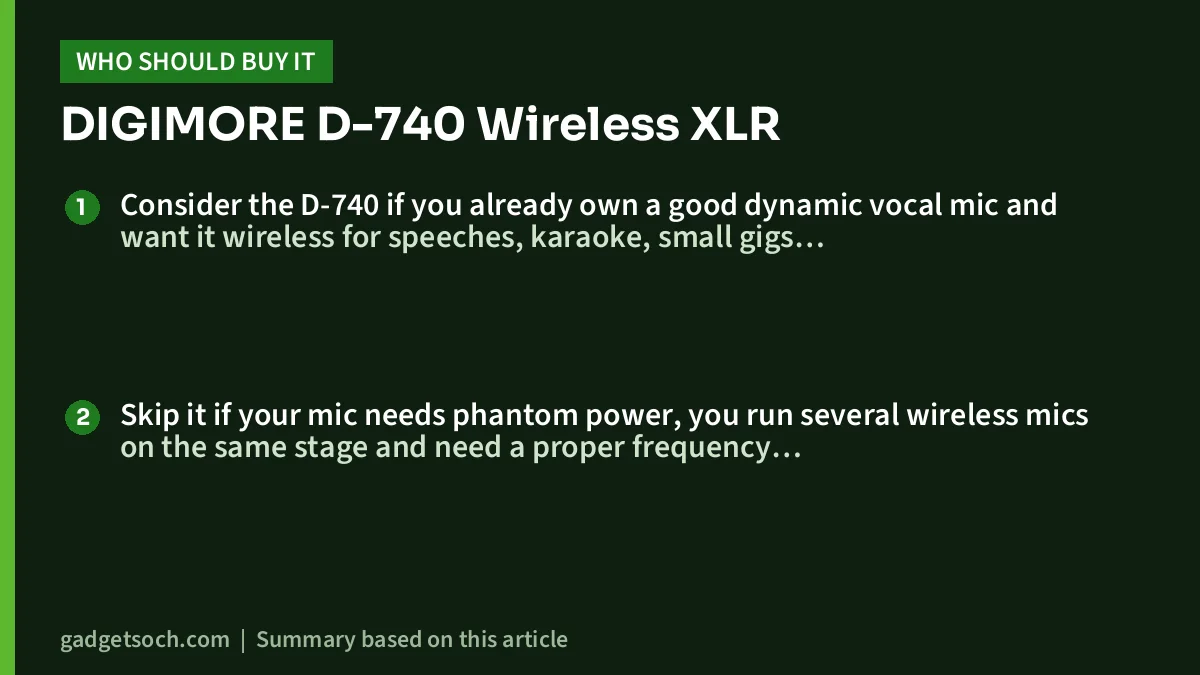
Consider the D-740 if you already own a good dynamic vocal mic and want it wireless for speeches, karaoke, small gigs or rehearsals, you need only one wireless channel, and you are happy to test it in your venue first.
Skip it if your mic needs phantom power, you run several wireless mics on the same stage and need a proper frequency plan, you need more than about 5 hours on one charge, or you need a guitar-specific wireless system with an instrument-level output.
Alternatives worth comparing
- Digimore D-305 HH: if you mainly want wireless vocals, Digimore’s own UHF dual handheld system lists 197 ft range, under 3 ms latency, cardioid mics with built-in 2200mAh batteries, 8 hours claimed playtime and both balanced XLR and 6.35mm receiver outputs.
- Digimore D-305 LL: a UHF system with two headset mics on 3-pin mini XLR connectors, 197 ft rated range, under 3 ms latency and balanced XLR plus 6.35mm outputs, for presenters who want hands-free mics.
- Sennheiser XSW-D XLR Base Set: a better-known plug-on XLR kit on 2.4 GHz, with an XLR female transmitter and XLR male receiver, up to 75 m range in optimal conditions and up to 5 hours of battery life, according to retailer specifications.
What to check before you order
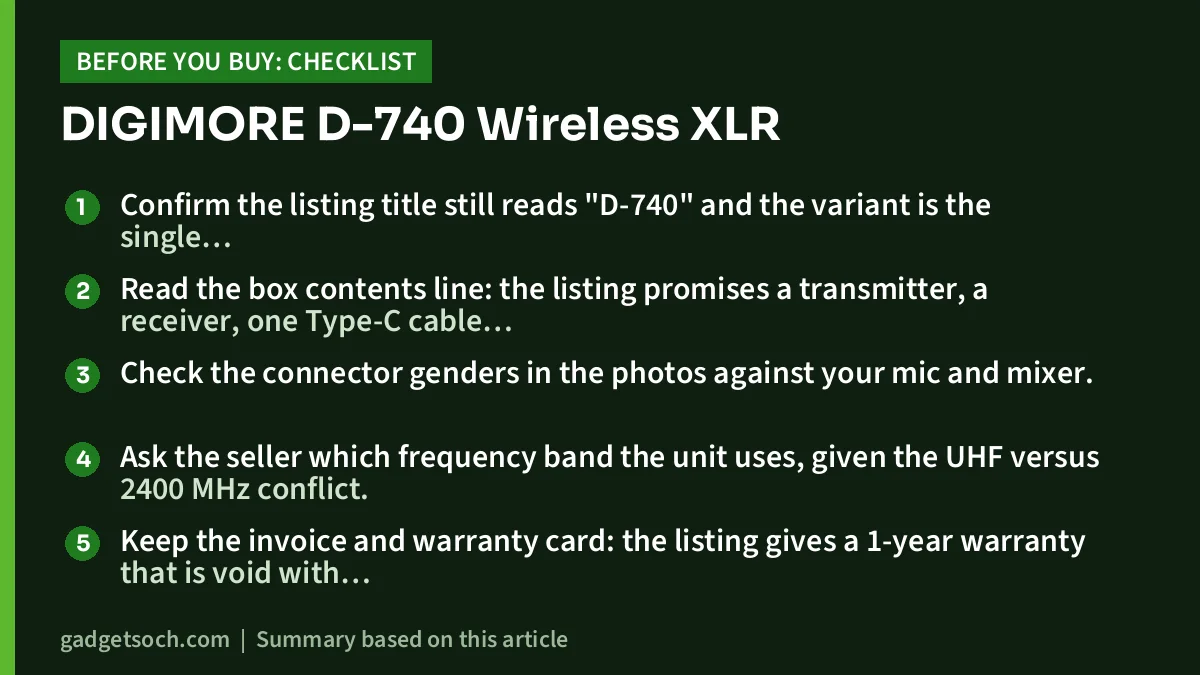
- Confirm the listing title still reads “D-740” and the variant is the single transmitter-plus-receiver set, colour black.
- Read the box contents line: the listing promises a transmitter, a receiver, one Type-C cable, a manual and a warranty card. Do not assume 6.35mm adapters are included.
- Check the connector genders in the photos against your mic and mixer.
- Ask the seller which frequency band the unit uses, given the UHF versus 2400 MHz conflict.
- Keep the invoice and warranty card: the listing gives a 1-year warranty that is void with physical damage. Digimore is an Ahmedabad-based company, according to the listing’s manufacturer details, and its site has a warranty registration form.
- Test it at home with your actual mic within the return window.
See the DIGIMORE D-740 transmitter and receiver set on Amazon.in
Frequently asked questions
Does the DIGIMORE D-740 work with condenser microphones?
Not reliably. Neither Digimore’s page nor the Amazon.in listing mentions phantom power, which most condenser mics need. Plan to use it with dynamic mics or line-level sources.
What is the range of the D-740?
Digimore rates it for up to 100 feet. Real range will be shorter through walls, crowds and stage equipment, so test it in your venue.
Is the D-740 UHF or 2.4 GHz?
The sources disagree. Digimore’s product page says UHF 640-697 MHz, while the Amazon.in listing says 2400 MHz. Check the label on the unit and ask the seller.
How long does the battery last?
The product title claims about 5 hours from a 3.7V 2000mAh rechargeable battery. Charging is over USB Type-C. Charging time is not published.
Bottom line
The DIGIMORE D-740 is an affordable-looking way to cut one XLR cable for a dynamic mic, with sensible headline claims on range, latency and charging. The contradictory frequency information, missing phantom power and short runtime mean it is best treated as a tool for small, tested setups rather than critical live work.
Check the current price of the DIGIMORE D-740 on Amazon.in
Related reading on GadgetSoch: Hayden HY-58 Wireless Mic Review: Single UHF Karaoke Mic With Type-C Charging and DIGIMORE D-305 HH Review: Two Wireless Handheld Mics With XLR Outputs, Explained.
Sources
- Digimore India: D-740 Wireless XLR Transmitter and Receiver (checked 17 October 2026)
- Amazon.in listing for DIGIMORE D-740, ASIN B0DHY4XBQJ (captured 17 October 2026)
- Digimore India: D-305 HH and D-305 LL product pages (checked 17 October 2026)
- Pinknoise Systems: Sennheiser XSW-D XLR Base Set specifications (checked 17 October 2026)
- Wikipedia: Phantom power and XLR connector (checked 17 October 2026)