
The Colorful GeForce GT 1030 4GB (GT1030 4G-V) is an entry-level, single-fan desktop graphics card. It makes sense as a display adapter or a light upgrade for an old office PC, not as a card for modern AAA games. If your processor has no integrated graphics, or your desktop needs an extra HDMI or VGA output, it can do that job. If you want to play recent games at decent settings, you need a much more capable card.
This article is based on NVIDIA’s official GT 1030 specifications and the Amazon.in listing data captured on 17 October 2026, not on hands-on testing. We could not open an official Colorful spec page for this exact model, so details that appear only on the listing are labelled as the seller’s claims.
One thing to know up front: the Amazon.in listing describes the memory in three different ways. The title says DDR4, the technical table says “GDDR4”, and the table’s 6000 MHz memory clock fits GDDR5-class speeds better than DDR4. On a GT 1030, memory type makes a big difference to speed, so confirm it before you order.
Quick verdict
- Best for: office and home desktops, or processors without integrated graphics, that just need a working display output
- Skip if: you want to play recent AAA games, edit video seriously or game on a high-refresh monitor
- Key strengths: 4 GB of memory per the listing, single-fan cooling, a low power class (NVIDIA rates the GT 1030 at 20 W or 30 W depending on version) and a 3-year warranty claimed in the listing title
- Key limitations: a narrow 64-bit memory bus, an inconsistent memory description on the listing, unverified claims about AAA gaming, and outputs listed as HDMI and VGA only

| Specification | Detail | Source |
|---|---|---|
| GPU | NVIDIA GeForce GT 1030 (Pascal architecture) | NVIDIA, Amazon.in listing |
| CUDA cores | 384 | NVIDIA reference spec |
| Memory size | 4 GB (NVIDIA’s reference design uses 2 GB) | Amazon.in listing, NVIDIA |
| Memory type | DDR4 in the title, “GDDR4” in the technical table | Amazon.in listing (inconsistent) |
| Memory bus | 64-bit | NVIDIA reference spec, listing title |
| Clock speed | 1152 MHz | Amazon.in listing title |
| Memory clock | 6000 MHz | Amazon.in listing table |
| Memory bandwidth | 16.8 GB/s or 48 GB/s depending on version | NVIDIA reference spec |
| Graphics card power | 20 W or 30 W depending on version | NVIDIA reference spec |
| Recommended system power | 300 W | NVIDIA reference spec |
| Outputs | HDMI, VGA | Amazon.in listing |
| Max digital resolution | 7680 x 4320 at 60 Hz (reference design) | NVIDIA reference spec |
| APIs | DirectX 12, Vulkan, OpenGL 4.5 | NVIDIA reference spec |
| Cooling | Single fan | Amazon.in listing |
| Size and weight | 18.4 x 11.1 cm, 250 g | Amazon.in listing |
| Interface | PCI Express | Amazon.in listing |
| Warranty | 3 years | Amazon.in listing title |
Check the current price of the Colorful GT 1030 4GB (GT1030 4G-V) on Amazon.in, and confirm the memory type shown on the listing before you buy.
What the GT 1030 actually is
The GeForce GT 1030 is an entry-level NVIDIA card built on the Pascal architecture. NVIDIA’s specification page lists 384 CUDA cores and a 64-bit memory interface, with support for DirectX 12, Vulkan, OpenGL 4.5 and GPU Boost. Those are entry-level numbers. For comparison, NVIDIA lists 3,840 CUDA cores for the current GeForce RTX 5060, ten times as many, on a much newer architecture.
That does not make it useless. It is built for a different job: giving a desktop a dedicated display output for everyday work, video and lighter games.
DDR4 or GDDR5: why the memory type matters
NVIDIA’s specification page lists two GT 1030 versions, one with GDDR5 memory and one with DDR4. Both have 384 CUDA cores and a 64-bit bus, but NVIDIA gives very different memory bandwidth figures for them: 48 GB/s for one and 16.8 GB/s for the other. That is close to a threefold gap, and on a card this small, memory bandwidth is often the main limit on graphics performance.
You can work out which figure belongs to which version. Bandwidth is the effective memory data rate multiplied by the bus width. On a 64-bit bus, 48 GB/s needs an effective rate of about 6,000 MT/s, which is GDDR5 territory. 16.8 GB/s works out to about 2,100 MT/s, which fits DDR4. So the DDR4 version has far less memory bandwidth than the GDDR5 one.
Here is the problem with this listing. The title says “4GB DDR4 RAM GDDR4”, and GDDR4 is not a memory type NVIDIA lists for the GT 1030. The technical table then gives a 6000 MHz memory clock, which lines up with the GDDR5 bandwidth figure rather than DDR4. Going by the title, the card on sale is most likely the DDR4 version, but we could not confirm this from an official Colorful page. Before ordering, check the box or label in the listing photos, or ask through the listing’s questions section, to confirm the memory type.
What about the 4 GB? NVIDIA’s reference design uses 2 GB, so Colorful’s card has more capacity, which can help when an older game or application asks for more video memory. Extra capacity cannot make up for low bandwidth, though. On a card at this level, how fast the memory is matters more than how much of it there is.
Gaming: be realistic
The listing title says the card “can play most of AAA game titles” and that “GTA V can be played”. These are seller claims. They give no resolution, settings or frame rates, and we found no independent test of this card to support them.
The specifications themselves tell a clearer story. The GT 1030 has a small fraction of the shader cores of current mainstream cards and a very narrow memory bus. Realistically, a card with these specs is aimed at older games, lighter esports and indie titles at reduced settings, not new AAA releases. If new games are your main reason for buying a graphics card, save towards a mainstream card instead.
Outputs, resolution and monitors
According to the Amazon.in listing, this card has HDMI and VGA outputs. That differs from NVIDIA’s reference design, which lists two DisplayPort 1.4 outputs, one HDMI 2.0b and one single-link DVI port. Partner cards often use their own layouts, so confirm the ports in the photos.
VGA helps with older monitors or projectors. For a modern monitor, use HDMI. The listing’s technical table gives two different maximum resolutions (2560 x 1440 in one row and 1920 x 1080 in another), while NVIDIA’s reference spec lists up to 7680 x 4320 at 60 Hz over digital outputs. The real limit depends on the ports fitted to this card, so if you plan to use a 1440p or 4K monitor, confirm support with the seller first. For gaming, plan around 1080p or lower.
Power, size and cooling
Low power draw is one of the GT 1030’s real strengths. NVIDIA rates graphics card power at 20 W or 30 W depending on version and recommends a 300 W system power supply. A PCI Express x16 slot can supply up to 75 W by itself, so a card in this class can normally run on slot power, and the listing does not mention any external power connector. That suits branded office desktops with modest power supplies.
The listing gives dimensions of 18.4 x 11.1 cm and a weight of 250 g, with a single fan. The listing does not say whether the card is low-profile or uses a full-height bracket, or whether it takes one expansion slot or two. If you own a slim or small form factor desktop, check the bracket in the photos and measure the inside of your case before ordering.
Who should buy it

- Owners of a processor without integrated graphics, such as Intel’s F-series chips, who need a display output (our Intel Core i5-12400F review explains why that chip needs a graphics card)
- Office and home desktop users who need an HDMI or VGA output their motherboard lacks
- People reviving an older PC with a low-wattage power supply for browsing, office work and video
- Casual players of older or lightweight games who are happy with low settings
Who should skip it
- Anyone buying a graphics card mainly to play new AAA games
- Video editors and 3D users who need serious GPU acceleration
- Buyers who need DisplayPort, since the listing shows only HDMI and VGA
- Owners of a modern processor whose integrated graphics already drive their monitor well, unless they specifically need an extra output
Alternatives worth comparing
A GT 1030 with GDDR5 memory. If you specifically want a GT 1030, the GDDR5 version is the one with NVIDIA’s 48 GB/s bandwidth figure, against 16.8 GB/s for the DDR4 version. Look for a listing that states GDDR5 clearly and consistently.
NVIDIA GeForce RTX 5060. A completely different class of card. NVIDIA lists 3,840 CUDA cores, 8 GB of GDDR7 on a 128-bit bus and DLSS 4 support. The trade-off is power: NVIDIA lists 145 W total graphics power, 550 W required system power and a PCIe 8-pin power connection, so many office PCs would need a new power supply too.
NVIDIA GeForce RTX 5060 Ti. For more memory headroom, NVIDIA lists the RTX 5060 Ti with 4,608 CUDA cores and 8 GB or 16 GB of GDDR7, at 180 W total graphics power and 600 W required system power.
Integrated graphics. For a new office-only PC, a processor with integrated graphics may remove the need for a separate card.
What to check before you order
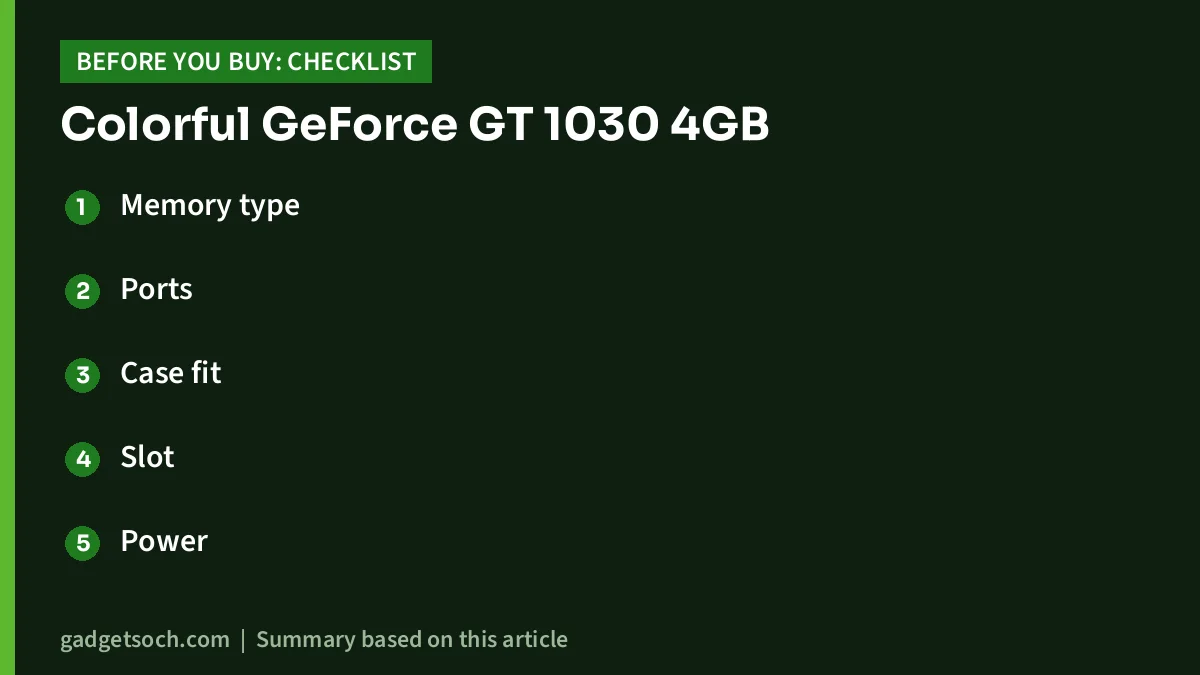
- Memory type: confirm DDR4 or GDDR5 from the photos or the seller, because the listing is inconsistent
- Ports: make sure HDMI or VGA matches your monitor, and note that no DisplayPort is listed
- Case fit: measure for an 18.4 cm card and check whether your case needs a low-profile bracket
- Slot: you need a free PCI Express x16 slot on the motherboard
- Power: NVIDIA recommends a 300 W system power supply for the GT 1030
- Warranty: the listing title says 3 years, so ask the seller who handles warranty service in India and keep the invoice and box
- Variant: make sure the listing still shows the 4 GB GT1030 4G-V model when you check out
See the Colorful GT1030 4G-V 4GB on Amazon.in and check the memory type and ports in the listing images before you place the order.
Frequently asked questions
Is the Colorful GT 1030 4GB good for gaming?
Only for older and lighter games at low settings. The listing’s AAA and GTA V claims come with no settings or frame rates, and NVIDIA’s specs (384 CUDA cores, 64-bit bus) put it far below mainstream gaming cards.
Is this card DDR4 or GDDR5?
The listing title says DDR4, the technical table says “GDDR4”, and the 6000 MHz memory clock it lists better matches GDDR5. We could not confirm the answer from an official Colorful page, so check with the seller or the box label in the photos.
Will it work with an Intel F-series processor?
Yes. F-series processors have no integrated graphics, so a card like this provides the display output. You need a motherboard with a free PCIe x16 slot.
What warranty does it have?
The listing title claims a 3-year warranty. Confirm the terms and the service process with the seller before you buy, and keep the invoice.
Final word
The Colorful GeForce GT 1030 4GB is a modest, low-power card for a specific problem: getting a display output and basic graphics into a desktop that lacks them. Whatever the listing title suggests, it is not a AAA gaming card, and because the listing describes its memory inconsistently, you should confirm whether it is DDR4 or GDDR5 before buying. If those limits suit you, check the current price of the Colorful GT 1030 4GB on Amazon.in.
Related reading on GadgetSoch: MSI GT 730 4GB DDR3 Review (N730-4GD3V2): A Basic Display Card, Not a Gaming GPU and Gigabyte RTX 3050 WINDFORCE OC 6G Review: Four Outputs, 6GB and What to Check.
Sources
- NVIDIA: GeForce GT 1030 specifications (checked 17 October 2026)
- NVIDIA: GeForce GT 1030 product page (checked 17 October 2026)
- NVIDIA: GeForce RTX 5060 family specifications (checked 17 October 2026)
- Amazon.in listing for ASIN B09N7B47Y7: title and technical details captured 17 October 2026
- Colorful’s official product page for the GT1030 4G-V could not be opened at the time of writing