

The UltraProlink Boost 145 (model UM1134) is a two-port wall charger rated for 145W combined: a USB-A port rated up to 100W and a USB-C port rated up to 45W, with a 1-metre USB-C to USB-C cable in the box. It is a sensible charger for someone with a modern USB-C phone who also wants a second port for earbuds, a watch or another phone. The catch is that neither UltraProlink nor the Amazon.in listing names the fast-charging protocol the USB-A port uses to reach 100W, so most buyers should treat it as a 45W USB-C PD/PPS charger with a useful extra port.
Short verdict: a reasonable pick for Samsung Galaxy, Google Pixel, Nothing Phone and iPhone owners who want USB Power Delivery and PPS on the USB-C port, and who like the brand’s claim that the two ports do not share power. It is the wrong buy if you need more than 45W over USB-C for a laptop, or if you were counting on the 100W headline for a specific phone.
This article is based on UltraProlink’s official product page and the Amazon.in listing, both checked on 17 October 2026, plus general charging standards. It is not based on hands-on testing, and we could not find an independent lab review of this model, so no real-world charging times are claimed here.
Quick verdict
- Best for: USB-C phones that fast-charge over USB Power Delivery or PPS, such as the Galaxy S24, Pixel 8 or Nothing Phone models the brand names
- Skip if: you need two USB-C ports, or want to charge a laptop that asks for more than 45W
- Key strengths: PD and PPS on USB-C, a dual-PCB design that UltraProlink says keeps each port’s power separate, a 45W-rated USB-C cable included
- Key limitations: the protocol behind the 100W USB-A rating is not named, only a 6-month replacement warranty, inconsistent 145W and 125W naming across pages
UltraProlink Boost 145 specifications
| Specification | Details |
|---|---|
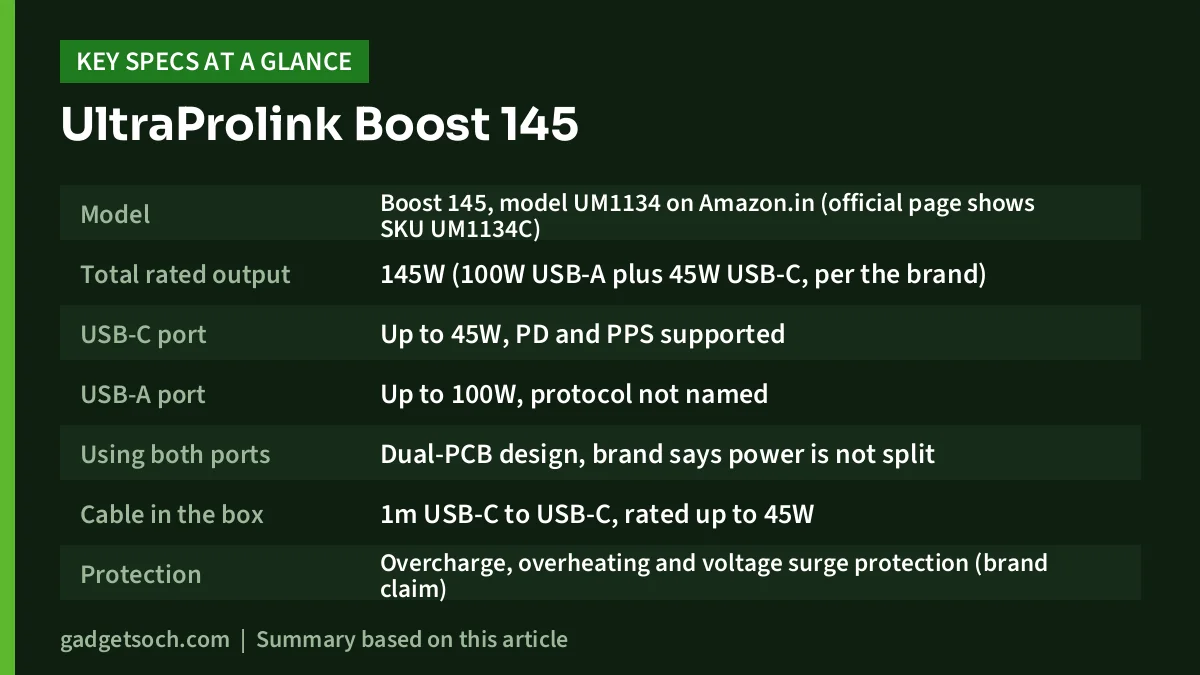
| Model | Boost 145, model UM1134 on Amazon.in (official page shows SKU UM1134C) |
| Total rated output | 145W (100W USB-A plus 45W USB-C, per the brand) |
| USB-C port | Up to 45W, PD and PPS supported |
| USB-A port | Up to 100W, protocol not named |
| Using both ports | Dual-PCB design, brand says power is not split |
| Cable in the box | 1m USB-C to USB-C, rated up to 45W |
| Protection | Overcharge, overheating and voltage surge protection (brand claim) |
| Plug and mounting | 2-pin wall plug (Amazon.in listing) |
| Input | 240V AC (Amazon.in listing) |
| Colour | White (Amazon.in listing) |
| Warranty | 6-month replacement for manufacturing defects |
| Made in | India |
Figures come from UltraProlink’s product page and the Amazon.in listing, both checked on 17 October 2026. Details found only on the listing are labelled as such. Check the current price of the UltraProlink Boost 145 on Amazon.in.
What the 145W figure really means
The 145W figure is the sum of two separate port ratings. No single device can draw 145W from this UltraProlink Boost 145. The most a USB-C device can take is 45W, and the most any device can take from the USB-A port is 100W, and only if it uses the protocol that port is designed for.
Chargers are often bought on the biggest number on the box, but the useful question is how many watts your device will accept from the port it uses. For most USB-C phones here, that is up to 45W, and often less, because the UltraProlink Boost 145 decides how much it draws.
There is also a naming inconsistency. UltraProlink’s own product page is titled “Boost 145”, yet its web address contains “125w”. The Amazon.in listing gives the model name as “Boost 145W” but an item type of “Boost 125”. The port ratings on both pages add up to 145W, so this looks like a labelling slip rather than a different product, but it is a good reason to check the model number printed on the box when it arrives.
The USB-C port: PD and PPS up to 45W
The USB-C port is the part of this UltraProlink Boost 145 most people will rely on. UltraProlink says it supports USB Power Delivery (PD) and Programmable Power Supply (PPS). PD is the common fast-charging standard used by iPhones, Pixels, many Android phones, tablets and USB-C laptops. PPS is an extension of PD that lets a phone request small voltage and current steps. Samsung’s Super Fast Charging uses PPS, which is why the brand highlights Galaxy phones.
The phones UltraProlink names as compatible are the Galaxy S24, S23, S22, S21, Z Fold5 and Z Flip5, the iPhone 15 series, the Pixel 8, 7 and 6, and the Nothing Phone (1), (2) and (3). The Amazon.in title also mentions the iPhone 16. Compatible here means the UltraProlink Boost 145 can use its supported fast-charging standard on this port. The speed it reaches is set by the phone, so a phone with a lower charging limit will simply take less than 45W.
For laptops, 45W over USB-C PD can keep many thin-and-light machines topped up during office work, but it is below what many larger laptops request. UltraProlink’s compatibility list names only phones, so if laptop charging is your main goal, check the USB-C charging requirement printed on your laptop’s original adapter first. Our power bank and charger buying guide explains how to match wattage to each device.
The USB-A port: why the 100W rating needs caution
USB-A ports cannot carry USB Power Delivery, so any fast charging over USB-A depends on a different protocol, usually a phone brand’s own system. UltraProlink’s page and the Amazon.in listing describe the USB-A port as 100W with “multi-protocol” support but do not name those protocols. That leaves a real gap: from the official information alone, you cannot tell whether your phone will get anything close to 100W from this port.
Phone-brand fast-charging systems over USB-A also commonly need a matching cable that can handle the higher current. The box includes only a USB-C to USB-C cable, so the USB-A port needs a cable you supply. If you plan to use it with a phone that relies on its own fast-charging system, ask UltraProlink’s support team which protocols the port supports before relying on the 100W figure.
For earbuds, a smartwatch, a speaker or an older phone, the USB-A port is still handy, and it means one fewer adapter in the socket.
Two ports, two circuit boards
The most distinctive claim is the dual-PCB design. UltraProlink says each port has its own dedicated circuit, so using both ports together does not cut the charging speed of either one. Many multi-port chargers share a single power stage and reduce each port’s output when a second device is connected.
If true, a phone on USB-C should keep its full speed while another device charges on USB-A. We found no independent measurement, so treat it as the manufacturer’s claim. A simple check at home is to watch your phone’s charging indicator, since many phones show a fast-charging label, with and without a second device plugged in.
Build, size and safety
According to the Amazon.in listing, the UltraProlink Boost 145 is white, uses a 2-pin plug and is rated for 240V AC input. The listing gives a weight of 50 grams. That figure is unusually low for a charger with this rating, and the official page does not state a weight, so treat it as unverified.
UltraProlink lists multi-layer protection against overcharging, overheating and voltage surges. Neither the product page nor the listing mentions BIS certification, so look for the BIS mark and registration number on the UltraProlink Boost 145 or its box. The included 1m cable is rated up to 45W, matching the USB-C port. The listing’s feature field mentions a braided cable, but the main description does not, so do not count on it.
Who should buy it, and who should skip it
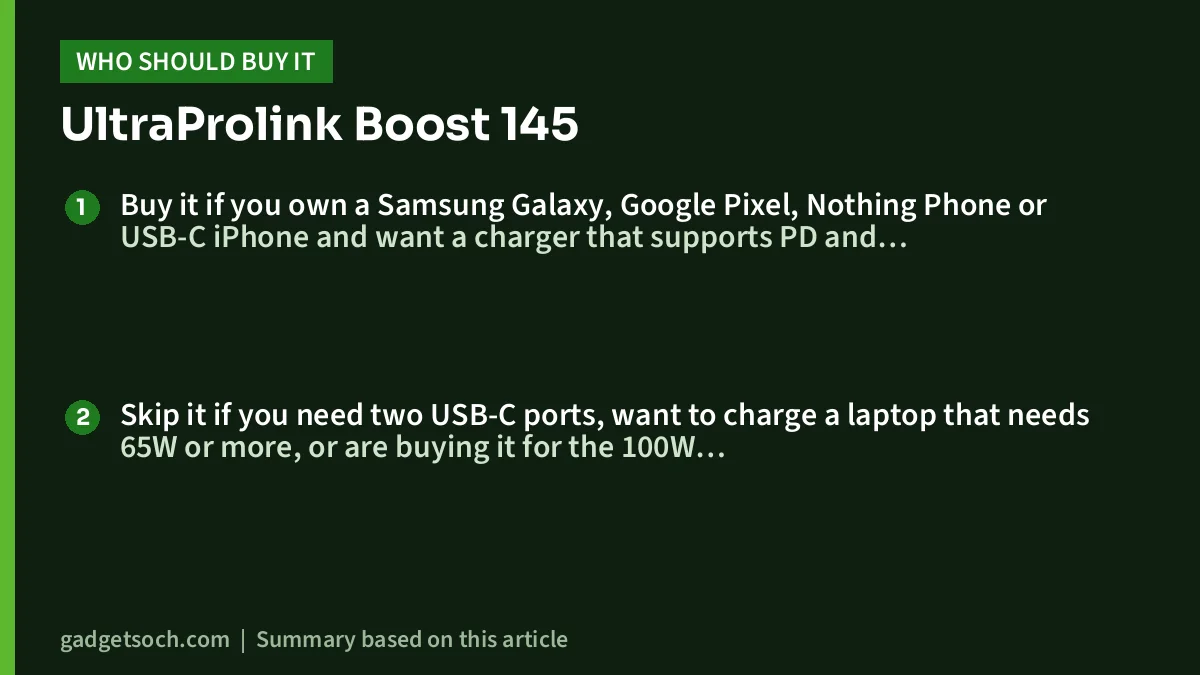
Buy it if you own a Samsung Galaxy, Google Pixel, Nothing Phone or USB-C iPhone and want a charger that supports PD and PPS, with a second port for earbuds, a watch or another phone. It also suits buyers who want a cable in the box.
Skip it if you need two USB-C ports, want to charge a laptop that needs 65W or more, or are buying it for the 100W USB-A figure without confirming your phone’s protocol is supported. If you only charge one basic phone, a simpler single-port adapter may be all you need; our Samsung 15W Travel Adapter review explains when lower wattage is enough. A six-month warranty is also on the short side.
Alternatives worth comparing
- UltraProlink Boost 45 MP (UM1342): the brand’s GaN charger with two USB-C ports rated at 45W total, shared between ports when both are used. UltraProlink lists PD 3.1, PD-PPS, Samsung Super Fast Charging 2.0 and SuperVOOC, Dash and Warp support, with a 45W USB-C cable included. It was marked sold out on the brand’s site when checked.
- Portronics Adapto 100 (POR 2492): a 100W GaN charger with two USB-C PD ports and one USB-A port, supporting Power Delivery and Quick Charge, with a USB-C to USB-C 100W cable named in the product title. Better suited to laptops, though Portronics does not publish per-port figures.
What to check before you order
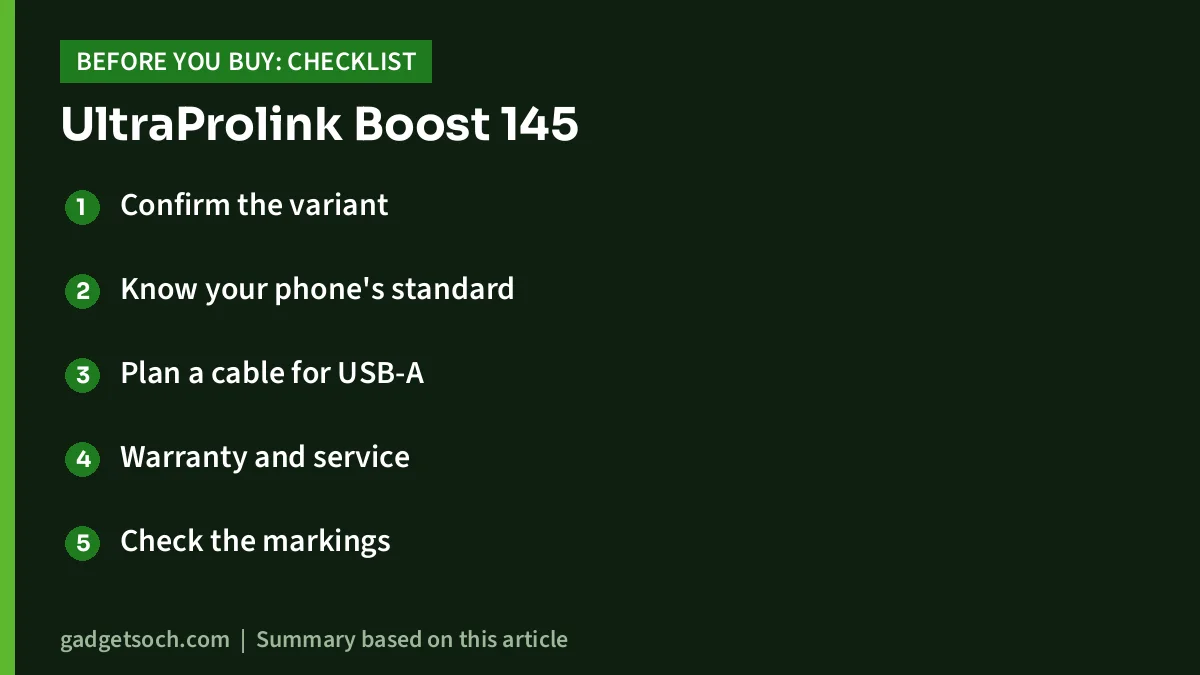
- Confirm the variant: the link here is for the white Boost 145 (UM1134) with a 1m USB-C to USB-C cable. Match the model number on the listing and on the box.
- Know your phone’s standard: PD and PPS phones benefit from the USB-C port. For the USB-A port’s 100W rating, ask UltraProlink which protocols are supported.
- Plan a cable for USB-A: only a USB-C to USB-C cable is included.
- Warranty and service: 6-month replacement for manufacturing defects. Keep the invoice and box, as support contacts are printed on the packaging.
- Check the markings: look for the BIS mark and the rated output printed on the charger body.
See the UltraProlink Boost 145 (UM1134, white) on Amazon.in and confirm the model and box contents before ordering.
Frequently asked questions
Can the UltraProlink Boost 145 charge one phone at 145W?
No. 145W is the combined rating of both ports. The USB-C port is rated up to 45W and the USB-A port up to 100W, and a single device uses only one port.
Does it support Samsung Super Fast Charging?
UltraProlink says the USB-C port supports PD and PPS and lists the Galaxy S24, S23, S22, S21, Z Fold5 and Z Flip5 as compatible. Since Samsung’s Super Fast Charging uses PPS, these phones should fast-charge on the USB-C port at whatever speed the phone supports, up to 45W.
Is it suitable for the iPhone 15 and iPhone 16?
The brand lists the iPhone 15 series and the Amazon.in title mentions the iPhone 16. Both use USB-C and Power Delivery, so the USB-C port with the included cable is the right pairing. The iPhone will draw only what it supports.
Can it charge a laptop?
Possibly, through the USB-C port at up to 45W, if your laptop accepts USB-C PD charging at that level. The brand does not list laptops as compatible, so check your laptop’s requirement first.
Does the speed drop when both ports are used?
UltraProlink says no, because each port has its own circuit board. This is a manufacturer claim, and we found no independent measurement of it.
Final word
The UltraProlink Boost 145 is best understood as a 45W USB-C PD/PPS charger with a high-rated second USB-A port and a cable in the box. That is a practical package for phone owners, and the claimed dual-PCB design is a point in its favour if it performs as described. Just do not buy it on the 145W headline alone. Check the current price of the UltraProlink Boost 145 on Amazon.in.
Related reading on GadgetSoch: boAt EnergyShroom PB401 (2026) Review: 20000mAh, 22.5W Power Bank Explained and Portronics Luxcell Mini 20K Advanced Review: 20,000mAh, 22.5W Power Bank Explained.
Sources
- UltraProlink: Boost 145 official product page (checked 17 October 2026)
- Amazon.in listing for ASIN B0D735RJJC: title, feature bullets and technical details (captured 17 October 2026)
- UltraProlink: Boost 45 MP official product page (checked 17 October 2026)
- Portronics: Adapto 100 official product page (checked 17 October 2026)