The Zebronics Wonder Bar 10 is a USB-powered 2.0 computer speaker rated at 10 W RMS (5 W per channel) that can sit on your desk as a single horizontal bar or split into two upright stereo speakers. It connects to a laptop, desktop, phone or TV through a 3.5 mm input, adds RGB lighting and a volume control, and is best seen as a simple, low-cost upgrade over built-in laptop speakers rather than a TV soundbar.
This article covers the black Wonder Bar 10 sold on Amazon.in as a 2.0 USB computer speaker. Short verdict: a tidy, flexible desk speaker for study, office work and casual music, but not for anyone who wants Bluetooth, deep bass or room-filling volume.
How we wrote this: the article is based on Zebronics’ official product page and the seller-provided Amazon.in listing, both checked on 17 October 2026. It is not a hands-on review, and we found no independent measurements to cite, so there are no sound-quality claims of our own.
Quick verdict
- Best for: laptop and desktop users who want clearer, louder sound than built-in speakers without taking much desk space
- Skip if: you need Bluetooth, a remote, a subwoofer, or a speaker for a living-room TV
- Strengths: 2-in-1 bar or split stereo layout, USB power with no separate adapter, 3.5 mm input, headphone and mic ports, RGB lights, light 482 g build
- Limitations: 10 W RMS is modest, bass is limited to 100 Hz and above on paper, Zebronics does not list Bluetooth, and the listing contains some contradictory specifications
Specifications
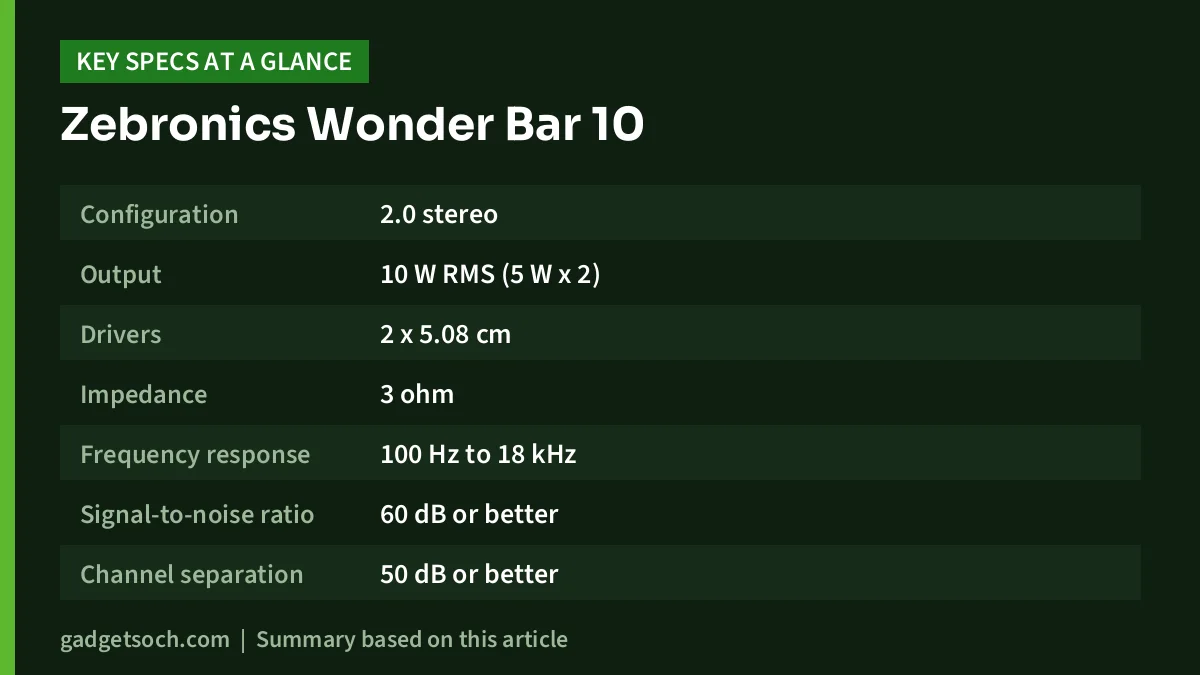
| Specification | Zebronics Wonder Bar 10 (official page unless noted) |
|---|---|
| Configuration | 2.0 stereo |
| Output | 10 W RMS (5 W x 2) |
| Drivers | 2 x 5.08 cm |
| Impedance | 3 ohm |
| Frequency response | 100 Hz to 18 kHz |
| Signal-to-noise ratio | 60 dB or better |
| Channel separation | 50 dB or better |
| Audio input | 3.5 mm line in |
| Other ports | 3.5 mm headphone and mic compatible |
| Power | USB powered (laptop, desktop or power bank, per the listing) |
| Design | Single horizontal bar or two vertical speakers |
| Lighting | RGB (listing says it syncs with music) |
| Controls | Volume control |
| Size | 370 x 80 x 70 mm (W x D x H) |
| Weight | 482 g |
| In the box | One speaker unit |
| Warranty | 1 year carry-in to service centre (listing) |
| Origin | China |
Check the current price of the Zebronics Wonder Bar 10 on Amazon.in
The 2-in-1 design: bar or two speakers?
The headline feature is flexibility. Zebronics says the Wonder Bar 10 can be set up either as one horizontal soundbar unit or as a vertical 2.0 speaker pair. As a bar, at 37 cm wide, it fits neatly under a monitor or in front of a laptop stand. Split into two, you can place one speaker on each side of the screen.
Splitting the speakers usually gives a wider stereo image, because the left and right drivers are further apart, which helps with music and games that use stereo effects. The bar layout saves space and looks cleaner on a small study table. Zebronics does not explain how the two halves stay connected when split, so check the listing photos and description if cable length between the halves matters for your desk.
Sound expectations: reading 10 W and 100 Hz correctly
Ten watts RMS split across two 5.08 cm drivers is a modest, honest figure for a desk speaker that you sit about an arm’s length from. It should be loud enough for video calls, online classes, YouTube and background music in a small room, but it is not designed to fill a large hall or a living room.
The official frequency response of 100 Hz to 18 kHz is the most telling number. Bass below 100 Hz, which includes the deep thump of electronic music and film explosions, is outside the stated range. That is normal for small drivers without a subwoofer. If bass matters to you, a 2.1 system with a separate subwoofer is the better route.
The Amazon.in listing’s technical section also mentions a 5-inch subwoofer and a 1-inch tweeter, which does not match the official description of two 5.08 cm drivers in a 2.0 layout. We have relied on Zebronics’ official page and recommend you ignore those listing fields.
The signal-to-noise ratio of 60 dB or better is basic. In practice, you may notice faint hiss with your ear close to the drivers at low volume, which is common with inexpensive powered speakers. Channel separation of 50 dB or better is reasonable for stereo playback.
Connections, power and setup
The Wonder Bar 10 uses two kinds of connection: USB for power and a 3.5 mm line input for sound. Zebronics describes USB only as the power source, not as a digital audio connection, so plan on connecting both. The box contents list only the Zebronics Wonder Bar 10 unit, so check the listing photos to see which cables are attached.
- Plug the USB connector into a laptop, desktop USB port, USB phone charger or power bank
- Connect the 3.5 mm plug to your computer’s headphone or audio-out jack
- On Windows or macOS, select the headphone or line output as the playback device if sound still comes from the laptop speakers
- Set the computer volume to around three-quarters and fine-tune with the speaker’s volume control
- If you hear a buzz, try a different USB port or a separate USB charger, since shared power and audio grounds on some laptops can cause noise
Because it uses a standard 3.5 mm input, the Wonder Bar 10 also works with phones and tablets that still have a headphone jack, or with a USB-C to 3.5 mm adapter for phones that do not. It can also connect to a TV or monitor with a headphone output. It is a wired speaker: Zebronics’ page does not list Bluetooth, even though one field in the Amazon.in listing says Bluetooth. Do not buy it expecting wireless pairing.
Headphone and mic ports
Zebronics lists 3.5 mm headphone and mic compatible ports on the Zebronics Wonder Bar 10. This can be handy on a desktop where the PC’s own sockets are hard to reach at the back of the cabinet. However, Zebronics does not explain how the mic port carries your microphone signal back to the computer, so if you want to use a headset mic through the speaker, check the listing images or ask Zebronics support before relying on it for calls.
RGB lights and build
The RGB lighting is a big part of the Wonder Bar 10’s appeal for gaming setups. The listing says the lights sync with the music. Zebronics does not describe lighting modes or a switch to turn the lights off, so if you prefer a plain look for an office desk, check the listing description first.
The enclosure is plastic according to the listing, and the speaker weighs 482 g. That light weight makes it easy to move, though light speakers can shift on a desk when cables are pulled, so route cables neatly.
Who should buy it
- Students attending online classes who want clearer voices than laptop speakers
- Home office workers who take calls and want a neat, compact speaker
- Gamers on a budget who like RGB lighting and stereo separation
- Anyone with a power bank who wants a simple speaker for a phone with a headphone jack
Who should skip it
- People who want Bluetooth or a speaker with a built-in battery
- Movie fans who want deep bass or a subwoofer
- Living-room TV owners who need HDMI ARC or optical input
- Buyers who want a remote control or EQ settings
Alternatives worth comparing
Zebronics Juke Bar 1610: a step up in power and flexibility. Zebronics rates it at 42 W RMS with two 5.71 cm drivers, Bluetooth 5.0, a 3.5 mm input, microSD MP3 playback and a built-in battery with Type-C charging, rated at up to 7 hours in the listing. It is 50 cm wide and weighs 966 g.
JBL Go 4: a tiny Bluetooth speaker rather than a desk bar. JBL India lists 4.2 W output, up to 7 hours of playtime plus up to 2 extra hours with Playtime Boost, IP67 water and dust resistance and a weight of 0.19 kg. It suits people who want portability over stereo sound on a desk.
Planning a full workstation? Our work from home desk setup guide covers keyboards, mice, monitors and cooling picks that pair well with a desk speaker.
What to check before you order
- Confirm the listing title says Wonder BAR 10, 2.0 USB Computer Speakers, 10 Watts, since Zebronics sells several Wonder Bar models
- Check that your computer has a 3.5 mm audio output, or plan for a USB-C to 3.5 mm adapter
- Make sure you have a free USB port or USB charger for power
- Remember it is wired only, regardless of any Bluetooth mention in the listing fields
- Keep the invoice, as the listing describes a one-year carry-in warranty
See the Zebronics Wonder Bar 10 on Amazon.in and check the photos for the cable layout and port positions before you buy.
Frequently asked questions
Does the Zebronics Wonder Bar 10 have Bluetooth?
Zebronics’ official page does not list Bluetooth. It describes a USB-powered speaker with a 3.5 mm input. One field in the Amazon.in listing mentions Bluetooth, but we treat that as an error.
Can I use it with a TV?
Yes, if your TV has a 3.5 mm headphone or audio output and a USB port or nearby charger for power. It cannot connect through HDMI ARC or optical.
Does it need a power adapter?
No separate adapter is included. It draws power over USB from a computer, USB charger or power bank.
Can the two speakers be separated?
Yes. Zebronics says it can be used as one horizontal bar or as a vertical 2.0 speaker pair.
What is the output power?
Zebronics rates it at 10 W RMS in total, 5 W per channel.
Final verdict
The Zebronics Wonder Bar 10 is a practical, light desk speaker whose real advantage is its 2-in-1 layout, letting you choose between a tidy bar and a wider stereo pair. With 10 W RMS and a 100 Hz lower limit, it improves on laptop speakers rather than replacing a proper music system, and it is wired only. If that suits your desk, check the Wonder Bar 10 on Amazon.in and confirm the model before ordering.
Related reading on GadgetSoch: JBL PartyBox Wireless Mic Review: Two Cordless Karaoke Mics for PartyBox Owners and boAt Stone 352 Pro Review: 14W RGB Bluetooth Speaker Specs, Pros and Cons.
Sources
- Zebronics: Zeb Wonderbar 10 (2.0 Speaker) product page, checked 17 October 2026
- Amazon.in listing for ZEBRONICS Wonder BAR 10 (ASIN B08K9PX15C), listing data captured 17 October 2026
- Zebronics: Zeb Juke Bar 1610, checked 17 October 2026
- JBL India: JBL Go 4, checked 17 October 2026