
The ASUS GeForce GT 710 2GB GDDR5 EVO (part number GT710-SL-2GD5-BRK-EVO) is a silent, fanless, low-profile graphics card. It is meant for adding display outputs to a desktop, not for gaming. Buy it if your PC has no working video output or you need a third monitor for office work. Skip it if you want to play modern games.
ASUS describes this card as passively cooled, with “true 0dB” operation and support for up to three displays. Those claims make it a sensible fit for home theatre PCs, office desktops, and processors that have no integrated graphics. It uses a GPU from an older NVIDIA generation, with 192 CUDA cores and a 64-bit memory bus, so its job is putting an image on screen, not rendering demanding 3D scenes.
How this article was put together: this guide is based on ASUS’s official specification and product pages and on the Amazon.in listing, all checked on 17 October 2026. It is not based on hands-on testing, and we have not reproduced any benchmark figures.
Quick verdict
- Best for: office PCs, home theatre PCs, CPUs without integrated graphics, and adding a second or third monitor
- Skip if: you want to play current games, edit high-resolution video, or run AI or GPU-compute software
- Key strengths: no fan and no noise, no external power connector, HDMI plus DVI-D plus VGA (D-Sub) outputs, up to three displays
- Key limitations: PCIe 2.0 interface, a 64-bit memory bus, HDMI 1.4b only (no DisplayPort), and very limited 3D performance
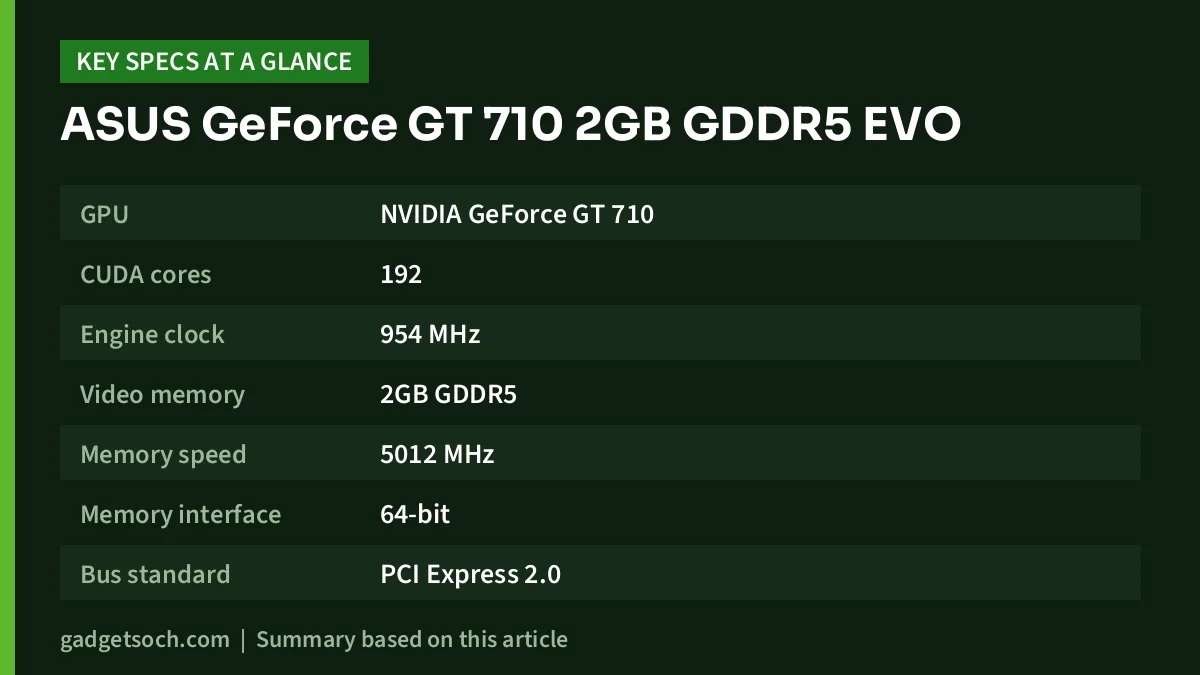
| Specification | ASUS GT710-SL-2GD5-BRK-EVO (per ASUS) | Note |
|---|---|---|
| GPU | NVIDIA GeForce GT 710 | Older-generation entry-level chip |
| CUDA cores | 192 | Very low for 3D work |
| Engine clock | 954 MHz | Same figure on the Amazon.in listing |
| Video memory | 2GB GDDR5 | Matches the listing title |
| Memory speed | 5012 MHz | The listing shows “954 GHz”, an obvious error |
| Memory interface | 64-bit | Narrow bus limits bandwidth |
| Bus standard | PCI Express 2.0 | Physically fits a PCIe x16 slot |
| Outputs | 1x HDMI 1.4b, 1x DVI-D, 1x D-Sub (VGA) | HDCP 1.4 support listed |
| Max displays | 3 | Per ASUS |
| Digital max resolution | 3840 x 2160 | The listing says 2560 x 1600 |
| Cooling | Passive (fanless) | ASUS: “true 0dB” |
| Power connectors | None | Draws power from the slot |
| Recommended PSU | 300W | ASUS figure |
| Dimensions | 17 x 6.9 x 3.9 cm | Listing gives 13.5 x 2.7 cm |
| Slot width | 2 slot | Heatsink takes two slots |
| Software | ASUS GPU Tweak III | The listing still mentions GPU Tweak II |
Check the current price of the ASUS GeForce GT 710 2GB GDDR5 EVO on Amazon.in
What this card is really for
A graphics card like the GT 710 solves a connection problem, not a performance problem. Many desktop processors, including Intel’s “F” series chips and many AMD Ryzen desktop CPUs, have no built-in graphics. A PC built around one of them shows nothing on screen until a graphics card is installed. If you only need Windows, a browser, office apps, video playback, and accounting or billing software, a basic card like this is enough.
The second common reason to buy one is extra outputs. Older office PCs often have just a single VGA port on the motherboard. ASUS says the GT 710 can drive three displays at once through its HDMI, DVI-D, and D-Sub ports, which suits billing counters, CCTV monitoring screens, or a simple trading or spreadsheet setup.
Design and silent cooling
The headline feature is the passive heatsink. With no fan, there is nothing to make noise, wear out, or pull dust into its bearings. ASUS calls the card a “low-profile graphics card for silent HTPC builds” and says it “creates a quieter workspace”.
Passive cooling depends on your cabinet’s airflow, so a cramped case with no fans will run the card warmer than a ventilated one. ASUS’s spec page lists the card as 2-slot, which matters in slim cases: the heatsink takes up the space of two expansion slots, even though the card is low-profile in height.
ASUS’s overview page also mentions Auto-Extreme Technology, which it describes as an automated manufacturing process meant to improve reliability, and a stainless steel bracket. The Amazon.in listing additionally claims “Super Alloy Power II” components. We could not find that claim on ASUS’s current product page, so treat it as the listing’s claim.
Display outputs and resolution: read this before connecting a 4K screen
This card has three outputs, which is unusual at the entry level, and it covers both old and new monitors:
- HDMI 1.4b: works with most TVs and modern monitors. It is an older HDMI version, so do not expect high refresh rates at 4K.
- DVI-D: digital-only DVI. Good for older office monitors with a DVI input. Note that DVI-D does not carry an analogue signal, so a simple DVI-to-VGA adapter will not work from this port.
- D-Sub (VGA): useful for old projectors and CRT-era or basic LCD monitors that only have VGA.
There is no DisplayPort, so a monitor that only has DisplayPort inputs needs an active adapter, or a different card. ASUS lists a digital maximum resolution of 3840 x 2160. The Amazon.in listing says 2560 x 1600. Where they differ, we follow the manufacturer, but for 4K use the realistic expectation is desktop work and video playback, not gaming.
Performance expectations
With 192 CUDA cores, a 954 MHz engine clock, and 2GB of GDDR5 memory on a 64-bit bus (all per ASUS), the GT 710 is designed for display and light multimedia duty. It is not a gaming card in 2026. Very old or very light games may run at low settings, but we have no verified benchmark data for this model, so we will not give frame-rate numbers.
GDDR5 is the faster memory option in this class, where many budget cards use slower DDR3. It helps with smooth desktop use, but it does not turn the card into a gaming GPU.
ASUS’s spec page does not list video codec support, so if you need hardware decoding of newer formats such as AV1, check NVIDIA’s documentation first.
Power, PSU and compatibility
Power is where the GT 710 is easiest to live with. ASUS lists no power connectors and a recommended PSU of 300W, a figure it says assumes a fully loaded system. Most branded office desktops, and assembled PCs with a basic power supply, can take this card without a PSU upgrade.
The card uses a PCI Express 2.0 interface in a standard x16-length slot. PCIe is backward and forward compatible, so it will physically fit and work in a newer PCIe 3.0, 4.0 or 5.0 x16 slot, just at its own PCIe 2.0 speed. For a card of this class, that limit does not matter in practice.
Two more checks matter in branded desktops. First, the slot: small form factor office PCs need a low-profile bracket and enough room for a 2-slot heatsink. ASUS calls this a low-profile card, but its pages do not say whether a low-profile bracket comes in the box, and the Amazon.in listing only lists “Graphic card” as box contents. Second, drivers: this is an older GPU generation, so check NVIDIA’s driver download page for a current driver for your version of Windows or Linux before ordering.
Who should buy it

- Anyone building or repairing a PC whose CPU has no integrated graphics and who will not game
- Office and shop PCs that need two or three monitors from one machine
- Home theatre and media PCs where fan noise is unwelcome
- Users of old monitors and projectors that only have VGA or DVI inputs
Who should skip it
- Gamers, even casual ones who want current titles. Look at an RTX 3050-class card or better
- Video editors and 3D or CAD users who need GPU acceleration
- Anyone whose monitor only has DisplayPort inputs
- Users whose CPU already has integrated graphics with enough ports, since a GT 710 adds outputs but little else
Alternatives worth comparing
These options suit different needs. The facts below come from the Amazon.in listings captured on 17 October 2026.
- MSI GeForce GT 730 4GB (N730-4GD3V2): according to its Amazon.in listing, it has 4GB of DDR3 on a 128-bit interface, PCIe 2.0 x16, and VGA, DVI-I and HDMI outputs, with support for two monitors. It is another basic display card, with more memory but slower memory type and one fewer simultaneous display than ASUS quotes for the GT 710.
- Gigabyte GeForce RTX 3050 WINDFORCE OC 6G: according to its listing, it has 6GB of GDDR6 on a 96-bit bus with 2x HDMI 2.1 and 2x DisplayPort 1.4a. It is a genuine entry gaming card, but it needs far more power and space than a fanless GT 710.
- A CPU with integrated graphics: if you are still choosing parts, a processor with built-in graphics can make a basic card unnecessary for office work. Check the motherboard has the video ports you need.
What to check before you order

- Exact variant: the Amazon.in link here is for the ASUS GeForce GT 710 2GB GDDR5 (listing model number 90YV0ALA-M0NA00, manufacturer part number GT710-SL-2GD5-BRK-EVO). Confirm the title says GDDR5 and not DDR3 before you pay.
- Ports versus your monitor: HDMI, DVI-D and VGA only, with no DisplayPort.
- Cabinet space: ASUS lists 17 x 6.9 x 3.9 cm and a 2-slot width. Slim cases also need a low-profile bracket, so confirm one is supplied with the seller.
- Warranty and service: the Amazon.in listing states a 3-year manufacturer warranty. Keep the invoice and confirm the warranty terms with ASUS India support for your city.
- Drivers: download the current driver from NVIDIA or ASUS support and avoid unofficial driver sites.
- Airflow: a fanless card needs some case airflow, and one front or rear case fan helps.
See the ASUS GT 710 2GB GDDR5 EVO (GT710-SL-2GD5-BRK-EVO) on Amazon.in and check the variant, seller, and warranty details on the listing.
Frequently asked questions
Can the ASUS GT 710 2GB GDDR5 run games?
It is not built for current games. With 192 CUDA cores and a 64-bit memory bus, it suits display, office, and video playback work. We have no verified benchmark data for this model, so we cannot give frame rates.
Does the GT 710 need an external power cable?
No. ASUS lists no power connectors for the GT710-SL-2GD5-BRK-EVO, and it recommends a 300W power supply.
How many monitors can I connect?
ASUS says up to three, using the HDMI 1.4b, DVI-D, and D-Sub (VGA) ports together.
Does it support 4K?
ASUS lists a digital maximum resolution of 3840 x 2160, while the Amazon.in listing says 2560 x 1600. The connection is HDMI 1.4b, so 4K is fine for desktop use and video, but not for high refresh rates.
Will it work in a PCIe 4.0 or 5.0 motherboard?
Yes, PCIe is backward compatible, so this PCIe 2.0 card works in newer x16 slots at PCIe 2.0 speed. That has no practical effect for a card of this class.
Is it really silent?
It has no fan. ASUS describes the cooling as passive “true 0dB”, so the card itself makes no fan noise. Your cabinet and CPU fans will still be audible.
Final word
The ASUS GeForce GT 710 2GB GDDR5 EVO is a quiet, no-fuss way to get a picture, or three pictures, out of a desktop. Its value lies in fanless operation, no power cable, and its HDMI, DVI-D and VGA outputs, not in speed. For gaming or creative work, spend more on a modern card instead.
Check the current price of the ASUS GeForce GT 710 2GB GDDR5 on Amazon.in
Related reading on GadgetSoch: ZOTAC RTX 5070 SOLID OC Review: 12GB GDDR7, Two-Slot SFF-Ready Card Explained and MSI RTX 3050 Ventus 2X 6G OC Review: A Compact 6GB Card and Its Limits.
Sources
- ASUS: GeForce GT 710 2GB GDDR5 EVO technical specifications (checked 17 October 2026)
- ASUS: GeForce GT 710 2GB GDDR5 EVO product overview (checked 17 October 2026)
- Amazon.in listing for ASIN B0D58PZ1V6: title, feature bullets, and technical details (captured 17 October 2026)
- Amazon.in listings for the MSI GT 730 4GB (B015DROZ6E) and Gigabyte RTX 3050 WINDFORCE OC 6G (B0D4XZXLL7), used for the alternatives (captured 17 October 2026)