If you want a short answer, buy the Sony WH-CH520 for a light on-ear headphone from an established brand that can stay connected to your phone and laptop at the same time, with an app equaliser and sound that published reviewers describe as balanced. Buy the Boult Q if you want a bigger battery claim, over-ear memory foam cushions, a 3.5mm wired backup and an IPX5 rating, and you are happy connecting to one device at a time.
Neither headphone offers active noise cancellation, so if your main goal is to quieten a noisy bus, metro or flight, an ANC model will serve you better than either of these.
How this comparison was put together: our picks are based on official specifications and published reviews summarised in our individual reviews, not hands-on testing. Availability and prices on Amazon.in change often, so check the listing before you order.
Quick verdict: Sony WH-CH520 or Boult Q?
- Choose the Sony WH-CH520 if you move between a phone and a laptop every day and want multipoint pairing
- Choose the Sony WH-CH520 if low weight matters, as Sony lists it at approximately 147 g
- Choose the Sony WH-CH520 if you want a proper app equaliser and confirmed AAC support for an iPhone
- Choose the Boult Q if you want the longer claimed battery life, up to 70 hours against Sony’s 50
- Choose the Boult Q if you need a 3.5mm wired mode for a laptop, desktop PC or in-flight system
- Choose the Boult Q if you prefer over-ear cushions, physical buttons and simple EQ presets without an app
Sony WH-CH520 vs Boult Q: specifications side by side
| Specification | Sony WH-CH520 | Boult Q |
|---|---|---|
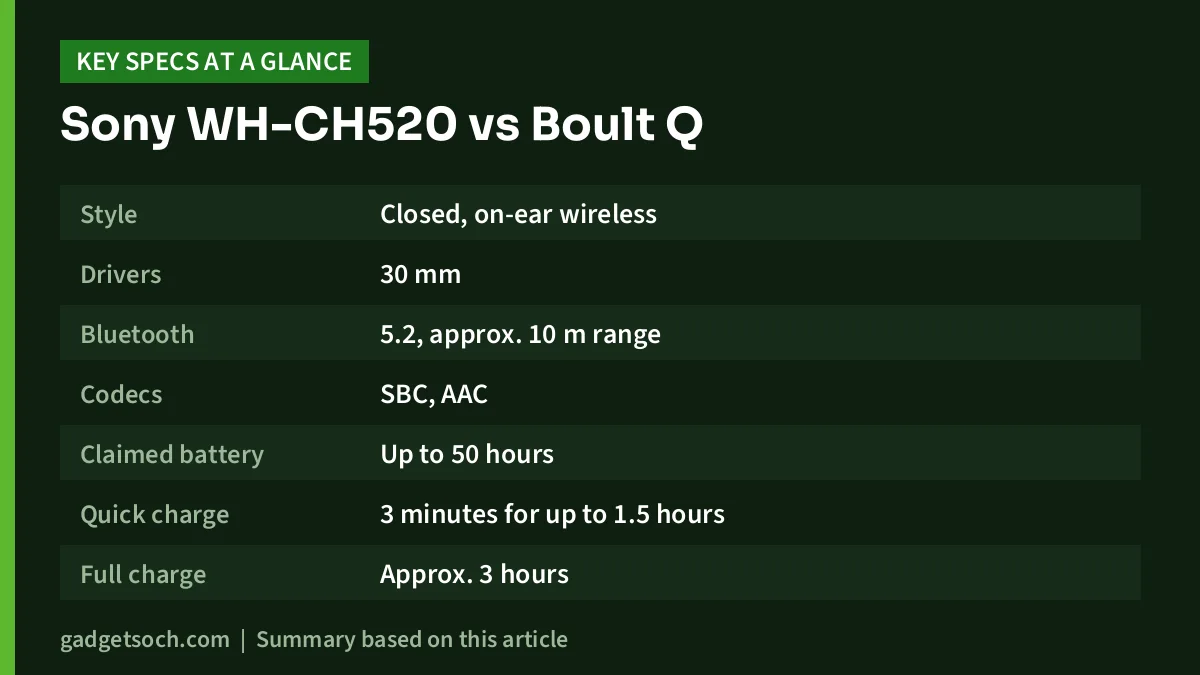
| Style | Closed, on-ear wireless | Over-ear wireless with mic |
| Drivers | 30 mm | 40 mm (Amazon listing and Boult tagline, Boult spec list says 12 mm) |
| Bluetooth | 5.2, approx. 10 m range | 5.4, about 10 m range |
| Codecs | SBC, AAC | Not confirmed |
| Claimed battery | Up to 50 hours | Up to 70 hours |
| Quick charge | 3 minutes for up to 1.5 hours | 10 minutes for about 10 hours (Boult FAQ) |
| Full charge | Approx. 3 hours | 120 minutes (user manual) |
| Charging port | USB Type-C | USB Type-C, 5V 1A input |
| Multipoint | Yes, two devices | Not mentioned by Boult |
| Active noise cancelling | No | Not claimed on Amazon listing (Boult page wording conflicts) |
| Call noise reduction | Not confirmed | Zen ENC mic |
| EQ | Five-band EQ and presets in Sony app | Four presets: Pop, Bass, Rock, Vocal |
| Companion app | Sony Sound Connect | None |
| Wired audio input | No | Yes, 3.5mm cable included |
| Water resistance | Not confirmed | IPX5 (Amazon listing, Boult page says IP67) |
| Weight | Approx. 147 g | Not confirmed |
| Gaming mode | Not confirmed | Yes, no latency figure given |
| Warranty | Not confirmed | 1 year (Boult product page) |
| In the box | USB cable | Headphones, Type-C cable, 3.5mm cable, manual, warranty card |
The Boult Q has a few spec lines that Boult’s own product page does not state consistently, so we have marked them in the table. We go with the figures that match across the Amazon listing, Boult’s tagline and the manual: 40mm drivers, IPX5 and ENC for calls rather than ANC. If one of those points decides your purchase, read the “About this item” section on the Amazon listing before ordering.
Design, fit and comfort
These two take different approaches to fit. The Sony WH-CH520 is an on-ear headphone, which means the pads rest on your ears rather than around them. Sony lists it at approximately 147 g and describes swivel earcups, an adjustable headband and soft cushioned pads. What Hi-Fi? found the padding fairly mild but noted that the pads did not trap heat quickly, and called the build a little plasticky yet well put together. Tom’s Guide found a two-hour stretch pleasant, but noticed a slight ache in both ears towards the end of a longer session.
The Boult Q is an over-ear headphone with memory foam earcups, according to Boult. Over-ear cups surround the ear instead of pressing on it, which many people find easier to wear for long periods, especially with glasses. However, Boult does not publish a weight or say whether the Q folds.
Better for whom: the Sony is the pick if you want a confirmed light weight for carrying in a college bag. The Boult Q is worth a look if on-ear pressure bothers you and you would rather have cushions around your ears, as long as you check the listing for weight before buying.
Sound and EQ options
The Sony uses 30 mm drivers with Sony’s DSEE processing, which tries to restore high-frequency detail lost in compressed streaming. Sony’s spec sheet confirms basic DSEE, not the more advanced DSEE Extreme or DSEE HX, so treat it as a mild enhancement. Published reviews broadly agree on an all-round tuning: What Hi-Fi? described the sound as balanced with well-controlled bass and bright treble, though it wanted stronger dynamics and detail. Tom’s Guide found the bass strong without being overbearing, while MobiGyaan called the bass fair.
The Boult Q uses 40mm drivers that Boult markets for strong bass under its “Supreme Bass” tagline. We could not locate an independent review of the Boult Q, so its sound claims come from Boult alone, and driver size by itself does not tell you how clean or controlled the bass is.
Customisation also differs. The Sony works with the Sony Sound Connect app, where What Hi-Fi? reported a five-band equaliser, presets and DSEE control. The Boult Q has no app, but a press of its EQ key cycles through Pop, Bass, Rock and Vocal presets. Sony lists SBC and AAC codecs. Boult does not list codecs, so do not expect LDAC or aptX from either.
Better for whom: the Sony suits listeners who want a balanced sound backed by published reviews and the option to fine-tune it in an app. The Boult Q suits bass-first listeners who are happy with four fixed presets and accept that its sound has not been independently reviewed.
Battery life and charging
On paper, the Boult Q wins here. Boult claims up to 70 hours of playtime, and its FAQ says a 10-minute charge gives about 10 hours. A full charge takes 120 minutes over USB Type-C, according to the manual.
Sony rates the WH-CH520 for up to 50 hours of listening, up to 40 hours of call time and up to 200 hours of standby. A 3-minute quick charge is rated for up to 1.5 hours, and a full charge takes about 3 hours. For context, What Hi-Fi? cited around 40 hours at full volume, and Tom’s Guide got a little over an hour from about five minutes of charging.
There is one more battery-related difference. The Boult Q includes a 3.5mm cable, so you can keep listening if the battery runs flat. The Sony has no wired input at all, so a dead battery means no music until you charge it.
Better for whom: the Boult Q is the better choice for heavy listeners who charge rarely and want a wired fallback. The Sony’s 50 hours is still plenty for most people, and published reviews give some real-world context for it, which is not available for the Boult.
Connectivity, calls and controls
This is where the Sony pulls ahead for work and study. It supports multipoint, so it can stay paired with a phone and a laptop together and switch to whichever device receives a call. What Hi-Fi? and FoneArena’s India launch report also mention Google Fast Pair for Android, and FoneArena lists Swift Pair for Windows PCs. Boult does not mention multipoint anywhere on its product page or in the manual, so our review assumes the Q connects to one device at a time, although it does use the newer Bluetooth 5.4.
For calls, the Sony has a built-in mic that Tom’s Guide found clear but sometimes tinny and echoey, with callers hearing background noise, so it is best used from a quiet room. The Boult Q uses a Zen ENC mic, which processes the microphone signal to reduce background noise for the person you are speaking to. Boult does not publish the number of mics and no independent call test is available, so we cannot say which sounds better in traffic.
Note the catch with the Boult Q’s wired mode: the manual says the buttons and microphone stop working once the cable is connected, so you cannot use its mic for a class or meeting while plugged in. It does offer physical buttons, a gaming mode (no latency figure given) and voice assistant support.
Better for whom: the Sony is clearly better if you juggle a laptop and phone for online classes or meetings. The Boult Q is better if you mainly need a single-device headphone with tactile buttons and a cable for wired-only sources.
Durability, warranty and what is in the box
The Amazon listing for the Boult Q states IPX5, which covers sweat and water jets, so it should handle a gym session or light rain. Boult’s own page says IP67 instead. Sony’s rating is not confirmed in our review.
Boult states a 1-year warranty, and its manual says this applies only to products bought through legal, formal channels, so keep your invoice. For the Sony, check the seller and warranty details shown on the Amazon listing and keep your invoice for any service claim. In the box, the Sony comes with only a USB cable, while the Boult Q includes a Type-C cable, a 3.5mm audio cable, a manual and a warranty card. Neither lists a charging adapter.
Better for whom: the Boult Q is the pick for workouts and for buyers who value a cable in the box. The Sony makes sense if you only ever use Bluetooth and do not need a stated sweat rating.
Who should buy which
Buy the Sony WH-CH520 if you are a student or work-from-home user who switches between a phone and a laptop, uses an iPhone, or wants a light headphone with an app equaliser. Skip it if you need a wired option or find on-ear pressure uncomfortable. Read our Sony WH-CH520 review for the full details, and check the current price of the Sony WH-CH520 on Amazon.in. The listing title does not name a colour, so confirm the colour before checkout.
Buy the Boult Q if you want the longest claimed battery life, an over-ear fit, IPX5 on the listing, physical buttons and a 3.5mm wired mode for laptops, desktops or flights. Skip it if you need multipoint, an app or independently reviewed sound. Read our Boult Q headphones review, and check the current price of the Boult Q (Black) on Amazon.in. Read the listing’s bullet points before ordering, as Boult’s own page conflicts on a few specs.
Frequently asked questions
Does either the Sony WH-CH520 or the Boult Q have active noise cancellation?
No. Sony’s spec sheet lists no noise cancelling or ambient mode. The Boult Q’s Amazon listing does not claim ANC, and its Zen ENC feature only reduces background noise on calls for the other person. Boult’s product page uses the word ANC in two battery lines, but the manual describes no ANC control.
Which has better battery life, Sony WH-CH520 or Boult Q?
The Boult Q has the bigger claim at up to 70 hours, against up to 50 hours for the Sony. Published reviews give some context for the Sony’s figure, while the Boult’s is Boult’s own claim. The Boult Q also has a wired mode for when the battery runs out.
Can I use the Sony WH-CH520 or the Boult Q with a wire?
Only the Boult Q. It includes a 3.5mm audio cable, though its buttons and mic do not work in wired mode. The Sony has no wired audio input and ships with only a USB cable.
Which is better for online classes and meetings?
The Sony WH-CH520, mainly because it supports multipoint and can stay connected to a laptop and phone together. Its mic is best used from a quiet room. Boult does not mention multipoint for the Q, and its mic cannot be used while the cable is plugged in.
Our full reviews
- Sony WH-CH520 review: light 50-hour on-ear headphones
- Boult Q headphones review: 70-hour battery, ENC mic and what it lacks
Related reading on GadgetSoch: boAt Rockerz Plus 450 ANC vs boAt Nirvana 751 ANC: Which ANC Headphone Should You Buy? and Noise Airwave Max 4 vs Airwave Max 5: Is ANC Worth the Upgrade?.