The JBL Go 4 is a palm-sized Bluetooth speaker that is worth buying if you want something rugged and easy to carry for a desk, a hostel room, a picnic or a bathroom shelf, and you can live with modest battery life. It brings IP67 water and dust protection, Bluetooth 5.3, multipoint pairing, Auracast multi-speaker linking and the JBL Portable app to a 190 g body. Its main weakness is stamina: JBL rates it at up to 7 hours, plus up to 2 more with Playtime Boost.
This article covers the variant the affiliate link opens on Amazon.in: the JBL Go 4 in Black, listed as “Without Mic”, with a Type-C charging port. It is aimed at students, first-time speaker buyers and anyone who wants a small, tough speaker to throw in a bag rather than a party speaker that fills a large hall.
How this article was written: it is based on JBL’s official India and global product pages and on published reviews, all checked on 17 October 2026. It is not a hands-on test, so where real-world sound or battery behaviour is mentioned, the publication that reported it is named.
Quick verdict
- Best for: carrying in a backpack or hanging from a bag, small rooms, outdoor trips where splashes and dust are likely, adding to an existing JBL Auracast setup
- Skip if: you want all-day battery, room-filling volume, or a speaker you can also take calls on (this listing is the Without Mic version)
- Key strengths: IP67 rating, 4.2 W output from a very small body, Bluetooth 5.3 with multipoint, Auracast support, app with EQ, partly recycled materials
- Key limitations: 7-hour rated playtime, physical size caps bass and volume, What Hi-Fi found Auracast stereo sync weak, Playtime Boost changes the sound balance
JBL Go 4 key specifications
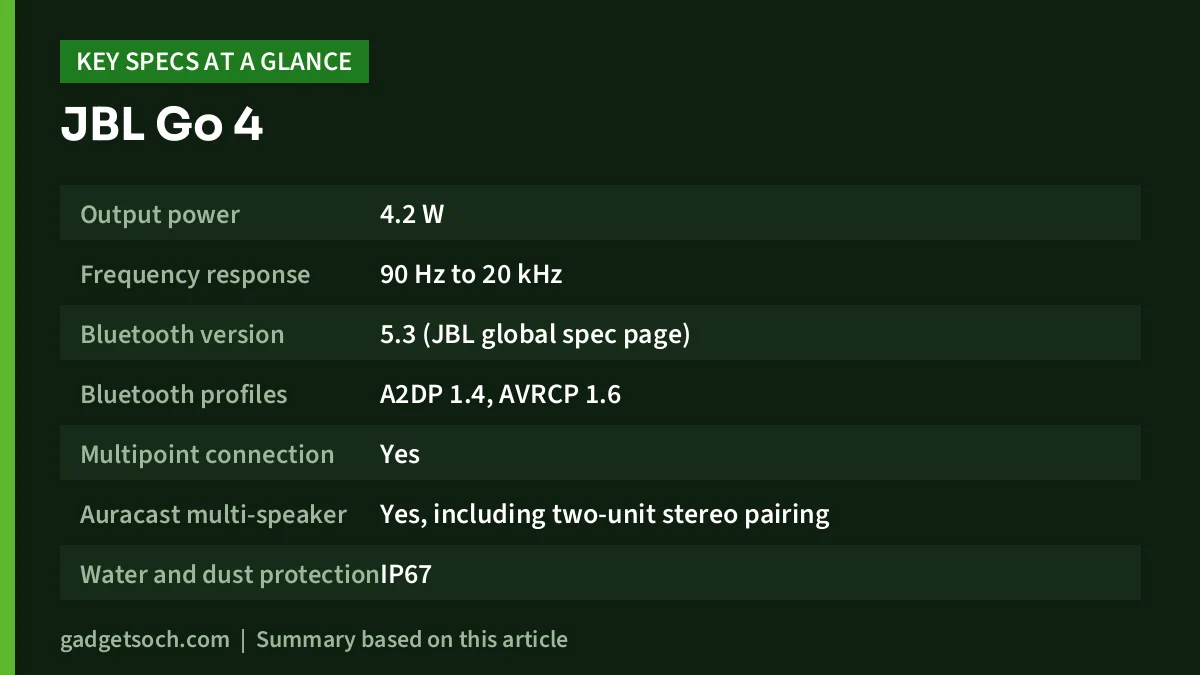
| Specification | JBL Go 4 (official figure) |
|---|---|
| Output power | 4.2 W |
| Frequency response | 90 Hz to 20 kHz |
| Bluetooth version | 5.3 (JBL global spec page) |
| Bluetooth profiles | A2DP 1.4, AVRCP 1.6 |
| Multipoint connection | Yes |
| Auracast multi-speaker | Yes, including two-unit stereo pairing |
| Water and dust protection | IP67 |
| Rated playtime | Up to 7 hours, plus up to 2 hours with Playtime Boost |
| Charging time | 3 hours |
| Charging port | USB Type-C (cable in box) |
| Dimensions (W x H x D) | 9.4 x 7.8 x 4.2 cm |
| Weight | 0.19 kg |
| App | JBL Portable |
| In the box | Speaker, Type-C cable, Quick Start Guide, warranty card and safety sheet |
Specifications are taken from JBL India and JBL.com product pages (checked 17 October 2026). JBL does not publish battery capacity or driver size for the Go 4, so those are not listed here.
Check the current price of the JBL Go 4 (Black, Without Mic) on Amazon.in
Design and build: small enough for any bag, tough enough for the beach
At 9.4 x 7.8 x 4.2 cm and 190 g, the JBL Go 4 is roughly the size of a deck of cards that has been stretched sideways. It slides into a laptop-bag side pocket and adds little weight to a travel kit.
JBL says it has redesigned the integrated loop on the Go 4, so you can hang it from a backpack strap, bathroom hook or tent pole instead of leaving it muffled on the ground.
The IP67 rating is the headline durability spec. The “6” means dust-tight, and the “7” means protection against temporary immersion in water. In Indian use, that covers monsoon drizzle, beach sand and bathroom splashes. JBL’s page does not say it floats, so do not treat it as a pool toy.
JBL also states that the Go 4 uses post-consumer recycled plastic and fabric for the grille. JBL’s India page shows several colours, but the link in this article is specifically the Black variant.
Sound: what 4.2 W and a 90 Hz floor mean in real life
The Go 4 is rated at 4.2 W output with a frequency response of 90 Hz to 20 kHz. Those two numbers set honest expectations. A 4.2 W speaker is designed for personal listening and small spaces, not for a crowded terrace party. The 90 Hz lower limit means the deepest bass in film scores, EDM drops and Punjabi tracks with heavy sub-bass will be suggested rather than physically felt. Most speakers of this size share that limit, because a tiny enclosure simply cannot move enough air for deep bass.
JBL markets the tuning as “Pro Sound with punchier bass”. Independent reviewers broadly support the punch part. What Hi-Fi called the Go 4 a “brilliant budget buy” with a “forward, cohesive sound” and described its bass as taut and robust, giving it full marks for sound, build and features. The same review also listed a clear caveat: its small size means an inevitable sonic limitation. What Hi-Fi felt the Tribit StormBox Micro 2 sounded more open and handled vocals more naturally, so the Go 4 is not the last word in clarity.
In short, expect lively sound for podcasts, YouTube and Bollywood playlists while cooking or studying, not a replacement for a bigger speaker at a group gathering.
The JBL Portable app and EQ
According to RTINGS, the Go 4’s biggest change over the earlier JBL Go 3 is companion app support. Through the JBL Portable app, JBL says you can get firmware updates, product support, feature unlocks and EQ presets, including a customisable equaliser. This is useful on a small speaker: if your music sounds too bass-heavy at a certain volume or too thin in a large room, you can nudge the EQ instead of living with the default tuning.
Battery life and charging: the main compromise
JBL rates the Go 4 at up to 7 hours of playback, and the Playtime Boost feature adds up to 2 hours more. Charging takes around 3 hours through the USB Type-C port. JBL does not publish the battery capacity.
Seven hours suits a commute or an evening on the terrace, but a full-day trip needs a power bank. What Hi-Fi likewise noted that 7 hours may be too limited for some buyers.
Playtime Boost is worth understanding before you rely on it. JBL describes it as a tap-to-extend feature. What Hi-Fi reported that switching it on created an odd sonic imbalance and recommended using it only in a pinch. Think of it as a reserve tank rather than the normal way to listen.
Type-C means your phone charger or power bank can top it up. JBL includes the cable but not a wall adapter.
Connectivity: Bluetooth 5.3, multipoint and Auracast
JBL’s global spec page lists Bluetooth 5.3 with A2DP 1.4 and AVRCP 1.6 profiles. A2DP is the profile that carries stereo music, and AVRCP lets you play, pause and skip tracks from the speaker’s buttons.
Multipoint connection lets the speaker stay connected to two source devices, so a friend can queue a song from their phone without you unpairing and re-pairing.
Auracast is the newer feature. JBL says you can pair two Go 4 units for stereo sound or link multiple JBL Auracast-enabled speakers for bigger sound. This is the one area where reviews urge caution: What Hi-Fi listed poor sound synchronisation of Auracast in stereo mode among its cons. If a stereo pair is your main reason for buying two, treat it as a bonus rather than a guarantee of perfect stereo.
Note that this Amazon listing is titled “Without Mic”, so treat it as a music speaker, not a speakerphone for calls.
Who should buy the JBL Go 4
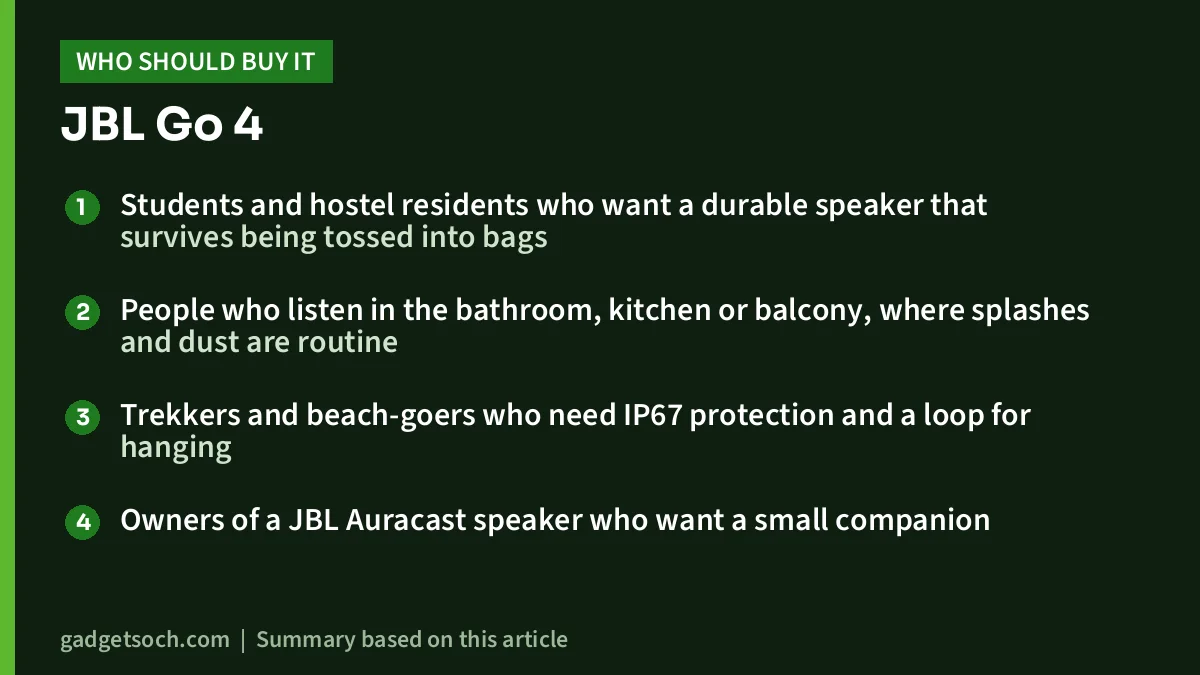
- Students and hostel residents who want a durable speaker that survives being tossed into bags
- People who listen in the bathroom, kitchen or balcony, where splashes and dust are routine
- Trekkers and beach-goers who need IP67 protection and a loop for hanging
- Owners of a JBL Auracast speaker who want a small companion
Who should skip it
- Anyone who needs 10+ hours of playback without a power bank
- Buyers who want room-filling volume for parties or a large living room
- Those who want hands-free calling through the speaker, since this listing is the Without Mic version
- Listeners who prioritise natural vocal clarity over punchy tuning, given What Hi-Fi’s comparison with the Tribit StormBox Micro 2
- People planning to rely on Auracast stereo as a serious home setup
Alternatives worth comparing
- JBL Clip 5: the bigger sibling with 7 W output, IP67, Bluetooth 5.3, Auracast and a redesigned integrated carabiner. JBL India lists up to 12 hours of playtime plus 3 hours with Playtime Boost. It weighs 285 g, so it is heavier but lasts noticeably longer.
- Sony SRS-XB100: Sony India rates it at 16 hours of battery life, and it includes a built-in mic for hands-free calls and a multiway strap. Pick this if battery life and calling matter more than Auracast.
- Tribit StormBox Micro 2: What Hi-Fi found it more open-sounding than the Go 4, with more natural vocals. Worth a look if clarity is your priority.
- JBL Go 3: the predecessor. RTINGS notes that the Go 4’s main addition over it is app support, so the Go 3 only makes sense if you never plan to use EQ or app features.
What to check before you order

- Variant and colour: this link opens the JBL Go 4 in Black, listed as Without Mic. Amazon pages can show other colours on the same listing, so confirm the selected colour on the product page before adding to cart.
- Seller: buy from a seller that provides a GST invoice, since you will need it for warranty claims in India.
- Warranty: JBL’s India page currently advertises an extended-warranty offer, but terms change. Read the warranty card in the box and the seller’s listing for the exact coverage.
- Box contents: you get the speaker, a Type-C cable, a Quick Start Guide and the warranty card. There is no wall adapter, so plan to use your phone charger.
- App compatibility: install the JBL Portable app after pairing to check for firmware updates and set your EQ.
If the Go 4 fits your use, see the JBL Go 4 Black (Without Mic) variant on Amazon.in and confirm the colour and seller before ordering.
Frequently asked questions
Is the JBL Go 4 waterproof?
Yes. JBL rates the Go 4 at IP67, which means it is dust-tight and protected against temporary immersion in water. It handles rain, splashes and bathroom use, but JBL does not say it floats.
How long does the JBL Go 4 battery last?
JBL rates it at up to 7 hours of playtime, with up to 2 additional hours using Playtime Boost. Full charging takes about 3 hours through USB Type-C. What Hi-Fi noted that Playtime Boost alters the sound balance, so it is best used as a backup.
Can I take calls on the JBL Go 4?
The variant linked here is listed on Amazon.in as “Without Mic”, so it is meant for music playback, not for calls. Choose a speaker with a built-in microphone if speakerphone use matters.
Can I connect two JBL Go 4 speakers together?
Yes. JBL says two Go 4 units can be paired for stereo through Auracast, and the Go 4 can join other JBL Auracast-enabled speakers. What Hi-Fi reported weak synchronisation in stereo mode, so results may not be perfect.
Does the JBL Go 4 have an app?
Yes. The JBL Portable app offers firmware updates, EQ presets and a custom equaliser. RTINGS identifies app support as the main upgrade over the JBL Go 3.
Final word
The JBL Go 4 does the basics of an ultra-portable speaker well on paper and, according to What Hi-Fi, in practice too: tough IP67 build, energetic sound for its size, multipoint pairing and a useful app. The trade-offs are the 7-hour rated battery and the physics of a tiny enclosure. If you mainly want a small, rugged companion for personal listening, it is an easy recommendation. Check the current price of the JBL Go 4 on Amazon.in.
Related reading on GadgetSoch: boAt Stone 352 Pro Review: 14W RGB Bluetooth Speaker Specs, Pros and Cons and JBL PartyBox Wireless Mic Review: Two Cordless Karaoke Mics for PartyBox Owners.
Sources
- JBL India: JBL Go 4 product page and specifications (checked 17 October 2026)
- JBL.com: JBL Go 4 specifications, including Bluetooth 5.3 (checked 17 October 2026)
- What Hi-Fi: JBL Go 4 review (checked 17 October 2026)
- RTINGS: JBL Go 4 review (checked 17 October 2026)
- JBL India: JBL Clip 5 product page (checked 17 October 2026)
- JBL.com: JBL Clip 5 specifications (checked 17 October 2026)
- Sony India: SRS-XB100 product page (checked 17 October 2026)